Autonomous legal support agents perform critical tasks like deposition analysis, contradiction detection, and proactive research. Effective governance ensures these systems augment rather than replace attorney judgment. This requires implementing Human-in-the-Loop (HITL) approval gates for high-stakes outputs and setting confidence score thresholds to determine when an action can proceed automatically versus when it requires review. These technical controls are the first line of defense against rogue actions and liability.

Guide
Setting Up Governance for Autonomous Legal Support Agents
A technical guide to implementing governance frameworks for autonomous legal AI agents. Learn to code HITL approval gates, set confidence score thresholds, and build immutable audit logs to ensure compliance and maintain attorney oversight.
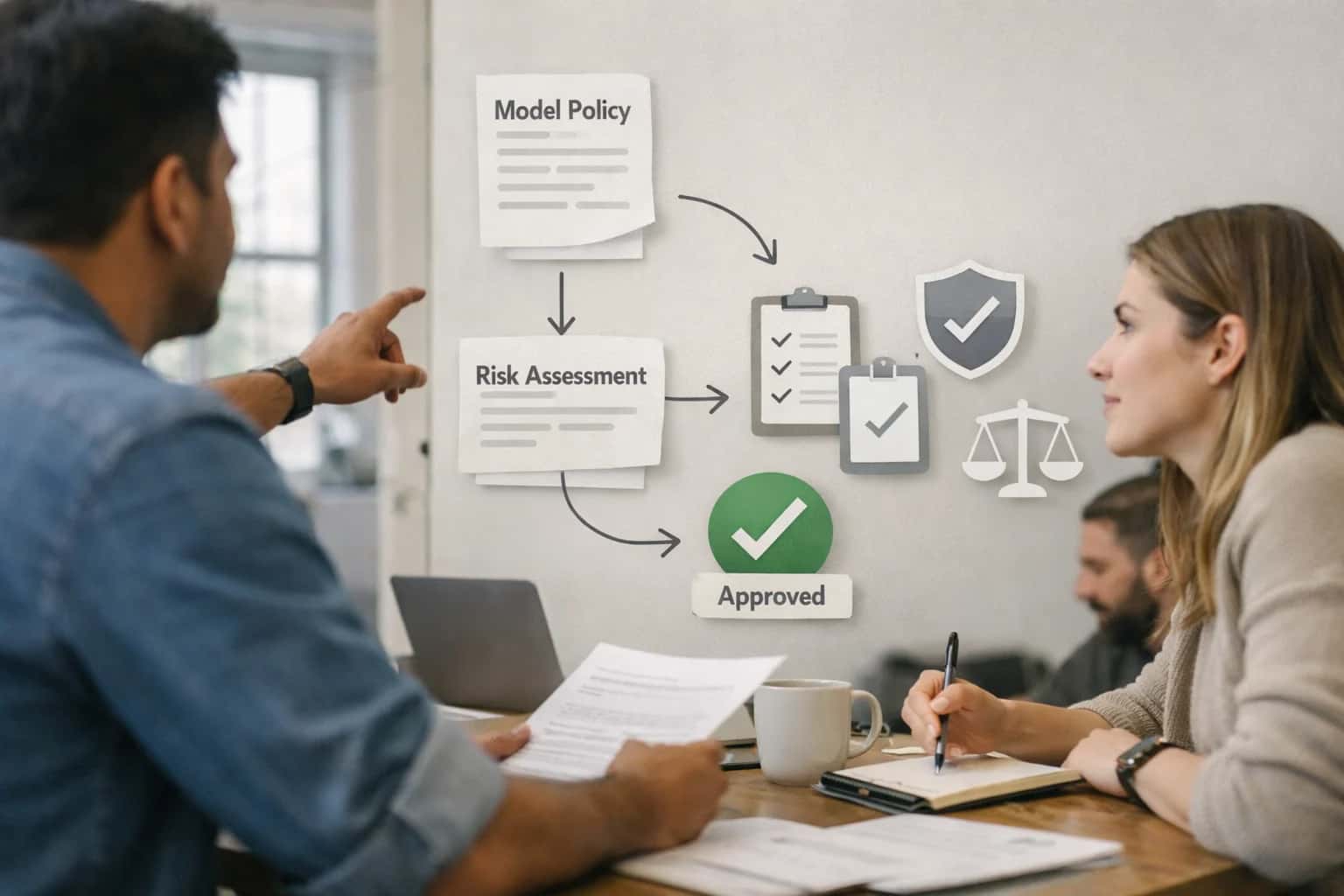
This guide establishes the technical and procedural frameworks required to govern autonomous AI agents in legal practice.
The second pillar of governance is auditability. Every agent decision must generate a comprehensive, immutable audit log. This log captures the input data, the agent's reasoning path, the confidence score, and the final action taken. This traceability is non-negotiable for compliance with ethical rules and regulations like the EU AI Act. Building this requires integrating with secure data pipelines and designing systems for explainable AI to make the agent's logic defensible in a legal context.
ACTION RISK TIERS
Legal Agent Action Governance Matrix
Defines the required Human-in-the-Loop (HITL) oversight level and automated action thresholds based on the potential impact and reversibility of an agent's proposed action.
| Agent Action Type | Risk Tier | Required HITL Gate | Confidence Threshold for Auto-Approval | Mandatory Audit Log Fields |
|---|---|---|---|---|
Generate a deposition summary for internal review | Low | Post-Action Review |
| Agent ID, Timestamp, Source Doc Hash, Summary Snippet |
Flag a potential testimony contradiction for attorney review | Medium | Pre-Action Approval |
| Agent ID, Timestamp, Contradiction Logic, Source Excerpts, Confidence Score |
Draft a routine procedural email (e.g., scheduling) | Low | None |
| Agent ID, Timestamp, Recipient, Email Snippet |
Propose a legal research query based on case facts | Medium | Pre-Action Approval |
| Agent ID, Timestamp, Case Context, Proposed Query, Justification |
Auto-file a court document in a managed system | High | Dual Pre-Action Approval | Not Applicable (null) | Agent ID, Timestamp, Approving Attorney IDs, Document Hash, Filing Confirmation Code |
Initiate a client communication regarding case strategy | High | Dual Pre-Action Approval | Not Applicable (null) | Agent ID, Timestamp, Approving Attorney IDs, Communication Draft, Client ID |
Update a internal case timeline based on a docket change | Low | Post-Action Review |
| Agent ID, Timestamp, Source Docket Entry, Change Description |
Generate a clause suggestion for a contract negotiation | Medium | Pre-Action Approval |
| Agent ID, Timestamp, Clause Context, Suggested Text, Alternative Options |
IMPLEMENTATION
Step 5: Integrate Governance with Legal Workflows
This step operationalizes your governance framework by embedding it directly into the legal team's daily tools and processes, ensuring oversight is seamless, not obstructive.
Integrate Human-in-the-Loop (HITL) approval gates directly into your case management system (e.g., Clio, PracticePanther) via webhooks or custom plugins. For example, an agent's request to file a motion triggers an automated Slack alert to the responsible attorney with a one-click approval button. This ensures attorney judgment remains the final authority for any substantive action, aligning with ethical rules and liability management covered in our guide on HITL Governance Systems.
Configure your agentic platform to log every decision—including the input context, the agent's reasoning, the confidence score, and the final action or recommendation—to a secure, immutable audit log. Use this log to generate compliance reports, conduct post-action reviews, and feed a continuous evaluation framework for model improvement. This creates a defensible, transparent record that is critical for internal oversight and potential regulatory scrutiny under frameworks like the EU AI Act.
Enabling Efficiency, Speed & Accuracy
Intelligent Analysis, Decision & Execution
We build AI systems for teams that need search across company data, workflow automation across tools, or AI features inside products and internal software.
Talk to Us
Search across company data
Give teams answers from docs, tickets, runbooks, and product data with sources and permissions.
Useful when people spend too long searching or get different answers from different systems.
Enterprise searchRAGPermissions
Read more
Automate internal workflows
Use AI to route work, draft outputs, trigger actions, and keep approvals and logs in place.
Useful when repetitive work moves across multiple tools and teams.
AI agentsWorkflow automationGovernance
Read more
Add AI to products and internal tools
Build assistants, guided actions, or decision support into the software your team or customers already use.
Useful when AI needs to be part of the product, not a separate tool.
AI integrationDecision supportModel routing
Read moreGOVERNANCE
Common Mistakes
Implementing governance for autonomous legal agents is a critical design challenge. These are the most frequent technical and procedural pitfalls that compromise security, compliance, and effectiveness.
A Human-in-the-Loop (HITL) gate is a mandatory checkpoint where an AI agent's proposed action is presented to a human for review and approval before execution. The common mistake is implementing it as a simple notification or an afterthought.
Correct implementation requires:
- Intent-Based Routing: The system must classify the agent's proposed action (e.g., 'send a legal notice', 'draft a clause', 'schedule a filing') and route only high-risk or high-impact actions to the appropriate attorney.
- Context-Rich Presentation: The gate must present the human reviewer with the agent's full reasoning trace, the source data it used, and the specific action it intends to take.
- Definitive Outcomes: The interface must provide clear 'Approve', 'Reject', or 'Modify' options. A 'Modify' action should feed directly back into the agent's context for a corrected attempt.
Without these, HITL becomes a bottleneck that degrades trust instead of enhancing it. For a deeper dive, see our guide on Human-in-the-Loop (HITL) Governance Systems.

About the author
Prasad Kumkar
CEO & MD, Inference Systems
Prasad Kumkar is the CEO & MD of Inference Systems and writes about AI systems architecture, LLM infrastructure, model serving, evaluation, and production deployment. Over 5+ years, he has worked across computer vision models, L5 autonomous vehicle systems, and LLM research, with a focus on taking complex AI ideas into real-world engineering systems.
His work and writing cover AI systems, large language models, AI agents, multimodal systems, autonomous systems, inference optimization, RAG, evaluation, and production AI engineering.
LinkedIn
Limited slotsGet a Free AI Consultation
Partnered with leading AI, data, and software stack.





How We Work
Custom AI workflows for your Business
One-fit-all AI don't work for modern businesses. At Inferensys, we aim to understand your business & custom requirements; which we use to define most efficient agentic workflows, the data, and the tools for your business.
01
Review the use case
We understand the task, the users, and where AI can actually help.
Read more02
Pick the right approach
We define what needs search, automation, or product integration.
Read more03
Build the first useful version
We implement the part that proves the value first.
Read more04
Improve from there
We add the checks and visibility needed to keep it useful.
Read moreThe first call is a practical review of your use case and the right next step.
Talk to Us