Architecting a Human-in-the-Loop (HITL) system for multi-agent orchestration means designing a control plane that can manage intervention states across a network of communicating, autonomous agents. You must choose between a centralized oversight model, where a single governance agent monitors all others, and a decentralized model, where each agent has localized approval logic. The choice depends on your system's tolerance for single points of failure versus the complexity of distributed state synchronization. This architecture ensures governance consistency and prevents contradictory actions from different agents.

Guide
How to Architect a HITL System for Multi-Agent Orchestration
A technical guide to extending human oversight to coordinated fleets of AI agents. Learn to design oversight models, manage intervention states, and ensure governance consistency within a Multi-Agent System (MAS) framework.
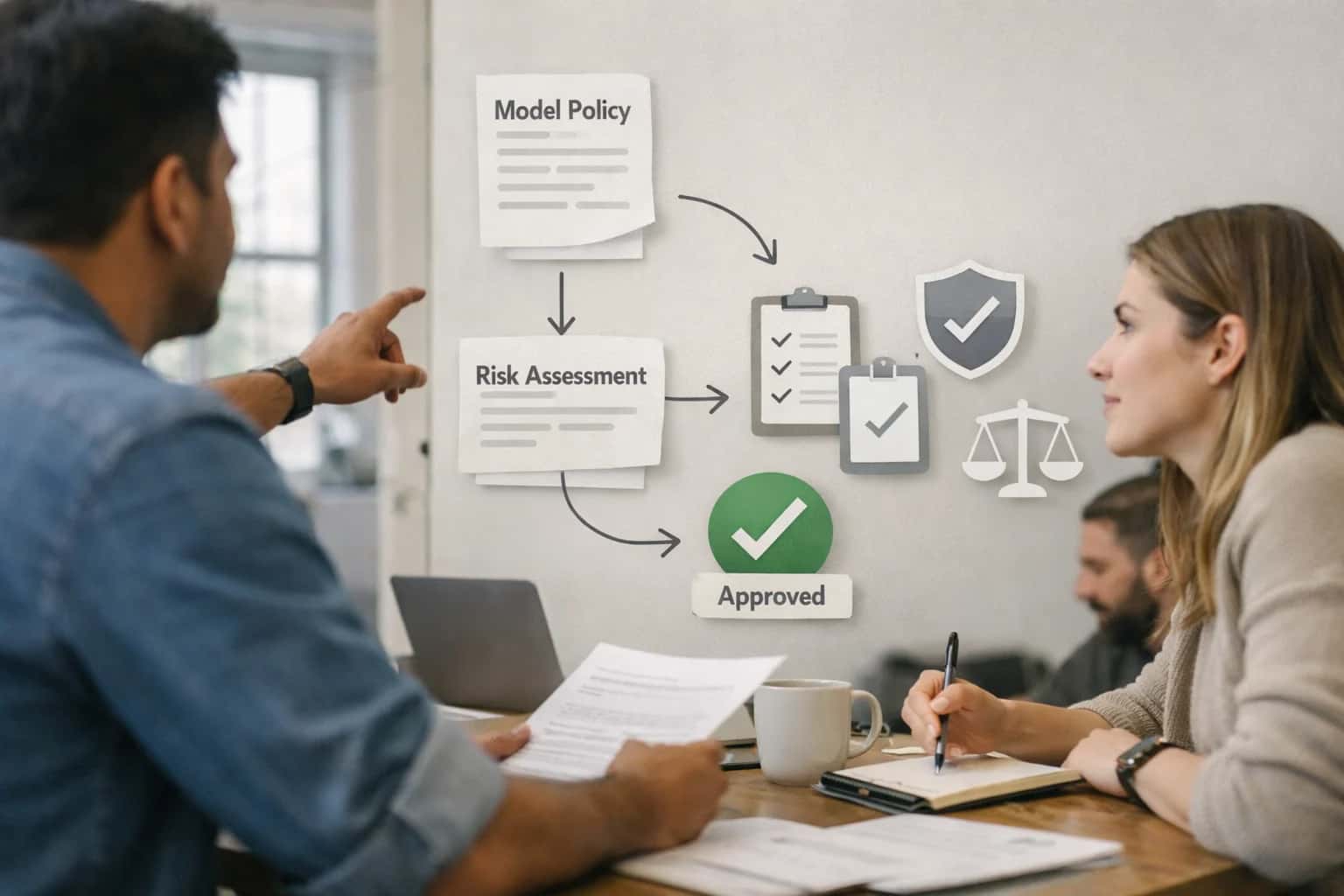
Extending human oversight to a coordinated fleet of AI agents requires a deliberate architectural approach. This guide explains the core models and patterns for effective governance in a Multi-Agent System (MAS).
The practical implementation involves defining clear escalation triggers and intervention protocols that are understood by every agent in the system. For example, an agent making a procurement decision must know when a cost threshold requires human approval, and how to pause its workflow while notifying the correct operator. You'll integrate these rules using orchestration frameworks, manage shared state via a database, and design dashboards for real-time oversight, linking these concepts to our guides on auditable logging systems and real-time intervention.
ARCHITECTURE PRIMER
Key Concepts for Multi-Agent HITL
Extending human oversight to a coordinated fleet of AI agents requires foundational design patterns. Master these concepts to build a robust, scalable governance layer for your Multi-Agent System (MAS).
01
Centralized vs. Decentralized Oversight
Choose your governance topology based on system complexity and latency tolerance.
- Centralized Orchestrator: A single 'governance agent' acts as a choke point, receiving all agent outputs, applying approval logic, and broadcasting decisions. Simplifies logging and policy enforcement but creates a single point of failure.
- Decentralized Peer Review: Agents are empowered to request review from designated human roles or other agents based on local confidence scores. Increases resilience and scalability but requires sophisticated state management to track intervention status across the system.
02
Intervention State Management
When a human pauses one agent, you must manage the state of the entire coordinated workflow.
- Global State Store: Use a distributed key-value store (e.g., Redis) to maintain a shared context of
agent_id,task_id,status(e.g.,running,paused_for_review,overridden). - Propagation Protocols: Design rules for state changes. If Agent A is paused, should collaborating Agents B and C also halt, enter a holding pattern, or proceed with degraded capabilities? Implement these as idempotent state transition functions.
03
Consensus & Conflict Resolution
Agents may arrive at conflicting conclusions that require human arbitration.
- Voting Mechanisms: Implement simple majority or weighted voting among agents for low-stakes decisions, flagging only tied votes for human review.
- Conflict Detection Heuristics: Programmatically identify disagreements by comparing structured outputs (e.g., different recommended actions, conflicting data interpretations). Surface these conflicts to the human operator with a clear comparison dashboard, linking to techniques for neuro-symbolic AI where logical contradictions must be resolved.
04
Orchestration Framework Integration
Embed HITL gates directly into your agent orchestration logic.
- LangChain/CrewAI: Use built-in callbacks or custom
HumanApprovalToolclasses to interrupt chain execution. Pass context (agent reasoning, source documents) to the approval interface. - Custom Schedulers: Build your own scheduler that checks a governance API for an
approvedstatus before dequeuing the next task for an agent. This pattern is essential for autonomous workflow design where tasks are dynamically routed.
05
Context Preservation for Review
A human reviewer needs the full context of the multi-agent interaction to make an informed judgment.
- Audit Trail Enrichment: Log not just the final agent output, but the sequence of inter-agent messages, tool calls, and data retrievals that led to the decision. Store this in a vector database for semantic querying during review.
- Visualization Tools: Build timelines or graph visualizations showing the agent interaction path, highlighting the specific node where low confidence or a conflict triggered the review request.
06
Graceful Degradation Protocols
Define system behavior when human review is delayed or unavailable.
- Timeout Policies: If a review request isn't addressed within a service-level agreement (SLA), the system should follow a default action: abort the task, proceed with the safest recommendation, or escalate to a different human role.
- Circuit Breakers: Monitor review queue latency. If it exceeds a threshold, automatically route lower-risk decisions to an automated fallback, conserving human attention for critical issues. This is a core component of a fallback protocol for AI system failures.
ARCHITECTURE FOUNDATION
Step 1: Define Your Oversight Model
The first step in architecting a Human-in-the-Loop (HITL) system for multi-agent orchestration is to explicitly define your oversight model. This foundational decision determines how human judgment is integrated into the autonomous workflow.
You must choose between a centralized or decentralized oversight model. A centralized model funnels all agent decisions requiring approval through a single governance node, ideal for enforcing uniform policy. A decentralized model embeds approval logic within individual agents or agent groups, offering scalability for heterogeneous fleets. Your choice dictates the system's intervention state management and communication overhead.
Define the approval triggers for each agent role. For a planner agent, this might be any plan exceeding a budget threshold. For an executor agent, it could be an action affecting a sensitive data field. Codify these rules as business logic within your orchestration framework, such as LangChain or LlamaIndex, to create a consistent governance layer across your Multi-Agent System (MAS).
ARCHITECTURAL COMPARISON
Centralized vs. Decentralized HITL Architecture
A core design decision for human oversight in a Multi-Agent System (MAS) is where to place the governance control plane. This table compares the two primary patterns.
| Feature | Centralized Orchestrator | Decentralized Peer-to-Peer |
|---|---|---|
Control Plane | Single master node (orchestrator) | Distributed across agent fleet |
Intervention Latency | < 100 ms for local agents | 200-500 ms (network dependent) |
Single Point of Failure | ||
Approval State Consistency | Guaranteed by orchestrator | Requires consensus protocol |
Scalability Complexity | High (orchestrator bottleneck) | Medium (adds network overhead) |
Integration with Existing MLOps | Simpler, single pipeline | Complex, requires agent-specific monitoring |
Best For | Strictly sequential workflows, regulated audits | Dynamic agent teams, high-availability systems |
Enabling Efficiency, Speed & Accuracy
Intelligent Analysis, Decision & Execution
We build AI systems for teams that need search across company data, workflow automation across tools, or AI features inside products and internal software.
Talk to Us
Search across company data
Give teams answers from docs, tickets, runbooks, and product data with sources and permissions.
Useful when people spend too long searching or get different answers from different systems.
Enterprise searchRAGPermissions
Read more
Automate internal workflows
Use AI to route work, draft outputs, trigger actions, and keep approvals and logs in place.
Useful when repetitive work moves across multiple tools and teams.
AI agentsWorkflow automationGovernance
Read more
Add AI to products and internal tools
Build assistants, guided actions, or decision support into the software your team or customers already use.
Useful when AI needs to be part of the product, not a separate tool.
AI integrationDecision supportModel routing
Read moreHITL ARCHITECTURE
Common Mistakes
Architecting a Human-in-the-Loop (HITL) system for multi-agent orchestration introduces unique pitfalls. These are the most frequent technical mistakes that lead to bottlenecks, inconsistent governance, and system failures.
A centralized approval gate forces all agent decisions through one human review queue, destroying the parallelism that makes multi-agent systems (MAS) valuable. This creates a single point of failure and latency.
The fix is a decentralized, domain-aware model:
- Route approvals based on agent type and decision context. A financial agent's transaction might go to a finance team, while a content agent's output goes to marketing.
- Use topic routing or semantic routing to classify decisions and send them to the appropriate human expert pool.
- Implement parallel approval queues to maintain system throughput. This aligns with designing multi-layer approval workflows for complex operations.

About the author
Prasad Kumkar
CEO & MD, Inference Systems
Prasad Kumkar is the CEO & MD of Inference Systems and writes about AI systems architecture, LLM infrastructure, model serving, evaluation, and production deployment. Over 5+ years, he has worked across computer vision models, L5 autonomous vehicle systems, and LLM research, with a focus on taking complex AI ideas into real-world engineering systems.
His work and writing cover AI systems, large language models, AI agents, multimodal systems, autonomous systems, inference optimization, RAG, evaluation, and production AI engineering.
LinkedIn
Limited slotsGet a Free AI Consultation
Partnered with leading AI, data, and software stack.





How We Work
Custom AI workflows for your Business
One-fit-all AI don't work for modern businesses. At Inferensys, we aim to understand your business & custom requirements; which we use to define most efficient agentic workflows, the data, and the tools for your business.
01
Review the use case
We understand the task, the users, and where AI can actually help.
Read more02
Pick the right approach
We define what needs search, automation, or product integration.
Read more03
Build the first useful version
We implement the part that proves the value first.
Read more04
Improve from there
We add the checks and visibility needed to keep it useful.
Read moreThe first call is a practical review of your use case and the right next step.
Talk to Us