A Governance API is a critical middleware layer that sits between your application and third-party AI models from providers like OpenAI, Anthropic, or Google. Its primary function is to enforce internal risk, compliance, and ethical policies before a query reaches an external model and after a response is received. This transforms a simple API call into a governed transaction, enabling confidence checks, mandatory logging, and approval workflows without modifying your core application logic. Think of it as a programmable firewall and audit system for AI.

Guide
Building a Governance API for Third-Party AI Model Integration
A developer guide to designing a secure API layer that enforces confidence checks, logging, and approval workflows, ensuring third-party AI models comply with internal risk and ethics policies.
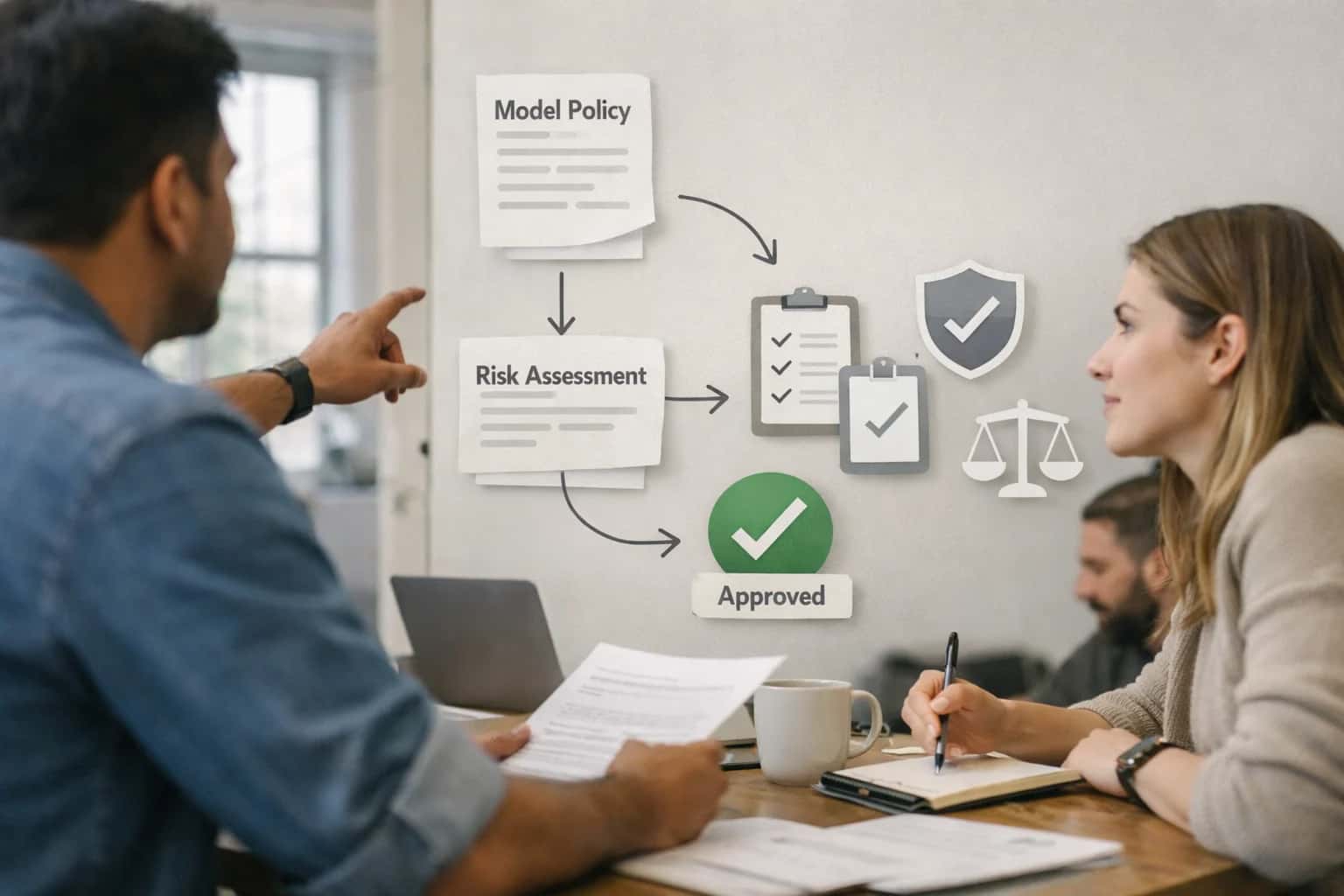
GOVERNANCE API
Introduction
A practical guide to building the control layer for integrating external AI models like GPT-4 and Claude into governed, production systems.
Building this API starts with defining the policy engine—the rules that determine which models can be used for which tasks, what data can be sent, and what confidence thresholds trigger human review. You then implement interceptors for pre-call validation (e.g., PII scrubbing) and post-call analysis (e.g., toxicity scoring). Finally, you integrate with audit logs and approval dashboards, creating a seamless bridge to your broader Human-in-the-Loop (HITL) governance framework. This ensures third-party AI acts as a compliant extension of your own systems.
ARCHITECTURE PRIMER
Key Concepts: The Governance API Pattern
A Governance API is the critical abstraction layer that enforces your organization's risk, compliance, and ethical policies on all third-party AI model calls. It transforms ad-hoc integrations into a governed ecosystem.
01
The API Gateway Pattern for AI
A Governance API acts as a reverse proxy between your application and external models like GPT-4 or Claude. Every request is routed through this single control point. This enables:
- Centralized policy enforcement for logging, cost control, and data masking.
- Standardized interfaces that abstract away vendor-specific SDKs.
- Resilience patterns like retries, fallbacks, and load balancing across multiple model providers.
Implement using frameworks like FastAPI or Express.js with middleware chains.
02
Confidence Scoring & Automated Routing
Not all decisions require human review. A Governance API must evaluate model confidence to automate low-risk approvals.
- Integrate tools like Weights & Biases or MLflow to capture confidence scores from model outputs.
- Implement tiered thresholds: e.g., confidence >90% auto-approves, 70-90% flags for review, <70% rejects automatically.
- Route low-confidence requests to a secondary model or a human-in-the-loop dashboard. This reduces operator fatigue and accelerates safe, automated workflows.
03
Immutable Audit Logging
Compliance demands a complete, tamper-proof record of every AI interaction. Your API must log:
- Request/Response Provenance: The exact prompt, model used, response, timestamps, and user ID.
- Decision Context: The confidence score, applied policy rules, and approval state (auto-approved, pending, overridden).
- Human Interventions: Any review, modification, or rejection by an operator. Store logs in a vector database (e.g., Pinecone, Weaviate) for semantic querying and link this to broader concepts of digital provenance and auditable logging systems.
04
Policy Engine Integration
Static code cannot manage evolving regulations. Decouple business logic by integrating a policy engine.
- Use tools like OPA (Open Policy Agent) or Cedar to define rules as declarative, reusable policies.
- Example policies: "Block prompts containing PII," "Limit monthly spend per department to $5000," "Require human review for financial advice over $10k."
- The Governance API evaluates each request against these policies before forwarding it to the model, ensuring consistent enforcement across all integrations.
05
Real-Time Intervention Hooks
For high-stakes decisions, the API must support seamless human takeover.
- Design webhook endpoints or use Server-Sent Events (SSE) to push flagged decisions to a human-in-the-loop dashboard in real-time.
- Maintain request state so a human's 'Approve,' 'Reject,' or 'Modify' action can be injected back into the original workflow.
- This pattern is essential for applications in finance, healthcare, and legal AI, forming the core of a real-time human intervention system.
06
Vendor-Agnostic Abstraction
Lock-in to a single AI provider creates strategic risk. A well-designed Governance API abstracts vendor specifics.
- Define a canonical request/response schema internal to your application.
- Implement adapters that translate this canonical schema to/from the formats required by OpenAI, Anthropic, Google, etc.
- This allows you to swap models based on cost, performance, or redundancy without changing your core application logic, future-proofing your AI infrastructure.
FOUNDATION
Step 1: Define Your Unified Request/Response Schema
The first and most critical step in building a Governance API is establishing a single, consistent interface for all third-party AI model interactions. This schema is the contract that enforces your governance rules.
A unified schema abstracts away the differences between providers like OpenAI, Anthropic, and Google Gemini. Your API accepts a single, standardized request format containing the prompt, context, and required governance parameters like max_confidence_threshold or required_approval_roles. Internally, your system translates this into the specific API call for the target model. This centralizes control and is the first principle of a scalable governance layer.
The response schema must also be standardized, wrapping the raw model output with governance metadata. This includes the model's confidence score, a unique decision ID for the audit log, and a flag indicating if human review is required based on your thresholds. This structured response is what the rest of your application—and your auditable logging system—depends on to enforce policy.
ARCHITECTURE PATTERNS
Provider Adapter: Key Implementation Differences
Comparison of three common patterns for building the adapter layer that standardizes interactions between your Governance API and third-party AI providers like OpenAI, Anthropic, and Google Gemini.
| Architectural Feature | Monolithic Adapter | Strategy Pattern Adapters | Plugin-Based Adapter System |
|---|---|---|---|
Provider-Specific Logic | Hardcoded conditionals | Encapsulated in dedicated strategy classes | Loaded as external, versioned modules |
Runtime Flexibility | Requires redeploy to add provider | New strategies can be registered at startup | Plugins can be hot-swapped without downtime |
Complexity for New Integrations | High (modify core service) | Medium (create new strategy class) | Low (develop standalone plugin) |
Governance Enforcement Point | Centralized, single code path | Per-strategy, with shared base validation | Per-plugin, with required governance hooks |
Audit Logging Integration | Direct calls to logging service | Uses abstracted logging interface | Plugins inject data into central audit pipeline |
Testing & Mocking Overhead | High (entire service) | Medium (per strategy) | Low (isolated plugin) |
Recommended Use Case | 1-2 fixed providers | 3-5 providers, moderate change | Unlimited providers, high-velocity ecosystem |
Enabling Efficiency, Speed & Accuracy
Intelligent Analysis, Decision & Execution
We build AI systems for teams that need search across company data, workflow automation across tools, or AI features inside products and internal software.
Talk to Us
Search across company data
Give teams answers from docs, tickets, runbooks, and product data with sources and permissions.
Useful when people spend too long searching or get different answers from different systems.
Enterprise searchRAGPermissions
Read more
Automate internal workflows
Use AI to route work, draft outputs, trigger actions, and keep approvals and logs in place.
Useful when repetitive work moves across multiple tools and teams.
AI agentsWorkflow automationGovernance
Read more
Add AI to products and internal tools
Build assistants, guided actions, or decision support into the software your team or customers already use.
Useful when AI needs to be part of the product, not a separate tool.
AI integrationDecision supportModel routing
Read moreGOVERNANCE API
Common Mistakes
Avoid these critical errors when building an API layer to govern third-party AI models. These pitfalls can undermine security, compliance, and the core purpose of your Human-in-the-Loop (HITL) system.
This happens when you treat the governance API as a synchronous pass-through layer. Every call to OpenAI or Anthropic must wait for your logging, validation, and approval checks to complete, adding latency.
Solution: Implement an asynchronous, event-driven architecture. Decouple the governance checks from the model inference call.
- Use a message queue (e.g., RabbitMQ, Kafka) to ingest requests.
- A separate service processes governance rules and logs the intent.
- Only then is the call forwarded to the external model. For high-risk decisions flagged for human review, the workflow integrates with your multi-layer approval system.
This pattern maintains auditability without blocking the request flow.

About the author
Prasad Kumkar
CEO & MD, Inference Systems
Prasad Kumkar is the CEO & MD of Inference Systems and writes about AI systems architecture, LLM infrastructure, model serving, evaluation, and production deployment. Over 5+ years, he has worked across computer vision models, L5 autonomous vehicle systems, and LLM research, with a focus on taking complex AI ideas into real-world engineering systems.
His work and writing cover AI systems, large language models, AI agents, multimodal systems, autonomous systems, inference optimization, RAG, evaluation, and production AI engineering.
LinkedIn
Limited slotsGet a Free AI Consultation
Partnered with leading AI, data, and software stack.





How We Work
Custom AI workflows for your Business
One-fit-all AI don't work for modern businesses. At Inferensys, we aim to understand your business & custom requirements; which we use to define most efficient agentic workflows, the data, and the tools for your business.
01
Review the use case
We understand the task, the users, and where AI can actually help.
Read more02
Pick the right approach
We define what needs search, automation, or product integration.
Read more03
Build the first useful version
We implement the part that proves the value first.
Read more04
Improve from there
We add the checks and visibility needed to keep it useful.
Read moreThe first call is a practical review of your use case and the right next step.
Talk to Us