A power-aware testing framework moves beyond functional accuracy to measure the true cost of intelligence. It validates that your AI meets both performance and energy-efficiency requirements before deployment. You will build a test harness to capture core metrics like energy-per-inference and simulate real-world conditions such as battery discharge profiles and variable sensor noise. This first-principles approach ensures your model's design aligns with the physical constraints of wearables and IoT devices, a core tenet of our Ultra-Low-Power AI for Wearables and IoT pillar.

Guide
How to Set Up a Testing Framework for Power-Aware AI Models
A practical guide to building a reproducible test harness that measures AI model performance under real-world power constraints for wearables and IoT.
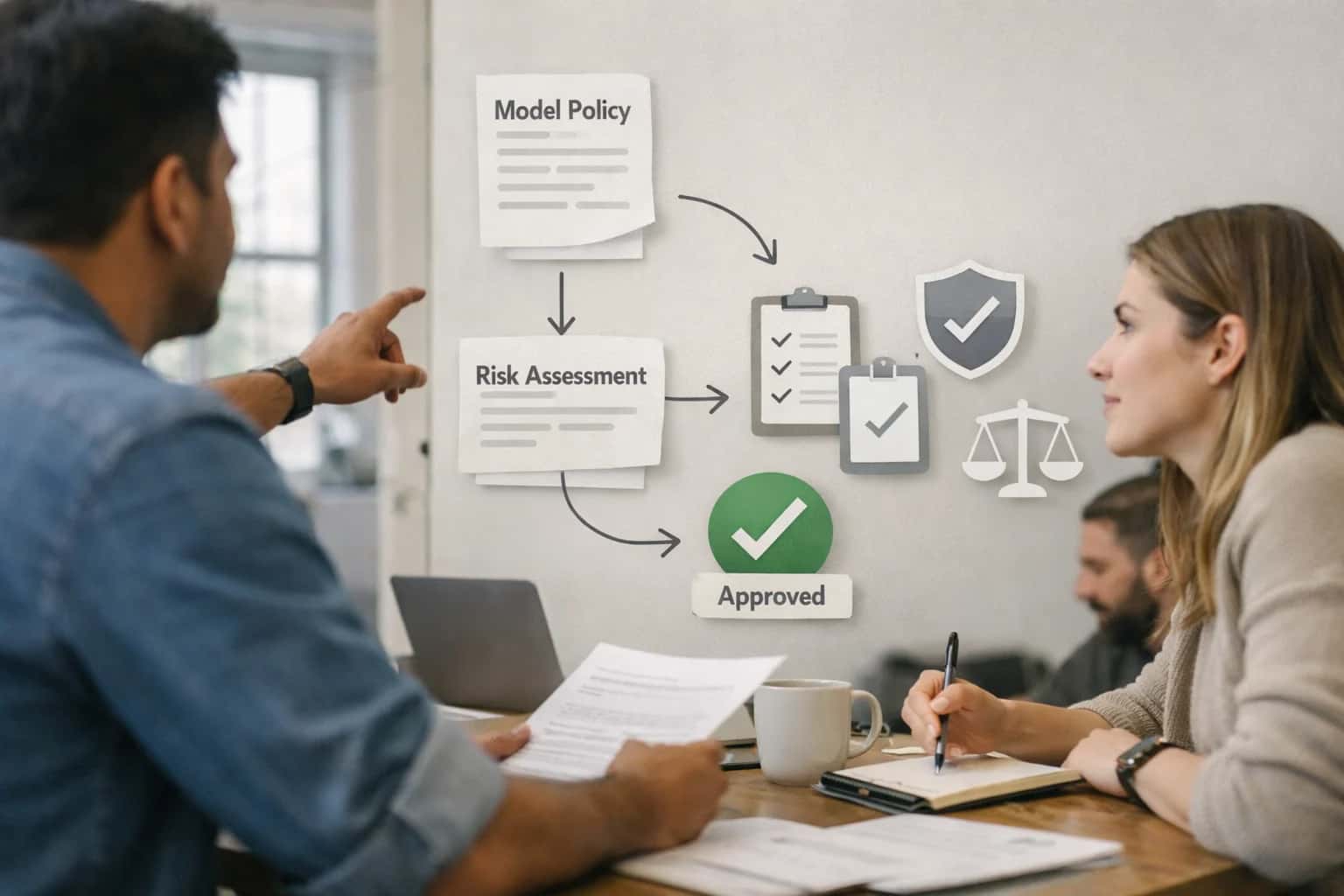
This guide establishes a methodology for rigorously testing AI model performance under real-world power constraints.
The framework creates reproducible benchmarks and defines clear pass/fail criteria. You will learn to stress-test models under power throttling, establish baselines for inferences-per-joule, and integrate these tests into your CI/CD pipeline. This systematic validation is critical for deploying reliable, long-lasting devices and connects directly to sibling topics on balancing model accuracy vs. power consumption and selecting the right hardware.
FRAMEWORK FOUNDATIONS
Key Concepts for Power-Aware Testing
Building a robust testing framework is the first step to ensuring your AI models meet functional and efficiency requirements. This involves creating reproducible benchmarks and defining pass/fail criteria under real-world power constraints.
01
Energy-Per-Inference Benchmarking
This is the foundational metric for power-aware AI. You must measure the energy consumed for a single model inference on your target hardware. Use tools like Joulescope or Monsoon Power Monitor to capture precise power traces. The process involves:
- Running a controlled inference loop
- Integrating the power-over-time curve
- Normalizing the result by batch size and input complexity This creates a baseline for comparing model architectures and optimization techniques, directly linking to our guide on How to Balance Model Accuracy vs. Power Consumption.
EXPLORE
03
Variable Sensor Noise Injection
Power constraints often correlate with noisy sensor data (e.g., low-gain amplifiers). Your framework must stress-test models with synthetic and real noise. Implement a noise injection layer that:
- Applies Gaussian noise, dropout, and real captured EMI artifacts to input data streams
- Measures the impact on model confidence and accuracy
- Identifies the Signal-to-Noise Ratio (SNR) threshold where performance becomes unacceptable This ensures your AI is robust to the imperfect data generated by ultra-low-power sensor systems.
04
Thermal-Aware Performance Testing
Processor power consumption generates heat, which can trigger thermal throttling and reduce clock speeds. Your testing must account for this feedback loop. Set up tests to:
- Monitor junction temperature using on-chip sensors
- Correlate temperature rise with inference latency and power draw
- Establish thermal operating envelopes for sustained AI workloads This prevents performance cliffs in the field and is critical for designing enclosures and heat dissipation, a key consideration in How to Select Hardware for Ultra-Low-Power AI Deployment.
05
Dynamic Workload Stress Testing
Real devices don't run AI in isolation. Your framework must simulate concurrent system loads. Create test scenarios that combine:
- AI inference tasks running at varying frequencies
- Background radio activity (BLE, Wi-Fi)
- Flash memory read/write operations
- User interface updates Profile the total system power and identify resource contention bottlenecks. This holistic view ensures your AI model's power budget is realistic within the full application context.
06
Pass/Fail Criteria and Reporting
Define quantitative, automated gates for model approval. Your framework should output a clear report with key performance indicators (KPIs). Essential criteria include:
- Maximum energy-per-inference (e.g., < 5 mJ)
- Inference latency SLA (e.g., < 100 ms for 99% of runs)
- Accuracy floor under noise (e.g., > 92% F1-score at 20dB SNR)
- Memory footprint ceiling (e.g., < 256 KB RAM) Automate these checks in your CI/CD pipeline to catch regressions. This formalizes the trade-offs explored in our guide on model optimization for MCUs.
FOUNDATION
Step 1: Design Your Test Harness Architecture
A robust test harness is the control center for validating power-aware AI models. This step defines the core components and data flows required to measure performance under real-world constraints.
Your test harness architecture must isolate and measure the energy-per-inference and latency of your AI model under controlled conditions. This requires three core components: a power measurement module (e.g., a precision multimeter or dedicated IC like the INA219), a workload generator to simulate real sensor input, and a results aggregator. The harness should run on the exact target hardware—whether an MCU or a dedicated accelerator—to capture authentic power profiles, a critical step detailed in our guide on How to Select Hardware for Ultra-Low-Power AI Deployment.
Design the data pipeline to log timestamped power draw, inference results, and system state (CPU frequency, sleep mode). Use this data to build a power signature for each model version. This baseline allows you to regress test for efficiency losses during optimization and establishes the pass/fail criteria for deployment. A well-architected harness turns subjective "it feels efficient" into quantifiable metrics, enabling reproducible benchmarks across your model lifecycle, a concept further explored in our pillar on Ultra-Low-Power AI for Wearables and IoT.
QUANTITATIVE BENCHMARKS
Core Power Testing Metrics Comparison
A comparison of essential metrics for evaluating AI model efficiency and performance under power constraints, critical for validating wearable and IoT deployments.
| Metric | Target Threshold (Pass) | Acceptable Range | Failure Condition |
|---|---|---|---|
Inferences Per Joule (IPJ) |
| 500 - 1000 | < 500 |
Peak Power Draw (Inference) | < 10 mW | 10 - 50 mW |
|
Average Inference Latency | < 100 ms | 100 - 500 ms |
|
Memory Footprint (RAM) | < 50 KB | 50 - 200 KB |
|
Standby Power Consumption | < 10 µW | 10 - 100 µW |
|
Accuracy Degradation (vs. Baseline) | < 2% | 2 - 5% |
|
Battery Life Impact (vs. Non-AI Baseline) | < 10% reduction | 10 - 25% reduction |
|
VALIDATION
Step 5: Define Pass/Fail Criteria and SLAs
Establishing clear, quantifiable benchmarks is the final step to ensure your power-aware AI model is ready for real-world deployment.
Pass/fail criteria are specific, measurable thresholds your model must meet to be considered functional. For power-aware AI, these go beyond accuracy to include energy-per-inference, peak memory usage, and inference latency. Define these by analyzing your Pareto frontiers from the accuracy vs. power trade-off analysis. For example, a health monitor might require 95% anomaly detection accuracy while consuming less than 10mJ per inference. This creates a binary go/no-go gate for model validation.
Service Level Agreements (SLAs) operationalize these criteria for the deployed system. An SLA might guarantee a device performs 1,000 inferences per day for 30 days on a single charge, or that model updates via over-the-air updates complete within a 2% battery drain. Document these SLAs alongside procedures for monitoring agent drift and triggering retraining. This formalizes performance expectations and connects your testing framework directly to product reliability and user experience.
Enabling Efficiency, Speed & Accuracy
Intelligent Analysis, Decision & Execution
We build AI systems for teams that need search across company data, workflow automation across tools, or AI features inside products and internal software.
Talk to Us
Search across company data
Give teams answers from docs, tickets, runbooks, and product data with sources and permissions.
Useful when people spend too long searching or get different answers from different systems.
Enterprise searchRAGPermissions
Read more
Automate internal workflows
Use AI to route work, draft outputs, trigger actions, and keep approvals and logs in place.
Useful when repetitive work moves across multiple tools and teams.
AI agentsWorkflow automationGovernance
Read more
Add AI to products and internal tools
Build assistants, guided actions, or decision support into the software your team or customers already use.
Useful when AI needs to be part of the product, not a separate tool.
AI integrationDecision supportModel routing
Read moreTESTING FRAMEWORK PITFALLS
Common Mistakes
Setting up a testing framework for power-aware AI models introduces unique pitfalls that can invalidate your benchmarks and lead to field failures. This section addresses the most frequent developer errors in measuring energy, simulating real-world conditions, and defining pass/fail criteria.
Measuring only latency gives a false sense of performance for battery-powered devices. A model might be fast but energy-inefficient, draining the battery quickly. You must measure energy-per-inference, which combines power draw and time.
Common Mistake: Using wall-clock time or CPU cycles as a proxy for energy. Solution: Integrate hardware power monitors (e.g., Joulescope, Monsoon power monitor) or use MCU-specific energy counters (like the ARM Energy Probe) directly into your test harness. Capture the integral of current over voltage during the entire inference operation. Always report results in millijoules (mJ) per inference for meaningful comparison.

About the author
Prasad Kumkar
CEO & MD, Inference Systems
Prasad Kumkar is the CEO & MD of Inference Systems and writes about AI systems architecture, LLM infrastructure, model serving, evaluation, and production deployment. Over 5+ years, he has worked across computer vision models, L5 autonomous vehicle systems, and LLM research, with a focus on taking complex AI ideas into real-world engineering systems.
His work and writing cover AI systems, large language models, AI agents, multimodal systems, autonomous systems, inference optimization, RAG, evaluation, and production AI engineering.
LinkedIn
Limited slotsGet a Free AI Consultation
Partnered with leading AI, data, and software stack.





How We Work
Custom AI workflows for your Business
One-fit-all AI don't work for modern businesses. At Inferensys, we aim to understand your business & custom requirements; which we use to define most efficient agentic workflows, the data, and the tools for your business.
01
Review the use case
We understand the task, the users, and where AI can actually help.
Read more02
Pick the right approach
We define what needs search, automation, or product integration.
Read more03
Build the first useful version
We implement the part that proves the value first.
Read more04
Improve from there
We add the checks and visibility needed to keep it useful.
Read moreThe first call is a practical review of your use case and the right next step.
Talk to Us