Budgeting for a task-specific SLM requires modeling the Total Cost of Ownership (TCO) across the entire lifecycle. Key cost drivers include data acquisition (sourcing and labeling), cloud compute for training (e.g., AWS Trainium, Google TPUs), and inference hosting for production APIs. You must also account for MLOps tooling and engineering labor for model development, integration, and maintenance. This financial model is essential for securing stakeholder buy-in and ensuring project viability.

Guide
How to Budget for Task-Specific SLM Development and Deployment
A practical guide for engineering leads to forecast costs, model TCO, and build a compelling ROI analysis for custom Small Language Model projects.
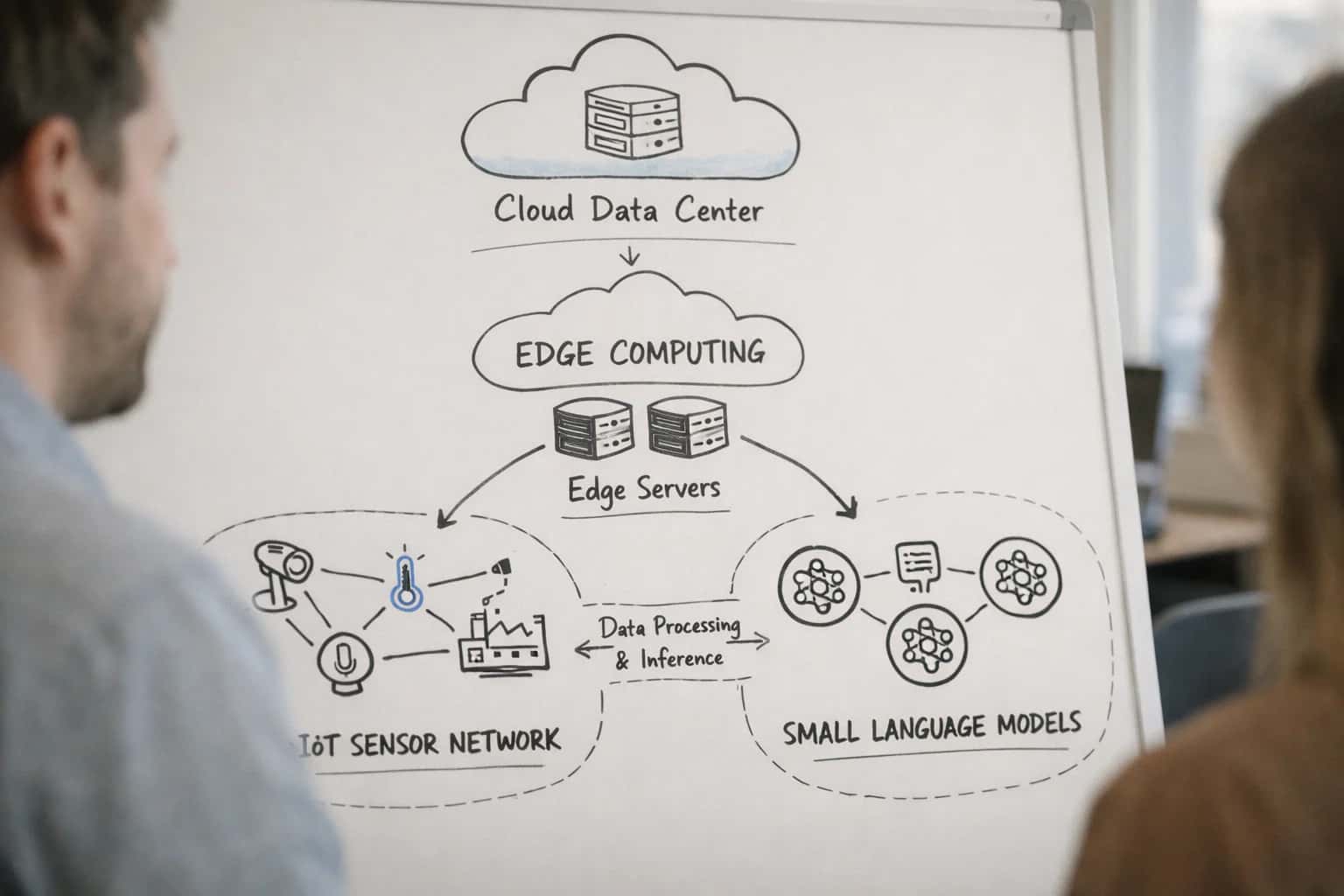
A practical guide to forecasting the true cost of developing and deploying a Small Language Model, from initial data acquisition to ongoing inference hosting.
To build a compelling ROI analysis, start by quantifying the operational efficiency gains or revenue uplift the SLM will deliver. Then, map these benefits against your detailed cost forecast. Use this analysis to justify the initial investment and plan for scaling. For a complete strategic framework, see our guide on How to Architect a Task-Specific SLM Strategy for Your Product. A robust budget is the foundation of a successful SLM initiative.
TCO COMPARISON
SLM Cost Breakdown Table
A detailed comparison of the total cost of ownership (TCO) for three common SLM development and deployment strategies.
| Cost Component | Fine-Tune Open-Source Model | Build Custom SLM from Scratch | Use Managed API Service |
|---|---|---|---|
Data Acquisition & Curation | $5k - $50k | $50k - $200k+ | $0 - $10k |
Cloud Compute for Training | $2k - $20k (AWS Trainium) | $50k - $500k+ (Google TPU v5e) | N/A |
Inference Hosting (Monthly) | $500 - $5k (Self-hosted) | $2k - $20k (Self-hosted) | $1k - $15k (Usage-based) |
MLOps & Engineering Labor | $50k - $150k | $200k - $500k+ | $20k - $80k |
Model Monitoring & Maintenance | |||
Vendor Lock-in Risk | |||
Time to Production | 2-4 months | 6-12+ months | 1-4 weeks |
Estimated First-Year TCO | $57.5k - $225k | $302k - $1.22M+ | $21k - $105k |
FINANCIAL PLANNING
Step 2: Estimate Development & Training Costs
This step translates your technical strategy into a concrete budget, forecasting the primary cost drivers for building and deploying a task-specific Small Language Model (SLM).
Accurate budgeting requires modeling four core expense categories. Compute costs for training and fine-tuning dominate, driven by GPU/TPU hours on platforms like AWS Trainium or Google Cloud TPUs. Data acquisition and preparation includes licensing, labeling, and synthetic generation. Engineering labor covers the full lifecycle from initial development to ongoing MLOps. Finally, inference hosting costs scale with user traffic and model complexity, whether deployed on cloud endpoints or edge devices.
Build a Total Cost of Ownership (TCO) model that projects expenses over 1-3 years. Factor in variable costs like cloud compute, which scales with experimentation, and fixed costs like tooling licenses. Use this model to create a compelling ROI analysis that justifies the investment by linking model performance to business outcomes, such as reduced operational overhead or increased revenue. This financial rigor is essential for securing stakeholder buy-in. For a deeper dive on strategic planning, see our guide on How to Architect a Task-Specific SLM Strategy for Your Product.
Enabling Efficiency, Speed & Accuracy
Intelligent Analysis, Decision & Execution
We build AI systems for teams that need search across company data, workflow automation across tools, or AI features inside products and internal software.
Talk to Us
Search across company data
Give teams answers from docs, tickets, runbooks, and product data with sources and permissions.
Useful when people spend too long searching or get different answers from different systems.
Enterprise searchRAGPermissions
Read more
Automate internal workflows
Use AI to route work, draft outputs, trigger actions, and keep approvals and logs in place.
Useful when repetitive work moves across multiple tools and teams.
AI agentsWorkflow automationGovernance
Read more
Add AI to products and internal tools
Build assistants, guided actions, or decision support into the software your team or customers already use.
Useful when AI needs to be part of the product, not a separate tool.
AI integrationDecision supportModel routing
Read moreSLM FINANCIAL PLANNING
Common Budgeting Mistakes
Underestimating the true cost of a task-specific SLM project is the fastest path to failure. This guide identifies the most frequent and costly budgeting errors engineering leads make, from hidden cloud bills to unplanned labor, and provides concrete strategies to avoid them.
The most common mistake is budgeting for a single training run. In reality, SLM development is iterative. You will run dozens of experiments for hyperparameter tuning, evaluate multiple base models, and likely need several retraining cycles to achieve target accuracy.
Hidden costs include:
- Experiment tracking and storage: Logs, checkpoints, and metrics from each run.
- Data preprocessing compute: Cleaning and tokenizing large datasets is computationally expensive.
- Inference load testing: Simulating production traffic to validate latency and throughput.
How to fix it: Model costs using a phased approach. Allocate separate budgets for R&D/experimentation, final training, and load testing. Use spot instances for experiments and reserved instances for final training. Always include a 20-30% contingency buffer for unplanned compute.

About the author
Prasad Kumkar
CEO & MD, Inference Systems
Prasad Kumkar is the CEO & MD of Inference Systems and writes about AI systems architecture, LLM infrastructure, model serving, evaluation, and production deployment. Over 5+ years, he has worked across computer vision models, L5 autonomous vehicle systems, and LLM research, with a focus on taking complex AI ideas into real-world engineering systems.
His work and writing cover AI systems, large language models, AI agents, multimodal systems, autonomous systems, inference optimization, RAG, evaluation, and production AI engineering.
LinkedIn
Limited slotsGet a Free AI Consultation
Partnered with leading AI, data, and software stack.





How We Work
Custom AI workflows for your Business
One-fit-all AI don't work for modern businesses. At Inferensys, we aim to understand your business & custom requirements; which we use to define most efficient agentic workflows, the data, and the tools for your business.
01
Review the use case
We understand the task, the users, and where AI can actually help.
Read more02
Pick the right approach
We define what needs search, automation, or product integration.
Read more03
Build the first useful version
We implement the part that proves the value first.
Read more04
Improve from there
We add the checks and visibility needed to keep it useful.
Read moreThe first call is a practical review of your use case and the right next step.
Talk to Us