Continuous bias monitoring is the practice of instrumenting production AI systems to track fairness metrics—such as demographic parity, equal opportunity, and predictive equality—across user subgroups in real time. Unlike one-time audits, this approach detects performance disparities as they emerge from shifting real-world data, a phenomenon known as model drift. Tools like WhyLabs and Arize automate this by calculating metrics per inference batch and visualizing disparities across sensitive attributes like age, gender, or zip code, enabling proactive intervention before harm occurs.

Guide
Setting Up Continuous Bias Monitoring for Deployed AI Systems
A step-by-step technical guide to instrumenting live AI systems for real-time bias detection. You will learn to track fairness metrics, configure automated alerts, and implement rollback triggers using tools like WhyLabs and Arize.
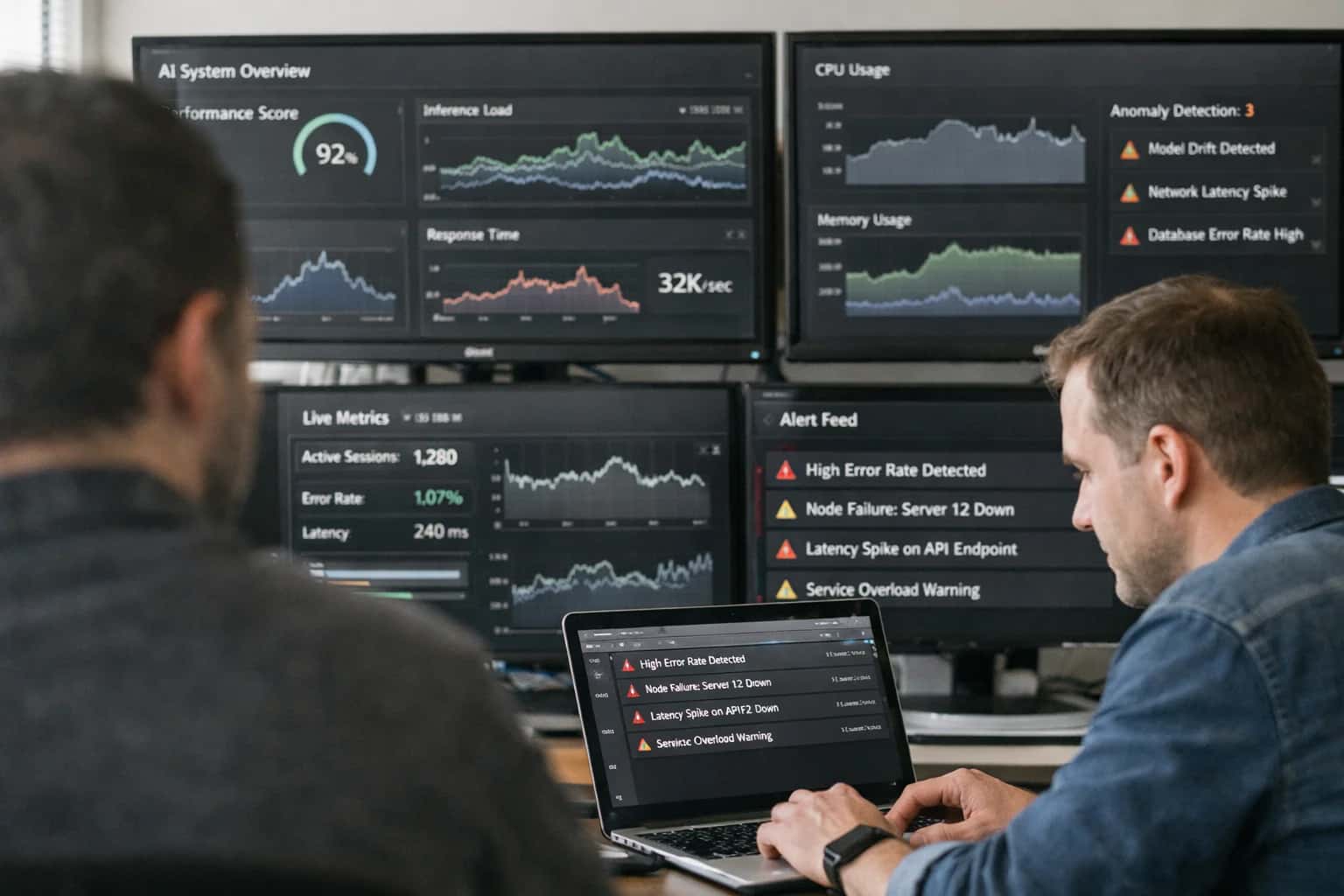
This guide details the technical implementation of real-time bias detection for live AI models, a critical component of a Responsible AI MLOps pipeline.
Implementation requires three core steps: First, instrument your serving pipeline to log predictions alongside the relevant protected attributes for each inference. Second, configure monitoring dashboards to calculate your chosen fairness metrics on a scheduled basis, setting thresholds for automated alerts. Finally, establish rollback protocols, integrating with your CI/CD system to trigger model retraining or revert to a prior version when bias violations exceed acceptable limits, as detailed in guides on How to Architect a Bias-Auditing Pipeline for Production AI and Launching a Responsible AI MLOps Pipeline.
PLATFORM OVERVIEW
Bias Monitoring Tools Comparison
A feature comparison of leading commercial and open-source tools for continuous bias and fairness monitoring in production AI systems.
| Core Feature / Metric | WhyLabs | Arize AI | Fairlearn |
|---|---|---|---|
Real-time metric tracking | |||
Automated subgroup disparity detection | |||
Pre-configured fairness metrics (e.g., Demographic Parity) | 20+ | 15+ | 10+ |
Custom metric & threshold configuration | |||
Automated alerting & rollback triggers | |||
Integration with major MLOps stacks (MLflow, Kubeflow) | |||
Model-agnostic support (tabular, NLP, CV) | |||
Open-source / self-hosted option | |||
Pricing model (approx. monthly) | $300-2000 | $500-2500 | Free |
Enabling Efficiency, Speed & Accuracy
Intelligent Analysis, Decision & Execution
We build AI systems for teams that need search across company data, workflow automation across tools, or AI features inside products and internal software.
Talk to Us
Search across company data
Give teams answers from docs, tickets, runbooks, and product data with sources and permissions.
Useful when people spend too long searching or get different answers from different systems.
Enterprise searchRAGPermissions
Read more
Automate internal workflows
Use AI to route work, draft outputs, trigger actions, and keep approvals and logs in place.
Useful when repetitive work moves across multiple tools and teams.
AI agentsWorkflow automationGovernance
Read more
Add AI to products and internal tools
Build assistants, guided actions, or decision support into the software your team or customers already use.
Useful when AI needs to be part of the product, not a separate tool.
AI integrationDecision supportModel routing
Read moreTROUBLESHOOTING
Common Mistakes
Setting up continuous bias monitoring is a critical operational discipline, but developers often stumble on the same pitfalls. This guide addresses the most frequent technical mistakes and provides clear fixes to ensure your monitoring system is effective and reliable.
The most common mistake is monitoring only for static bias—the bias present in your training data—and ignoring emergent bias that arises in production. Models interact with a dynamic world; the distribution of user data can shift, or the model's behavior can create new feedback loops that introduce bias post-deployment.
Fix: Implement a dual-track monitoring system.
- Static Track: Continue to evaluate against your original, annotated test sets for baseline fairness metrics.
- Dynamic Track: Instrument your live inference endpoints to collect predictions and user feedback. Calculate fairness metrics (e.g., demographic parity, equalized odds) on these real-time inference logs, segmented by relevant user subgroups. Tools like WhyLabs and Arize AI are built for this exact purpose, allowing you to track performance disparities as they emerge.

About the author
Prasad Kumkar
CEO & MD, Inference Systems
Prasad Kumkar is the CEO & MD of Inference Systems and writes about AI systems architecture, LLM infrastructure, model serving, evaluation, and production deployment. Over 5+ years, he has worked across computer vision models, L5 autonomous vehicle systems, and LLM research, with a focus on taking complex AI ideas into real-world engineering systems.
His work and writing cover AI systems, large language models, AI agents, multimodal systems, autonomous systems, inference optimization, RAG, evaluation, and production AI engineering.
LinkedIn
Limited slotsGet a Free AI Consultation
Partnered with leading AI, data, and software stack.





How We Work
Custom AI workflows for your Business
One-fit-all AI don't work for modern businesses. At Inferensys, we aim to understand your business & custom requirements; which we use to define most efficient agentic workflows, the data, and the tools for your business.
01
Review the use case
We understand the task, the users, and where AI can actually help.
Read more02
Pick the right approach
We define what needs search, automation, or product integration.
Read more03
Build the first useful version
We implement the part that proves the value first.
Read more04
Improve from there
We add the checks and visibility needed to keep it useful.
Read moreThe first call is a practical review of your use case and the right next step.
Talk to Us