An AI Ethics Governance Program is a formal, cross-functional framework that embeds ethical principles into your organization's AI development lifecycle. It defines clear roles, such as an AI Ethics Officer, and establishes mandatory processes like ethical impact assessments for new projects. This program shifts ethics from an ad-hoc discussion to a core engineering requirement, ensuring accountability and systematic risk management. It is the foundational structure upon which all other bias mitigation and fairness practices depend.

Guide
Launching an AI Ethics Governance Program for Technical Leaders
A step-by-step guide to establishing a formal AI ethics governance program, including defining the AI Ethics Officer role, chartering a cross-functional review board, and implementing mandatory ethical impact assessments for new AI projects.
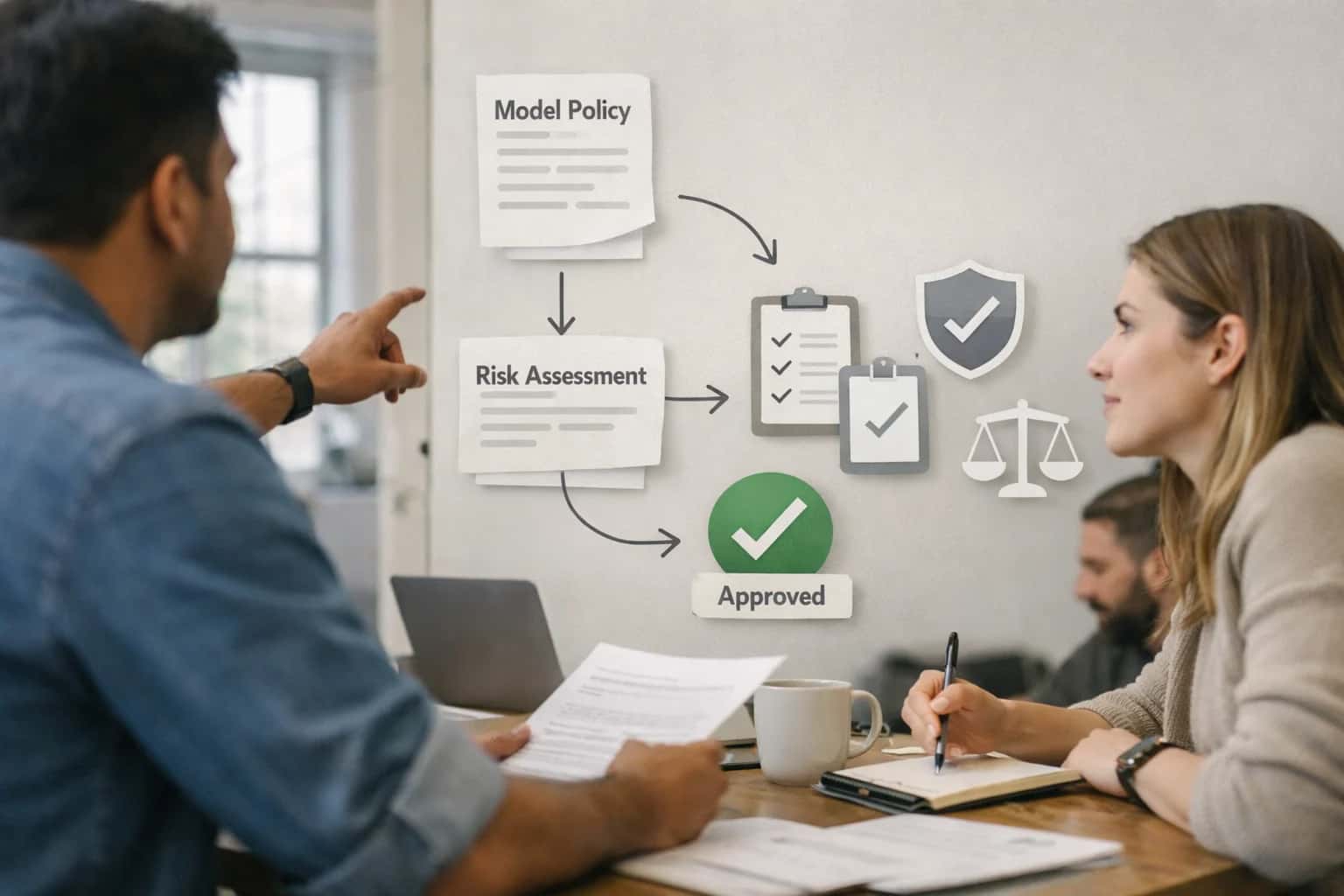
A formal governance program establishes the accountability and processes needed to manage ethical risk at an institutional level, moving ethics from an abstract concern to an operational reality.
To launch this program, technical leaders must first charter a cross-functional review board with representatives from engineering, legal, product, and compliance. This board is responsible for reviewing assessments, setting policy, and approving high-risk AI deployments. The second critical step is to implement a standardized ethical impact assessment template that projects must complete, evaluating potential risks related to fairness, transparency, safety, and privacy. This creates a consistent, auditable process for managing ethical risk, as detailed in guides on Algorithmic Impact Assessments (AIAs) and Model Risk Management.
DOCUMENTATION
Core Governance Artifacts and Templates
Essential templates and documents to formalize your AI ethics governance program, ensuring consistent process and clear accountability.
| Artifact | Purpose | Primary Owner | Review Cadence | Key Output |
|---|---|---|---|---|
AI Ethics Charter | Defines the program's mission, scope, and core principles. | AI Ethics Officer / Steering Committee | Annual | Signed charter document |
Ethical Impact Assessment (EIA) Template | Structured questionnaire to identify and score ethical risks for new AI projects. | Project Lead | Per project initiation | Risk score & mitigation plan |
Model Card Template | Standardized documentation of model performance, limitations, and fairness metrics. | ML Engineer / Data Scientist | Per model version | Published model card |
Algorithmic Impact Assessment (AIA) Report | In-depth analysis for high-risk systems, evaluating societal impact and human rights risks. | Cross-Functional Review Board | Pre-deployment for high-risk tier | Approval recommendation |
Red-Teaming Protocol | Formal process for adversarial testing to uncover harmful behaviors or biases. | Security & Ethics Teams | Pre-deployment & annually | Vulnerability report & remediation log |
Incident Response Playbook | Step-by-step guide for responding to an AI ethics incident (e.g., bias violation). | AI Ethics Officer | Bi-annual review & drills | Contained incident, post-mortem report |
Governance Board Meeting Minutes | Formal record of review board decisions, action items, and risk acceptances. | Governance Board Secretary | Per meeting | Approved minutes & action log |
Enabling Efficiency, Speed & Accuracy
Intelligent Analysis, Decision & Execution
We build AI systems for teams that need search across company data, workflow automation across tools, or AI features inside products and internal software.
Talk to Us
Search across company data
Give teams answers from docs, tickets, runbooks, and product data with sources and permissions.
Useful when people spend too long searching or get different answers from different systems.
Enterprise searchRAGPermissions
Read more
Automate internal workflows
Use AI to route work, draft outputs, trigger actions, and keep approvals and logs in place.
Useful when repetitive work moves across multiple tools and teams.
AI agentsWorkflow automationGovernance
Read more
Add AI to products and internal tools
Build assistants, guided actions, or decision support into the software your team or customers already use.
Useful when AI needs to be part of the product, not a separate tool.
AI integrationDecision supportModel routing
Read moreAI ETHICS GOVERNANCE
Common Mistakes
Launching an AI ethics governance program is a strategic imperative, but technical leaders often stumble on the same implementation pitfalls. This guide addresses the most frequent errors that undermine program effectiveness and credibility.
These are distinct, complementary roles. The AI Ethics Officer is a dedicated, senior individual (often a C-suite role) accountable for the program's strategy, execution, and reporting. They own the ethical risk framework.
The AI Ethics Governance Board is a cross-functional committee (e.g., from Legal, Engineering, Product, Compliance) that reviews high-risk projects, adjudicates edge cases, and provides diverse perspectives. A common mistake is appointing a board without a clear charter or empowering an officer without executive authority, creating a 'talking shop' with no real power. The officer drives the process; the board provides oversight and challenge.

About the author
Prasad Kumkar
CEO & MD, Inference Systems
Prasad Kumkar is the CEO & MD of Inference Systems and writes about AI systems architecture, LLM infrastructure, model serving, evaluation, and production deployment. Over 5+ years, he has worked across computer vision models, L5 autonomous vehicle systems, and LLM research, with a focus on taking complex AI ideas into real-world engineering systems.
His work and writing cover AI systems, large language models, AI agents, multimodal systems, autonomous systems, inference optimization, RAG, evaluation, and production AI engineering.
LinkedIn
Limited slotsGet a Free AI Consultation
Partnered with leading AI, data, and software stack.





How We Work
Custom AI workflows for your Business
One-fit-all AI don't work for modern businesses. At Inferensys, we aim to understand your business & custom requirements; which we use to define most efficient agentic workflows, the data, and the tools for your business.
01
Review the use case
We understand the task, the users, and where AI can actually help.
Read more02
Pick the right approach
We define what needs search, automation, or product integration.
Read more03
Build the first useful version
We implement the part that proves the value first.
Read more04
Improve from there
We add the checks and visibility needed to keep it useful.
Read moreThe first call is a practical review of your use case and the right next step.
Talk to Us