Managing the lifecycle of a robotic model is fundamentally different from managing a static machine learning model. A robot policy in production is a continually learning system that must adapt to new tasks and environments. A specialized MLOps pipeline is required to handle this dynamism, automating the flow from data collection and training in simulation to safe deployment and monitoring on a physical fleet. This pipeline ensures reproducibility, safety, and scalability across the entire model lifecycle.

Guide
Setting Up an MLOps Pipeline for Robotic Model Lifecycle Management
A developer guide to building a specialized MLOps pipeline for managing the lifecycle of continually learning robot policies. Covers model registry, simulation-based testing, and continuous deployment to a fleet.
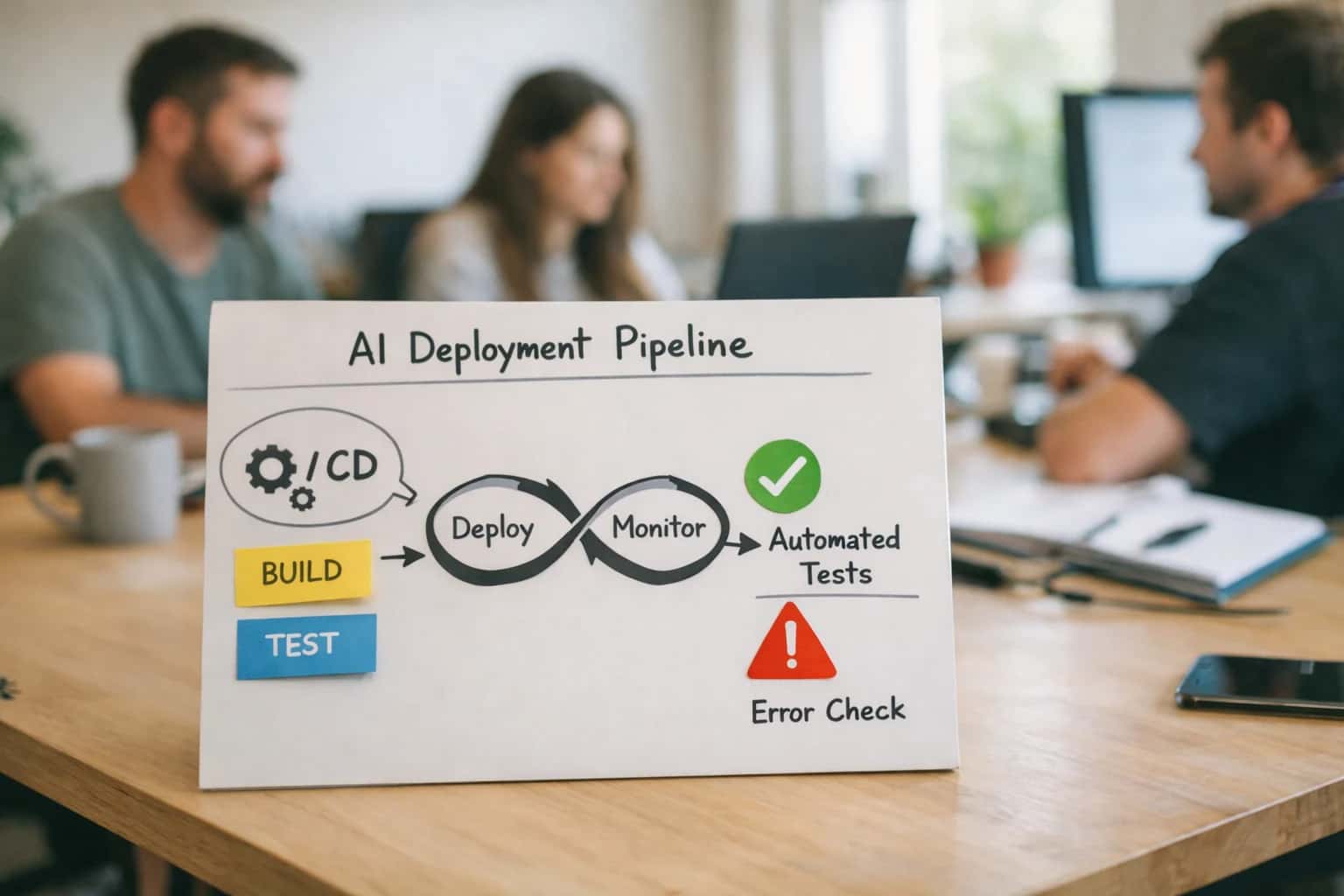
This guide outlines the specialized MLOps practices required for managing the lifecycle of continually learning robot policies.
Your pipeline must integrate key components: a model registry (like Weights & Biases) to version and track skill policies, automated simulation-based regression testing to validate updates, and a continuous deployment system (often using Kubernetes) to roll out policies to robots. Crucially, it must monitor for policy drift in dynamic environments and include robust rollback procedures. This operational backbone is what transforms a research prototype into a reliable production asset. For foundational concepts, see our guide on How to Architect a Few-Shot Learning Pipeline for Industrial Robots.
PIPELINE COMPONENTS
Core Tool Comparison for Robotic MLOps
A comparison of leading tools for managing the specialized MLOps lifecycle of adaptive robotic models, from simulation to fleet deployment.
| Feature / Capability | Weights & Biases (W&B) | MLflow | Kubeflow |
|---|---|---|---|
Robotic Model Registry | |||
Simulation Run Tracking & Logging | Limited (Manual) | ||
Policy Drift Detection for Sensor Data | Via Plugins | ||
Kubernetes-Native Deployment | Via Integrations | Via Plugins | |
Continuous Deployment to Robot Fleet | Via CI/CD | Manual Scripting | Via Pipelines |
Sim-to-Real Experiment Versioning | |||
Integrated Visualization for Trajectories | |||
Cost for 10K Simulation Runs/Month | $500-1,000 | $0 (Self-hosted) | $300-700 (GKE) |
Enabling Efficiency, Speed & Accuracy
Intelligent Analysis, Decision & Execution
We build AI systems for teams that need search across company data, workflow automation across tools, or AI features inside products and internal software.
Talk to Us
Search across company data
Give teams answers from docs, tickets, runbooks, and product data with sources and permissions.
Useful when people spend too long searching or get different answers from different systems.
Enterprise searchRAGPermissions
Read more
Automate internal workflows
Use AI to route work, draft outputs, trigger actions, and keep approvals and logs in place.
Useful when repetitive work moves across multiple tools and teams.
AI agentsWorkflow automationGovernance
Read more
Add AI to products and internal tools
Build assistants, guided actions, or decision support into the software your team or customers already use.
Useful when AI needs to be part of the product, not a separate tool.
AI integrationDecision supportModel routing
Read moreTROUBLESHOOTING
Common Mistakes When Setting Up an MLOps Pipeline for Robotic Models
Deploying continually learning robots introduces unique MLOps challenges. Avoid these common pitfalls to build a reliable, safe, and scalable model lifecycle management system.
This is the sim-to-real gap. The most common mistake is insufficient domain randomization. Your simulation must vary physics parameters (mass, friction), visual textures, and lighting beyond what you think is realistic.
Fix: Implement a structured domain randomization schedule in your simulator (e.g., NVIDIA Isaac Sim). Start with high randomization to learn robust features, then gradually reduce variation in a gradual reality increase phase. Validate using real-world proxy metrics like task completion rate and force signature analysis, not just simulation reward. Learn more about bridging this gap in our guide on Setting Up a Sim-to-Real Transfer Strategy.

About the author
Prasad Kumkar
CEO & MD, Inference Systems
Prasad Kumkar is the CEO & MD of Inference Systems and writes about AI systems architecture, LLM infrastructure, model serving, evaluation, and production deployment. Over 5+ years, he has worked across computer vision models, L5 autonomous vehicle systems, and LLM research, with a focus on taking complex AI ideas into real-world engineering systems.
His work and writing cover AI systems, large language models, AI agents, multimodal systems, autonomous systems, inference optimization, RAG, evaluation, and production AI engineering.
LinkedIn
Limited slotsGet a Free AI Consultation
Partnered with leading AI, data, and software stack.





How We Work
Custom AI workflows for your Business
One-fit-all AI don't work for modern businesses. At Inferensys, we aim to understand your business & custom requirements; which we use to define most efficient agentic workflows, the data, and the tools for your business.
01
Review the use case
We understand the task, the users, and where AI can actually help.
Read more02
Pick the right approach
We define what needs search, automation, or product integration.
Read more03
Build the first useful version
We implement the part that proves the value first.
Read more04
Improve from there
We add the checks and visibility needed to keep it useful.
Read moreThe first call is a practical review of your use case and the right next step.
Talk to Us