A digital watermarking strategy is a cross-functional plan to embed verifiable, tamper-evident signals into all AI-generated content. This moves beyond a technical proof-of-concept to an enterprise-wide governance initiative. The goal is to establish content authenticity and digital provenance, allowing anyone to verify the origin and integrity of media, from marketing images to synthetic video. This is a critical defense against misinformation and IP theft in an AI-saturated landscape.

Guide
Launching a Digital Watermarking Strategy for Enterprise AI
A tactical guide to develop and execute a cross-functional strategy for implementing digital watermarking across all enterprise AI content generators. Covers standard selection, pilot programs, governance, and rollout.
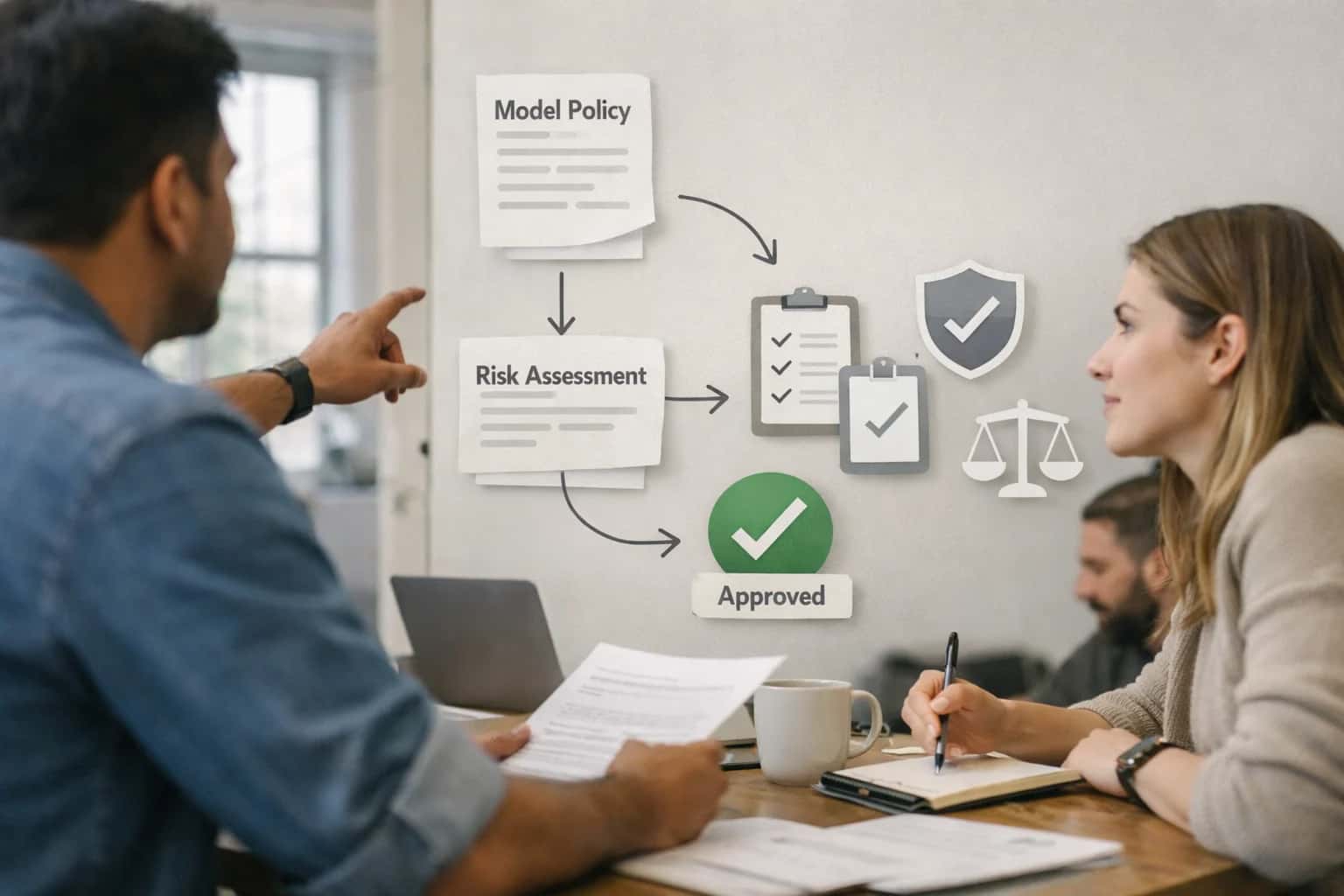
This guide provides a strategic roadmap for implementing digital watermarking across your organization's AI content generators to combat deepfakes and intellectual property theft.
Your strategy must balance security, usability, and cost. Start by selecting an open standard like C2PA to ensure interoperability. Then, pilot the technology with a high-risk, high-visibility team such as Marketing. Concurrently, define governance policies for watermark application and train staff on verification tools. This creates a controlled rollout that delivers measurable security value while building organizational muscle memory for a provenance-aware culture.
STRATEGY FOUNDATION
Key Concepts: Digital Watermarking and Provenance
Before implementing tools, understand the core principles and standards that define a robust enterprise watermarking strategy. These concepts form the technical and governance bedrock.
02
Robustness vs. Fidelity
This is the fundamental trade-off in watermarking design. Robustness refers to a watermark's ability to survive transformations like compression, cropping, or filtering. Fidelity refers to the watermark's imperceptibility and lack of impact on content quality.
- High robustness often requires stronger signal embedding, which can degrade fidelity.
- Enterprise strategy must define acceptable thresholds for each content type (e.g., marketing images vs. internal documents).
- Adversarial attacks specifically test robustness; your strategy must account for them.
03
Provenance vs. Watermarking
These are complementary but distinct concepts. Digital Watermarking is a technique for embedding information into the content signal itself (pixels, audio waves). Provenance is the broader record of origin and history, which can be stored in a watermark or in a separate metadata file (like a C2PA manifest).
- A complete strategy uses both: watermarks for persistent, in-band signals and manifests for rich, queryable metadata.
- Watermarks survive where metadata is stripped; manifests provide more detailed audit trails.
04
Assertion-Based Provenance
Provenance data is built from assertions—machine-readable statements of fact about the content. Common assertions include:
createdBy: The AI model or human author.createdWith: The software tool (e.g.,Adobe Firefly,Stable Diffusion).actions: A chain of edits likecropped,color-adjusted.- Cryptographic hashes of the original asset and each assertion create an immutable chain. This structure enables selective disclosure—you can share only relevant parts of the history while maintaining verifiability.
05
Verification Ecosystem
A watermark is useless without a reliable way to check it. The verification ecosystem includes:
- Browser Extensions & Native OS Tools: For consumer-facing verification (e.g., checking social media images).
- Enterprise APIs: For automated, high-volume verification in content moderation or ingestion pipelines.
- Public Ledgers & Timestamping Services: To provide temporal proof that a watermark existed at a specific time, preventing 'pre-dating' attacks. Your strategy must define which verification channels you will support and promote.
06
Governance & Policy Triggers
Technical implementation must be driven by business policy. Define clear governance rules that trigger specific actions based on provenance data.
- Automated Takedown: Block content lacking a valid watermark from internal distribution channels.
- Usage Rights Enforcement: Allow or restrict content reuse based on licensing assertions in the manifest.
- Audit Compliance: Automatically generate reports for regulators proving content origin and edit history. Policies turn provenance data from a record into an enforceable control.
FOUNDATION
Step 1: Conduct a Risk Assessment and Content Inventory
Before implementing any technology, you must define the scope of your problem. This initial step identifies what needs protection and why, ensuring your strategy targets real business risks.
A risk assessment identifies which AI-generated assets are most vulnerable to misuse, such as deepfakes or IP theft. Start by cataloging all content generators in use—from marketing's image tools to R&D's code assistants. For each, evaluate the potential impact of tampering or misattribution. High-risk outputs, like official corporate communications or product designs, become the priority for your initial watermarking pilot, directly linking technical effort to business value.
Next, perform a content inventory. Audit the volume, format, and distribution channels of AI-generated media. This quantifies the scale of the problem and informs tool selection—high-volume video requires different solutions than low-volume documents. This inventory, combined with your risk analysis, creates a data-driven rollout plan. It ensures you implement standards like C2PA where they matter most, balancing security with usability and cost from day one.
STRATEGY COMPARISON
Rollout Plan: Phased vs. Big Bang Approach
Key differences between a gradual, team-by-team rollout and an enterprise-wide launch of a digital watermarking strategy.
| Feature | Phased Rollout | Big Bang Rollout |
|---|---|---|
Initial Investment | $50-100k (pilot team) | $500k+ (enterprise-wide) |
Time to Full Coverage | 6-12 months | < 1 month |
Operational Risk | Low (contained to pilot) | High (enterprise-wide impact) |
Change Management Load | Gradual, manageable | Intense, requires major training blitz |
Ability to Iterate | ||
Cross-Team Dependency Complexity | Low (sequential integration) | High (simultaneous coordination) |
Executive Visibility & Momentum | Builds gradually with pilot wins | Immediate, high-visibility launch |
Ease of Isolating & Fixing Issues |
OPERATIONALIZING YOUR STRATEGY
Step 5: Build Verification Workflows and Train Staff
A watermarking strategy is only effective if your organization can consistently verify content. This final step focuses on building the operational workflows and training the staff who will use them daily.
Define clear verification workflows that integrate into existing content review and legal processes. For example, marketing teams should verify watermarks on all AI-generated assets before publication using a tool like the C2PA Verify SDK. Legal teams need a process to authenticate disputed content. Build these steps into your Content Management System (CMS) and Digital Asset Management (DAM) platforms to enforce compliance. This creates a systematic defense against deepfakes and IP theft.
Conduct hands-on training for all relevant staff—creators, reviewers, and legal counsel—on using verification tools and interpreting results. Focus on common failure modes, such as how social media compression can degrade watermarks, and the escalation path for unverifiable content. Training transforms policy into practice, ensuring your digital provenance strategy delivers real security. Document these workflows alongside your broader governance policies for audit readiness.
Enabling Efficiency, Speed & Accuracy
Intelligent Analysis, Decision & Execution
We build AI systems for teams that need search across company data, workflow automation across tools, or AI features inside products and internal software.
Talk to Us
Search across company data
Give teams answers from docs, tickets, runbooks, and product data with sources and permissions.
Useful when people spend too long searching or get different answers from different systems.
Enterprise searchRAGPermissions
Read more
Automate internal workflows
Use AI to route work, draft outputs, trigger actions, and keep approvals and logs in place.
Useful when repetitive work moves across multiple tools and teams.
AI agentsWorkflow automationGovernance
Read more
Add AI to products and internal tools
Build assistants, guided actions, or decision support into the software your team or customers already use.
Useful when AI needs to be part of the product, not a separate tool.
AI integrationDecision supportModel routing
Read moreTROUBLESHOOTING
Common Mistakes
Launching an enterprise digital watermarking strategy involves complex technical and organizational decisions. These are the most frequent pitfalls developers and architects encounter, along with clear solutions to ensure your strategy is robust and effective.
This is the classic robustness vs. fidelity trade-off. A fragile watermark embedded in pixel values or low-frequency DCT coefficients will be destroyed by common transformations like JPEG compression, resizing, or cropping.
Solution: Use robust watermarking algorithms designed for AI content. For images, investigate DNN-based watermarking where the watermark is embedded in the feature space of the model itself, making it resilient. For a standardized approach, implement the C2PA specification, which uses cryptographic signatures attached to the asset's manifest, not embedded in pixel data, ensuring the provenance claim survives format changes. Always test your chosen method against a suite of common transformations before deployment.

About the author
Prasad Kumkar
CEO & MD, Inference Systems
Prasad Kumkar is the CEO & MD of Inference Systems and writes about AI systems architecture, LLM infrastructure, model serving, evaluation, and production deployment. Over 5+ years, he has worked across computer vision models, L5 autonomous vehicle systems, and LLM research, with a focus on taking complex AI ideas into real-world engineering systems.
His work and writing cover AI systems, large language models, AI agents, multimodal systems, autonomous systems, inference optimization, RAG, evaluation, and production AI engineering.
LinkedIn
Limited slotsGet a Free AI Consultation
Partnered with leading AI, data, and software stack.





How We Work
Custom AI workflows for your Business
One-fit-all AI don't work for modern businesses. At Inferensys, we aim to understand your business & custom requirements; which we use to define most efficient agentic workflows, the data, and the tools for your business.
01
Review the use case
We understand the task, the users, and where AI can actually help.
Read more02
Pick the right approach
We define what needs search, automation, or product integration.
Read more03
Build the first useful version
We implement the part that proves the value first.
Read more04
Improve from there
We add the checks and visibility needed to keep it useful.
Read moreThe first call is a practical review of your use case and the right next step.
Talk to Us