Real-time occupant and environment awareness uses interior sensors (cameras, microphones, capacitive arrays) and external context (weather, traffic) to create a holistic vehicle state model. This system must perform privacy-preserving activity recognition, detect environmental conditions like fog or rain, and fuse multi-modal data for robustness. The core challenge is building low-latency inference pipelines that trigger personalized responses—such as adjusting climate control or alerting a drowsy driver—without compromising safety or user trust.

Guide
How to Implement AI for Real-Time Occupant and Environment Awareness
A developer guide to building AI systems that use interior and exterior sensors to understand vehicle state, recognize occupant activity, assess environmental conditions, and trigger personalized responses.
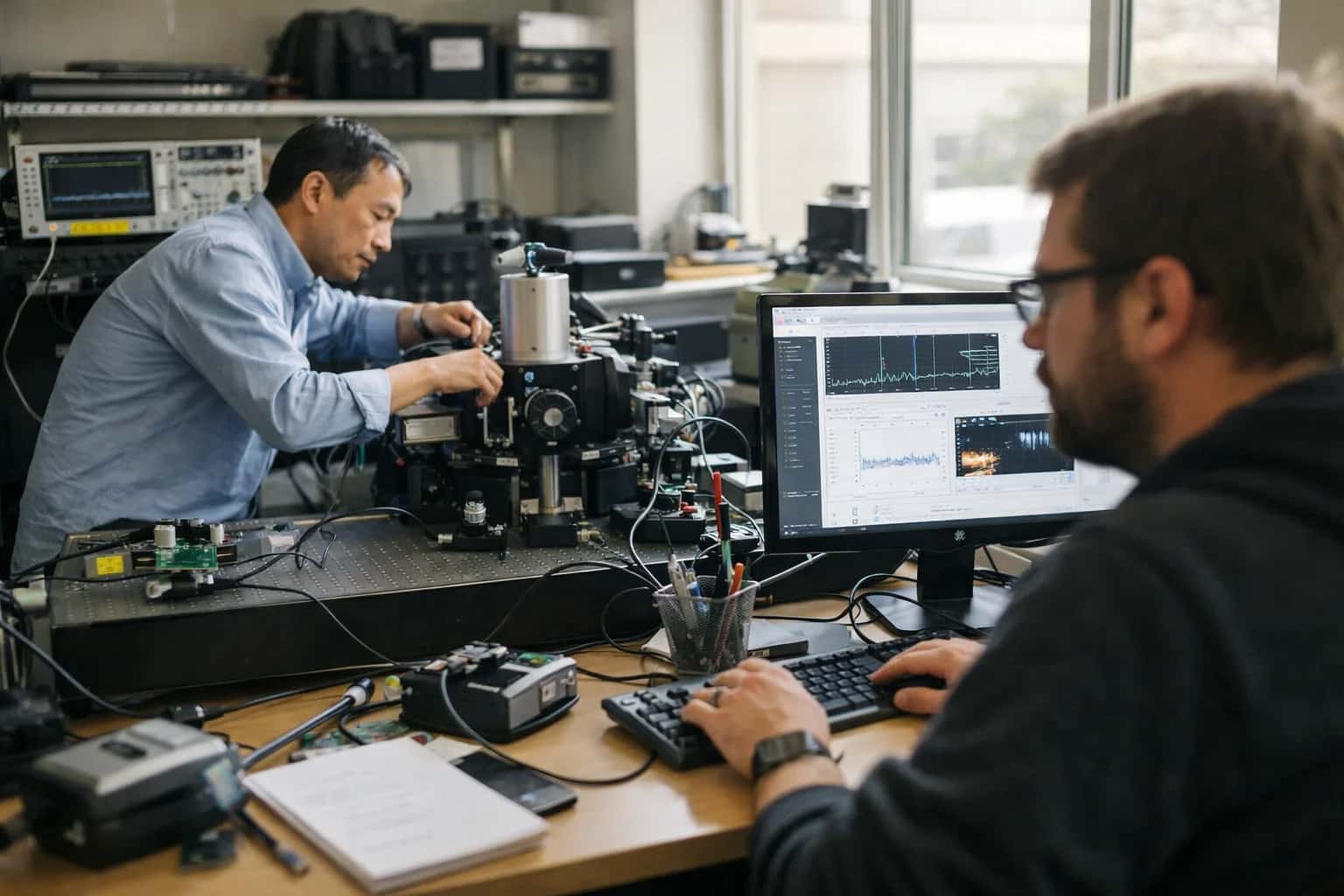
This guide provides a technical foundation for building AI systems that interpret the vehicle's interior and exterior state using sensor data, enabling personalized and safe responses.
Implementation begins by defining the sensor suite and selecting appropriate machine learning models for specific tasks: convolutional networks for visual occupancy, audio classifiers for cabin events, and time-series models for capacitive sensing. You must architect a sensor fusion layer to correlate these disparate signals, manage data flow within a zonal E/E architecture, and implement strict data anonymization at the edge. The final system integrates with vehicle ECUs to enact responses, forming a critical component of context-aware signal sensing for advanced driver-assistance and autonomous features.
INTERIOR SENSING
Sensor and Model Trade-Offs Matrix
This table compares the primary sensor modalities for real-time occupant and environment awareness, evaluating their technical characteristics, model requirements, and implementation trade-offs.
| Feature / Metric | RGB/IR Camera | Capacitive Sensor Array | Microphone Array |
|---|---|---|---|
Primary Detection Method | Visual pattern recognition | Proximity & touch via electric field | Acoustic pattern recognition |
Key Use Cases | Occupant presenceActivity recognitionGaze tracking | Seat occupancySteering wheel gripGesture control | Voice commandsEmotion detectionCabin anomaly detection |
Privacy Risk Level | High | Low | Medium |
Typical Latency | < 100 ms | < 50 ms | < 200 ms |
Model Complexity | High (CNNs, Vision Transformers) | Low to Medium (Classifiers, RNNs) | Medium (Audio Spectrograms, Transformers) |
Data Bandwidth | High (1-10 Mbps) | Low (< 100 Kbps) | Medium (0.5-2 Mbps) |
Robustness to Lighting | |||
Robustness to Occlusion | |||
Fusion Synergy | High with LiDAR/Radar | High with seatbelt sensors | High with vibration sensors |
Enabling Efficiency, Speed & Accuracy
Intelligent Analysis, Decision & Execution
We build AI systems for teams that need search across company data, workflow automation across tools, or AI features inside products and internal software.
Talk to Us
Search across company data
Give teams answers from docs, tickets, runbooks, and product data with sources and permissions.
Useful when people spend too long searching or get different answers from different systems.
Enterprise searchRAGPermissions
Read more
Automate internal workflows
Use AI to route work, draft outputs, trigger actions, and keep approvals and logs in place.
Useful when repetitive work moves across multiple tools and teams.
AI agentsWorkflow automationGovernance
Read more
Add AI to products and internal tools
Build assistants, guided actions, or decision support into the software your team or customers already use.
Useful when AI needs to be part of the product, not a separate tool.
AI integrationDecision supportModel routing
Read moreTROUBLESHOOTING
Common Mistakes
Implementing AI for real-time occupant and environment awareness is a complex integration challenge. These are the most frequent technical pitfalls developers encounter and how to fix them.
Models trained only on well-lit RGB images fail because they lack robustness to environmental variability. The fix is multi-modal sensor fusion.
- Supplement cameras with infrared (IR) or thermal sensors that are invariant to visible light conditions.
- Fuse capacitive or Time-of-Flight (ToF) sensor data to detect presence based on proximity, not just visual features.
- Use data augmentation during training that simulates extreme lighting, fog, or glare to improve generalization.
This approach aligns with building a robust Multi-Modal Sensor Correlation Engine for coherent environmental understanding.

About the author
Prasad Kumkar
CEO & MD, Inference Systems
Prasad Kumkar is the CEO & MD of Inference Systems and writes about AI systems architecture, LLM infrastructure, model serving, evaluation, and production deployment. Over 5+ years, he has worked across computer vision models, L5 autonomous vehicle systems, and LLM research, with a focus on taking complex AI ideas into real-world engineering systems.
His work and writing cover AI systems, large language models, AI agents, multimodal systems, autonomous systems, inference optimization, RAG, evaluation, and production AI engineering.
LinkedIn
Limited slotsGet a Free AI Consultation
Partnered with leading AI, data, and software stack.





How We Work
Custom AI workflows for your Business
One-fit-all AI don't work for modern businesses. At Inferensys, we aim to understand your business & custom requirements; which we use to define most efficient agentic workflows, the data, and the tools for your business.
01
Review the use case
We understand the task, the users, and where AI can actually help.
Read more02
Pick the right approach
We define what needs search, automation, or product integration.
Read more03
Build the first useful version
We implement the part that proves the value first.
Read more04
Improve from there
We add the checks and visibility needed to keep it useful.
Read moreThe first call is a practical review of your use case and the right next step.
Talk to Us