Architecting a multi-camera AI surveillance network requires moving beyond individual camera feeds to a unified perception system. The core challenge is designing a centralized tracking system that can maintain the identity of objects—like people or vehicles—as they move between different camera fields of view. This involves timestamp synchronization across all devices and a network architecture that balances edge computing for real-time detection with a central server for global reasoning and operator dashboards. Learn more about the fundamentals in our guide on Computer Vision Sensing and Dynamic Interpretation.

Guide
How to Architect a Multi-Camera Surveillance Network with AI
A practical guide to designing and deploying a coordinated network of intelligent cameras for real-time monitoring, object tracking, and centralized oversight.
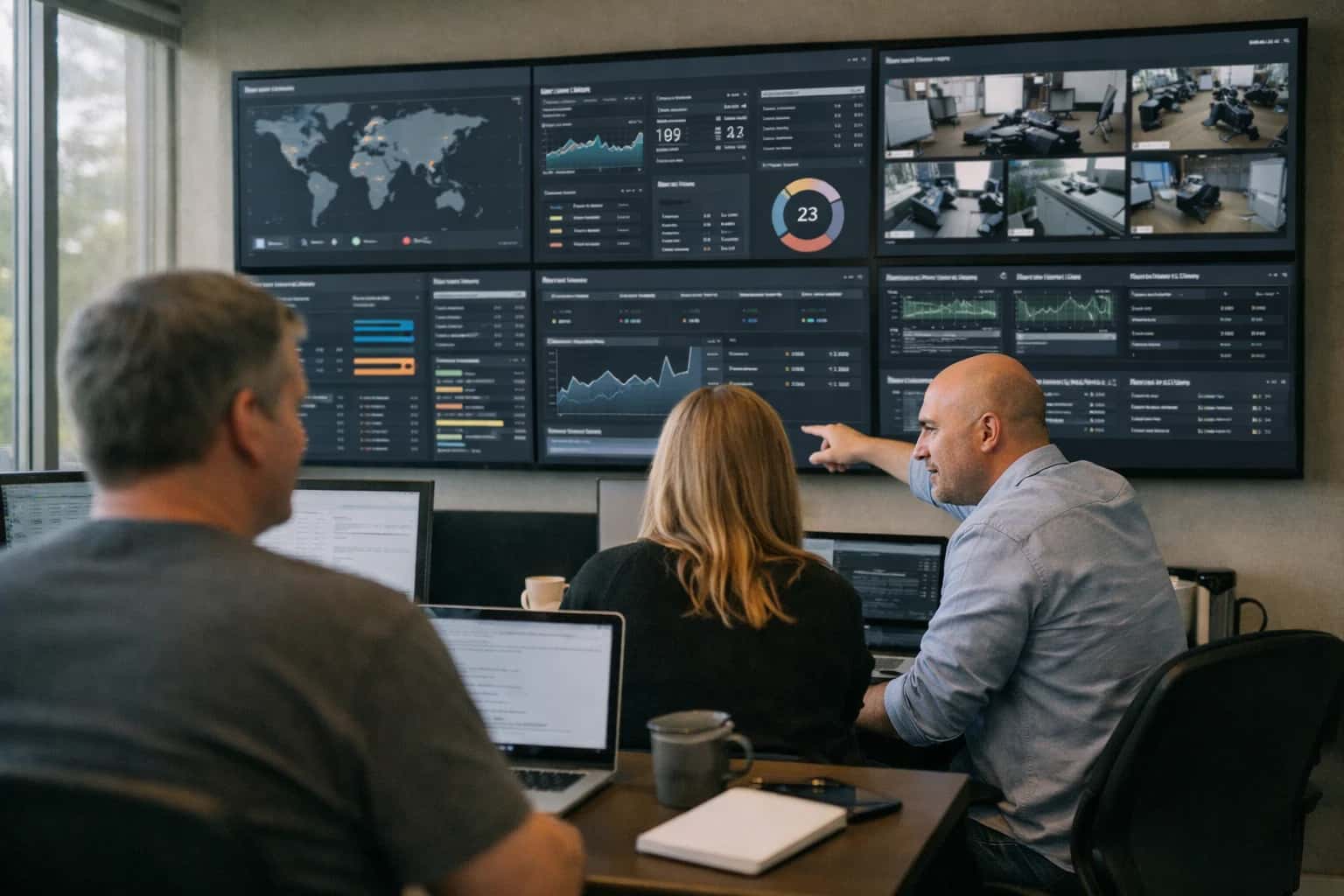
This guide provides the framework for designing a coordinated network of intelligent cameras, covering camera placement, synchronization, and centralized tracking.
Successful deployment hinges on practical planning. Start by conducting a site survey to determine camera placement for optimal coverage with minimal blind spots. Next, provision your network with sufficient bandwidth planning to handle multiple high-resolution streams. Deploy edge devices like NVIDIA Jetson or Google Coral to run initial object detection, reducing latency and bandwidth. Finally, implement a central command system that aggregates data, performs cross-camera hand-offs, and provides a unified interface for operators. For related infrastructure, see our guide on How to Architect a Low-Latency Video Inference Pipeline.
ARCHITECTURE FOUNDATIONS
Key Concepts
Building a multi-camera AI surveillance network requires a layered approach. Master these core concepts to design a system that is scalable, reliable, and intelligent.
02
Camera Placement & Field of View (FoV) Planning
Effective coverage is a geometric and strategic problem. You must avoid blind spots while minimizing redundant views. Key techniques include:
- Overlap Zones: Designate areas where camera FoVs overlap by 15-30%. This is critical for handoff tracking, allowing the system to maintain object identity as it moves between cameras.
- Height and Angle: Mount cameras at optimal heights to balance detail (for facial/object recognition) and coverage area.
- PTZ Logic: Program Pan-Tilt-Zoom (PTZ) cameras to automatically focus on areas of interest flagged by fixed cameras, creating a dynamic, responsive network.
04
Network Bandwidth & Storage Planning
Unplanned network costs can cripple a project. You must calculate the data load:
- Raw Streams: A 1080p camera at 30 FPS can generate ~4 Mbps. For 100 cameras, that's 400 Mbps continuously.
- Processed Streams: After edge AI filtering, you may only send metadata (JSON) and triggered video clips, reducing bandwidth by over 90%.
- Storage Tiers: Implement a multi-tier strategy: keep high-resolution clips for 30 days on fast storage for investigation, and lower-resolution continuous footage for 90 days on cold storage for audit. Use H.265 encoding to reduce file sizes.
05
Command Dashboard & Alerting
The human interface must translate AI insights into actionable intelligence. A central dashboard should:
- Display a unified map with live camera feeds and tracked object trails.
- Aggregate alerts from rule-based triggers (e.g., "person in restricted area") and anomaly detection.
- Provide forensic tools for searching events by time, location, or object type. Integrate with notification systems (Slack, PagerDuty) and ensure the UI is designed for high-stress, rapid decision-making by security operators.
06
System Synchronization & Health Monitoring
A distributed system requires robust operational oversight.
- Time Synchronization: Use Precision Time Protocol (PTP) for sub-millisecond clock alignment across all cameras and servers. This is non-negotiable for accurate tracking handoffs.
- Health Checks: Implement heartbeat monitoring for every camera and edge node. The system must detect failures (e.g., defocused lens, network drop) and alert operators.
- Model Drift Monitoring: Continuously evaluate the performance of your deployed AI models using a shadow mode or canary deployment strategy to detect accuracy degradation over time, a core concept in MLOps for agentic systems.
FOUNDATIONAL PLANNING
Step 1: Define Surveillance Objectives and Coverage Zones
The first and most critical step in architecting a multi-camera surveillance network is to clearly define what you need to see and where. This establishes the technical requirements for your entire AI system.
Start by defining your surveillance objectives. Are you monitoring for perimeter intrusion, tracking foot traffic flow, or detecting specific behaviors like loitering? Each objective dictates the required computer vision models—object detection, person re-identification, or action recognition—and the performance metrics for accuracy and latency. This clarity prevents over-engineering and ensures your AI agents are tasked with relevant, actionable inference. For related infrastructure planning, see our guide on How to Architect a Low-Latency Video Inference Pipeline.
Next, map your coverage zones. Physically audit the site to identify blind spots, occlusion risks, and optimal mounting points. Use camera field-of-view calculators to determine the type (e.g., PTZ, fixed, fisheye) and quantity of cameras needed for complete coverage. This zone mapping directly informs your network's multi-object tracking logic, defining where handoffs between camera views must occur. A well-defined zone plan is the blueprint for your entire Computer Vision Sensing and Dynamic Interpretation system.
ARCHITECTURE DECISION
Edge vs. Cloud Compute Comparison
A critical trade-off analysis for processing AI video analytics in a multi-camera surveillance network.
| Feature / Metric | Edge Compute | Cloud Compute | Hybrid (Edge + Cloud) |
|---|---|---|---|
Latency | < 100 ms | 200-2000 ms | < 100 ms (critical), 200-2000 ms (non-critical) |
Bandwidth Consumption | Low (metadata only) | High (raw video stream) | Medium (metadata + selective video) |
Upfront Hardware Cost | $500-$5,000 per node | $0 (OpEx) | $500-$5,000 per node + OpEx |
Operational Cost (OpEx) | Low (power) | High (egress, compute) | Medium (power + selective cloud) |
Privacy & Data Sovereignty | |||
Scalability (Adding Cameras) | Linear (add edge nodes) | Elastic (auto-scale) | Elastic for analytics, linear for ingestion |
Model Update & Management | Complex (OTA updates) | Simple (centralized) | Moderate (centralized control, distributed deployment) |
Resilience to Network Outage |
Enabling Efficiency, Speed & Accuracy
Intelligent Analysis, Decision & Execution
We build AI systems for teams that need search across company data, workflow automation across tools, or AI features inside products and internal software.
Talk to Us
Search across company data
Give teams answers from docs, tickets, runbooks, and product data with sources and permissions.
Useful when people spend too long searching or get different answers from different systems.
Enterprise searchRAGPermissions
Read more
Automate internal workflows
Use AI to route work, draft outputs, trigger actions, and keep approvals and logs in place.
Useful when repetitive work moves across multiple tools and teams.
AI agentsWorkflow automationGovernance
Read more
Add AI to products and internal tools
Build assistants, guided actions, or decision support into the software your team or customers already use.
Useful when AI needs to be part of the product, not a separate tool.
AI integrationDecision supportModel routing
Read moreTROUBLESHOOTING
Common Mistakes
Architecting a multi-camera AI surveillance network involves complex interdependencies. These are the most frequent technical pitfalls developers encounter and how to fix them.
This is a camera handoff failure, typically caused by poor spatial calibration and inconsistent feature re-identification (Re-ID).
The Fix:
- Calibrate a Unified Coordinate System: Use camera calibration to map all camera views to a common real-world floor plan. This allows the system to predict an object's path from one camera's exit point to another's entry point.
- Implement a Strong Re-ID Model: Don't rely solely on bounding box color. Use a dedicated Re-ID model (like OSNet) trained on cropped person/vehicle images to generate robust feature embeddings that persist across different angles and lighting.
- Use a Central Tracker: Implement a centralized multi-camera tracker (e.g., using a tool like NVIDIA DeepStream or OpenVINO) that maintains global track IDs, fusing detections from all streams, rather than having each camera track independently.
For foundational tracking concepts, see our guide on Setting Up a Dynamic Object Tracking System for Logistics.

About the author
Prasad Kumkar
CEO & MD, Inference Systems
Prasad Kumkar is the CEO & MD of Inference Systems and writes about AI systems architecture, LLM infrastructure, model serving, evaluation, and production deployment. Over 5+ years, he has worked across computer vision models, L5 autonomous vehicle systems, and LLM research, with a focus on taking complex AI ideas into real-world engineering systems.
His work and writing cover AI systems, large language models, AI agents, multimodal systems, autonomous systems, inference optimization, RAG, evaluation, and production AI engineering.
LinkedIn
Limited slotsGet a Free AI Consultation
Partnered with leading AI, data, and software stack.





How We Work
Custom AI workflows for your Business
One-fit-all AI don't work for modern businesses. At Inferensys, we aim to understand your business & custom requirements; which we use to define most efficient agentic workflows, the data, and the tools for your business.
01
Review the use case
We understand the task, the users, and where AI can actually help.
Read more02
Pick the right approach
We define what needs search, automation, or product integration.
Read more03
Build the first useful version
We implement the part that proves the value first.
Read more04
Improve from there
We add the checks and visibility needed to keep it useful.
Read moreThe first call is a practical review of your use case and the right next step.
Talk to Us