An intelligent data summarization layer is a Retrieval-Augmented Generation (RAG) system that automates the extraction of key insights from dense reports, logs, or intelligence feeds. The core workflow involves three steps: chunking source documents into manageable segments, embedding those chunks into numerical vectors using a model like text-embedding-3-small, and storing them in a vector database. When a summary is requested, the system retrieves the most relevant chunks based on a semantic search of the query and passes them as context to a Large Language Model (LLM) like GPT-4. This architecture grounds the summary in your specific data, preventing hallucinations and ensuring factual accuracy.

Guide
How to Set Up an Intelligent Data Summarization Layer for Reports
A step-by-step technical guide to implementing a Retrieval-Augmented Generation (RAG) system that automatically generates concise, actionable summaries from lengthy reports, logs, and intelligence feeds.
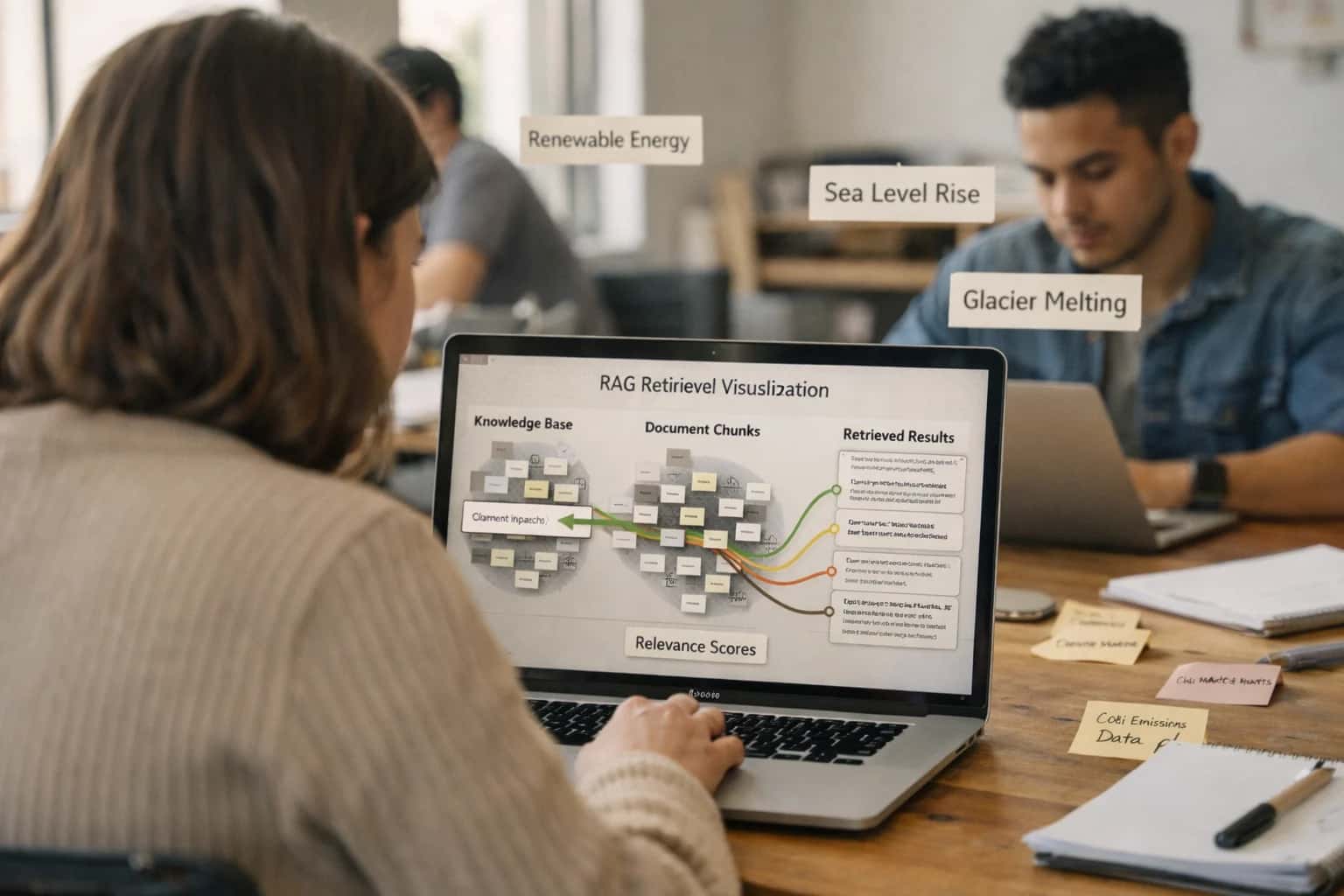
Learn to build a Retrieval-Augmented Generation (RAG) system that automatically generates concise, role-specific summaries from lengthy documents, saving hours of manual review.
To implement this, you must first define stakeholder personas (e.g., executive, analyst) and tailor summary prompts for each. Use libraries like LangChain or LlamaIndex to orchestrate the chunking, embedding, and retrieval pipeline. Integrate the system with your document repositories via APIs. Finally, implement a feedback mechanism where users can rate summary quality; this data is crucial for fine-tuning prompts and improving relevance scoring. This system directly reduces cognitive load by transforming information overload into actionable intelligence, a core tenet of our Cognitive Load Reduction for Human Operators pillar. For related architectures, see our guide on How to Architect an AI-Powered Information Filtering System.
ARCHITECTURE PRIMER
Key Concepts: How RAG Powers Summarization
Retrieval-Augmented Generation (RAG) transforms raw data into actionable insights by grounding an LLM in your specific documents. This layer is the core of an intelligent summarization system.
01
Document Chunking Strategies
Effective summarization starts with intelligent document segmentation. You must split long reports into semantically coherent chunks for retrieval.
- Semantic Chunking: Use models like
sentence-transformersto split at natural topic boundaries, not just fixed character counts. - Overlap Windows: Maintain a 10-15% token overlap between chunks to preserve context across boundaries.
- Metadata Embedding: Attach source, author, and timestamp to each chunk for traceable citations in the final summary. Poor chunking is the most common cause of hallucinated or incomplete summaries.
02
Vector Embedding & Indexing
Convert text chunks into numerical vectors for similarity search. This creates the 'memory' your RAG system queries.
- Model Selection: Use dedicated embedding models like OpenAI's
text-embedding-3-smallor open-source alternatives likeBAAI/bge-small-en-v1.5. - Indexing: Store vectors in a dedicated database like Pinecone, Weaviate, or pgvector for PostgreSQL. Indexing enables sub-second retrieval from millions of documents.
- Hybrid Search: Combine vector similarity with keyword (BM25) filters for precision when dealing with specific names or codes.
03
The Retrieval & Rerank Step
The system fetches the most relevant chunks before summarization. This step determines the factual grounding of your output.
- Top-K Retrieval: First, fetch a broad set of candidate chunks (e.g., top 20) based on vector similarity.
- Reranking: Use a cross-encoder model (like
BAAI/bge-reranker-base) to precisely reorder the top candidates by relevance to the query. This improves accuracy by 20-30%. - Query Expansion: Reformulate the user's request (e.g., 'Summarize this report') into multiple search queries to cover different aspects.
04
LLM Prompt Engineering for Summaries
The final LLM call synthesizes retrieved chunks into a concise summary. The prompt dictates the format, tone, and focus.
- Structured Instructions: Use system prompts that define the stakeholder role (e.g., 'You are an analyst creating an executive summary for a CTO').
- Citation Enforcement: Instruct the model to base every claim on the provided context and use
[Source: Doc1, Page 3]notation. - Length Control: Use token limits and directives like 'In 3 bullet points...' to enforce brevity.
Example prompt:
Based ONLY on the following context, produce a 5-sentence summary for a financial auditor. Cite your sources.
05
Evaluation & Continuous Improvement
Deploying RAG is not a one-time task. You must measure quality and create feedback loops.
- Automated Metrics: Track Retrieval Precision (are the right chunks fetched?) and Faithfulness (does the summary match the source?).
- Human-in-the-Loop (HITL) Sampling: Regularly sample summaries for human review. Log corrections to fine-tune retrieval or prompt logic.
- A/B Testing: Run experiments comparing different chunking strategies or LLM providers (e.g., GPT-4 vs. Claude 3) on key quality dimensions.
06
Tools & Frameworks to Implement
Use these established tools to build your summarization layer faster.
- LlamaIndex: High-level framework for connecting data sources to LLMs with built-in chunking and retrieval abstractions.
- LangChain: For more customizable pipeline orchestration, agentic control flow, and integration with hundreds of tools.
- Haystack (by deepset): Open-source framework focused on production-ready, scalable document search and question answering. Start with a prototype using LlamaIndex, then migrate to a custom LangChain pipeline for fine-grained control in production.
FOUNDATION
Step 1: Design the System Architecture
A robust architecture is the foundation of any intelligent summarization system. This step defines the core components and data flow required to process documents and generate actionable insights.
Your architecture must define three core layers: an ingestion pipeline for document processing, a vector knowledge base for semantic search, and an orchestration layer for summarization logic. The ingestion layer uses a text splitter to chunk lengthy reports into manageable segments. These chunks are then converted into vector embeddings using a model like OpenAI's text-embedding-3-small and stored in a dedicated vector database such as Pinecone or Weaviate. This creates the retrievable knowledge foundation for your Retrieval-Augmented Generation (RAG) system.
The orchestration layer, built with a framework like LangChain or LlamaIndex, manages the summarization workflow. It queries the vector store for the most relevant document chunks based on a user's request, formats this context, and instructs a Large Language Model (LLM) to generate a concise summary. Crucially, you must design for different stakeholder roles by implementing prompt templates that tailor output for executives, analysts, or field operators. This ensures the summary delivers the right information density and focus.
CORE COMPONENTS
Tool Comparison: Embedding Models and Vector Databases
Selecting the right embedding model and vector database is critical for building a performant and cost-effective Retrieval-Augmented Generation (RAG) system. This table compares popular options based on key technical and operational criteria.
| Feature / Metric | OpenAI text-embedding-3 | Cohere Embed v3 | Open-Source (e.g., BGE) | Pinecone | Weaviate | pgvector |
|---|---|---|---|---|---|---|
Primary Use Case | General-purpose API-based embeddings | Domain-tuned embeddings (e.g., multilingual) | Full control, data privacy, cost avoidance | Managed, high-performance vector search | Vector search with built-in hybrid capabilities | Vector search within existing PostgreSQL |
Pricing Model | Per-token usage | Per-token usage | Free (self-hosted compute cost) | Pod-based subscription | Hybrid (cloud/self-hosted) | Free (within database cost) |
Max Embedding Dimensions | Up to 3072 | Up to 1024 | Typically 384-1024 | Supports up to 20k | Supports up to 65k | Supports up to 2000 (standard) |
Metadata Filtering | ||||||
Hybrid Search (Keyword + Vector) | Requires external setup | Requires external setup | ||||
Self-Hosting / On-Premises | ||||||
Typical Latency (p95) | < 100 ms | < 150 ms | Varies (50-500 ms) | < 50 ms | < 100 ms |
|
Ease of Integration | Very High (simple API) | High (simple API) | Medium (model serving infra) | Very High (managed service) | High (managed or self-hosted) | High (if using Postgres) |
Enabling Efficiency, Speed & Accuracy
Intelligent Analysis, Decision & Execution
We build AI systems for teams that need search across company data, workflow automation across tools, or AI features inside products and internal software.
Talk to Us
Search across company data
Give teams answers from docs, tickets, runbooks, and product data with sources and permissions.
Useful when people spend too long searching or get different answers from different systems.
Enterprise searchRAGPermissions
Read more
Automate internal workflows
Use AI to route work, draft outputs, trigger actions, and keep approvals and logs in place.
Useful when repetitive work moves across multiple tools and teams.
AI agentsWorkflow automationGovernance
Read more
Add AI to products and internal tools
Build assistants, guided actions, or decision support into the software your team or customers already use.
Useful when AI needs to be part of the product, not a separate tool.
AI integrationDecision supportModel routing
Read moreTROUBLESHOOTING
Common Mistakes
Setting up an intelligent summarization layer is more than just connecting an LLM to a vector database. These are the most frequent technical pitfalls developers encounter and how to fix them.
This is the cardinal sin of a poorly implemented Retrieval-Augmented Generation (RAG) system. It happens when the retrieved context is insufficient or irrelevant.
The root cause is usually in the retrieval step, not the LLM.
How to fix it:
- Improve chunking: Don't just split by character count. Use semantic chunking with libraries like
langchain.text_splitter.RecursiveCharacterTextSplitteror structure-aware splitters for PDFs/HTML. - Enhance retrieval: Use hybrid search combining dense vector search (for semantic meaning) with sparse keyword search (for precise term matching).
- Add metadata filtering: Tag chunks with source, document type, or date. Filter retrieval to the most relevant subsets before sending to the LLM.
- Implement re-ranking: Use a cross-encoder model (e.g.,
BAAI/bge-reranker-large) to re-score the topkretrieved chunks for better relevance.
Read our guide on Agentic Retrieval-Augmented Generation (RAG) for advanced techniques.

About the author
Prasad Kumkar
CEO & MD, Inference Systems
Prasad Kumkar is the CEO & MD of Inference Systems and writes about AI systems architecture, LLM infrastructure, model serving, evaluation, and production deployment. Over 5+ years, he has worked across computer vision models, L5 autonomous vehicle systems, and LLM research, with a focus on taking complex AI ideas into real-world engineering systems.
His work and writing cover AI systems, large language models, AI agents, multimodal systems, autonomous systems, inference optimization, RAG, evaluation, and production AI engineering.
LinkedIn
Limited slotsGet a Free AI Consultation
Partnered with leading AI, data, and software stack.





How We Work
Custom AI workflows for your Business
One-fit-all AI don't work for modern businesses. At Inferensys, we aim to understand your business & custom requirements; which we use to define most efficient agentic workflows, the data, and the tools for your business.
01
Review the use case
We understand the task, the users, and where AI can actually help.
Read more02
Pick the right approach
We define what needs search, automation, or product integration.
Read more03
Build the first useful version
We implement the part that proves the value first.
Read more04
Improve from there
We add the checks and visibility needed to keep it useful.
Read moreThe first call is a practical review of your use case and the right next step.
Talk to Us