An observability layer for AI-generated code is a system that collects telemetry data—traces, metrics, and logs—specifically from AI coding agents and their outputs. Unlike standard application monitoring, it must track intent drift (where generated code diverges from user requirements), model performance, and the quality of AI suggestions over time. This foundation is critical for moving from experimental vibe coding to reliable, production-grade AI-native development, as detailed in our guide on How to Architect an AI-Native Development Platform.

Guide
Setting Up an Observability Layer for AI-Generated Code
A practical guide to instrumenting, tracing, and monitoring AI-generated software components in production using OpenTelemetry and custom metrics.
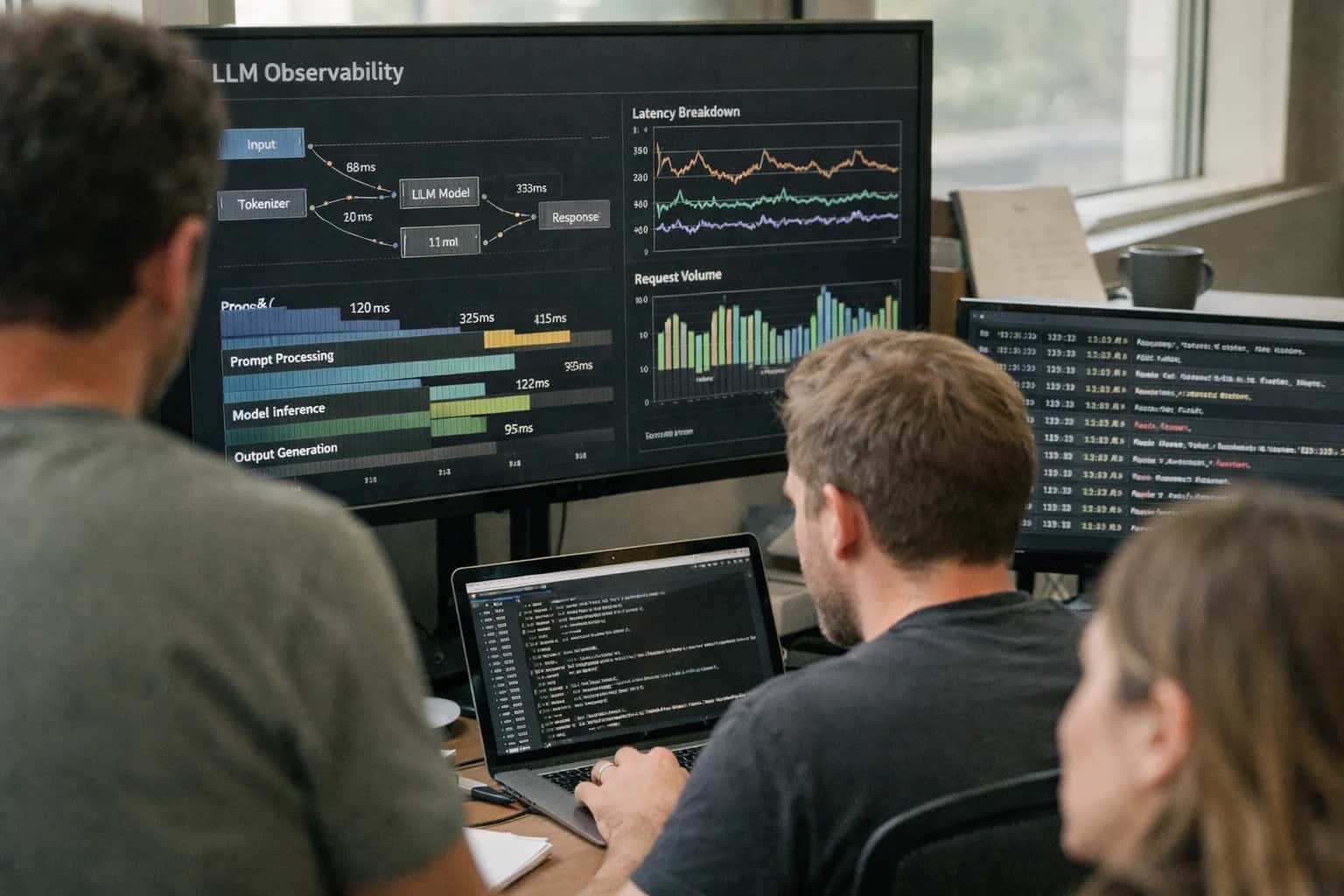
Observability for AI-generated code moves beyond traditional monitoring to track the unique behaviors and failure modes of AI-assisted development.
To implement this, you instrument your AI development platform using standards like OpenTelemetry. Key steps include creating custom spans for AI actions (e.g., code_generation, context_retrieval), logging prompt-response pairs, and emitting metrics for acceptance rates and error patterns. This data feeds dashboards and alerts, enabling teams to detect anomalous behavior—like a sudden drop in code quality—and correlate it with model updates or context changes, ensuring governance and performance.
OBSERVABILITY FOCUS
Core AI Code Generation Metrics
Key performance and quality indicators to instrument when monitoring AI-generated code in production.
| Metric | Purpose | Measurement Method | Target / Alert Threshold |
|---|---|---|---|
Hallucination Rate | Measures frequency of fabricated or nonsensical code | Static analysis & human review sampling | < 2% of generated functions |
Compilation Success Rate | Tracks if generated code compiles without syntax errors | Automated build system integration |
|
Test Pass Rate | Measures functional correctness against unit tests | CI/CD pipeline test execution |
|
Security Vulnerability Rate | Tracks introduction of known CVEs or unsafe patterns | SAST tool integration (e.g., Semgrep, Snyk) | 0 Critical/High severity issues |
Cognitive Complexity Drift | Monitors trend toward unmaintainably complex code | Automated analysis with tools like CodeClimate | < 15% increase per sprint |
Context Adherence Score | Evaluates how well code matches the original user intent/prompt | Semantic similarity analysis & manual audit |
|
Generation Latency (P95) | Measures time from prompt to complete code snippet | Application Performance Monitoring (APM) tracing | < 5 seconds |
Human Edit Distance | Quantifies manual changes required to make code production-ready | Diff analysis between AI output and final merged code | Median < 10% line changes |
IMPLEMENTATION
Step 2: Instrument with OpenTelemetry
This step integrates OpenTelemetry to create a unified, vendor-agnostic observability layer for monitoring AI-generated code in production.
OpenTelemetry (OTel) is the open-source standard for generating, collecting, and exporting telemetry data—traces, metrics, and logs. Instrumenting your AI-native platform with OTel provides a single pane of glass for monitoring the performance and health of AI-generated components. You instrument key points in your natural language to code pipeline, such as the intent interpreter, model inference calls, and code validation steps. This creates detailed traces that map the entire journey from user prompt to deployed artifact, which is critical for our guide on Setting Up Governance for AI-Generated Code.
Start by adding the OTel SDK to your application. For a Python-based service, you would instrument a model call to trace latency and capture errors. Use the @trace decorator to wrap your LLM invocation function. Export these traces to a backend like Jaeger or an APM tool. This foundational data allows you to set alerts for anomalous behavior, such as a spike in generation latency or an increase in validation failures, directly supporting the objectives outlined in How to Measure Productivity in an AI-Native Dev Workflow.
Enabling Efficiency, Speed & Accuracy
Intelligent Analysis, Decision & Execution
We build AI systems for teams that need search across company data, workflow automation across tools, or AI features inside products and internal software.
Talk to Us
Search across company data
Give teams answers from docs, tickets, runbooks, and product data with sources and permissions.
Useful when people spend too long searching or get different answers from different systems.
Enterprise searchRAGPermissions
Read more
Automate internal workflows
Use AI to route work, draft outputs, trigger actions, and keep approvals and logs in place.
Useful when repetitive work moves across multiple tools and teams.
AI agentsWorkflow automationGovernance
Read more
Add AI to products and internal tools
Build assistants, guided actions, or decision support into the software your team or customers already use.
Useful when AI needs to be part of the product, not a separate tool.
AI integrationDecision supportModel routing
Read moreTROUBLESHOOTING
Common Mistakes
When instrumenting AI-generated code, developers often stumble on the same pitfalls. This section addresses the most frequent errors, from missing context to misconfigured alerts, and provides clear fixes.
The most common mistake is logging only the final output of an AI code generator without capturing the reasoning context. This creates opaque telemetry that's useless for debugging.
Fix: Instrument the entire generation pipeline. For every AI-generated code block, create a span that includes:
- The original user prompt or intent
- The specific model and parameters used
- The retrieved context (e.g., relevant files from the RAG index)
- The full chain-of-thought reasoning, if available
python# Example OpenTelemetry span attributes for an AI code action span.set_attributes({ "ai.action": "generate_function", "ai.model": "claude-3-5-sonnet", "ai.user_intent": "Create a secure login endpoint", "ai.context_files": ["auth_schema.json", "user_model.py"], "ai.reasoning_trace_id": trace_id # Link to a separate trace of the LLM's reasoning steps })
Without this, you cannot distinguish between a model hallucination and a correct response to a flawed prompt.

About the author
Prasad Kumkar
CEO & MD, Inference Systems
Prasad Kumkar is the CEO & MD of Inference Systems and writes about AI systems architecture, LLM infrastructure, model serving, evaluation, and production deployment. Over 5+ years, he has worked across computer vision models, L5 autonomous vehicle systems, and LLM research, with a focus on taking complex AI ideas into real-world engineering systems.
His work and writing cover AI systems, large language models, AI agents, multimodal systems, autonomous systems, inference optimization, RAG, evaluation, and production AI engineering.
LinkedIn
Limited slotsGet a Free AI Consultation
Partnered with leading AI, data, and software stack.





How We Work
Custom AI workflows for your Business
One-fit-all AI don't work for modern businesses. At Inferensys, we aim to understand your business & custom requirements; which we use to define most efficient agentic workflows, the data, and the tools for your business.
01
Review the use case
We understand the task, the users, and where AI can actually help.
Read more02
Pick the right approach
We define what needs search, automation, or product integration.
Read more03
Build the first useful version
We implement the part that proves the value first.
Read more04
Improve from there
We add the checks and visibility needed to keep it useful.
Read moreThe first call is a practical review of your use case and the right next step.
Talk to Us