An AI Content Incident Response Plan is a predefined protocol for rapidly containing and correcting AI-generated content failures, such as viral misinformation, brand-damaging outputs, or severe hallucinations. Unlike traditional IT incident response, this plan must address the unique challenges of generative AI, where errors are probabilistic and can propagate instantly across platforms. The core objective is to minimize reputational damage and legal exposure by having clear roles, communication channels, and technical containment steps ready before an incident occurs.

Guide
Launching an AI Content Incident Response Plan
A technical guide to building a rapid-response playbook for AI-generated content failures, including viral misinformation and brand-damaging outputs. Learn to define severity levels, assemble a response team, and implement containment protocols.
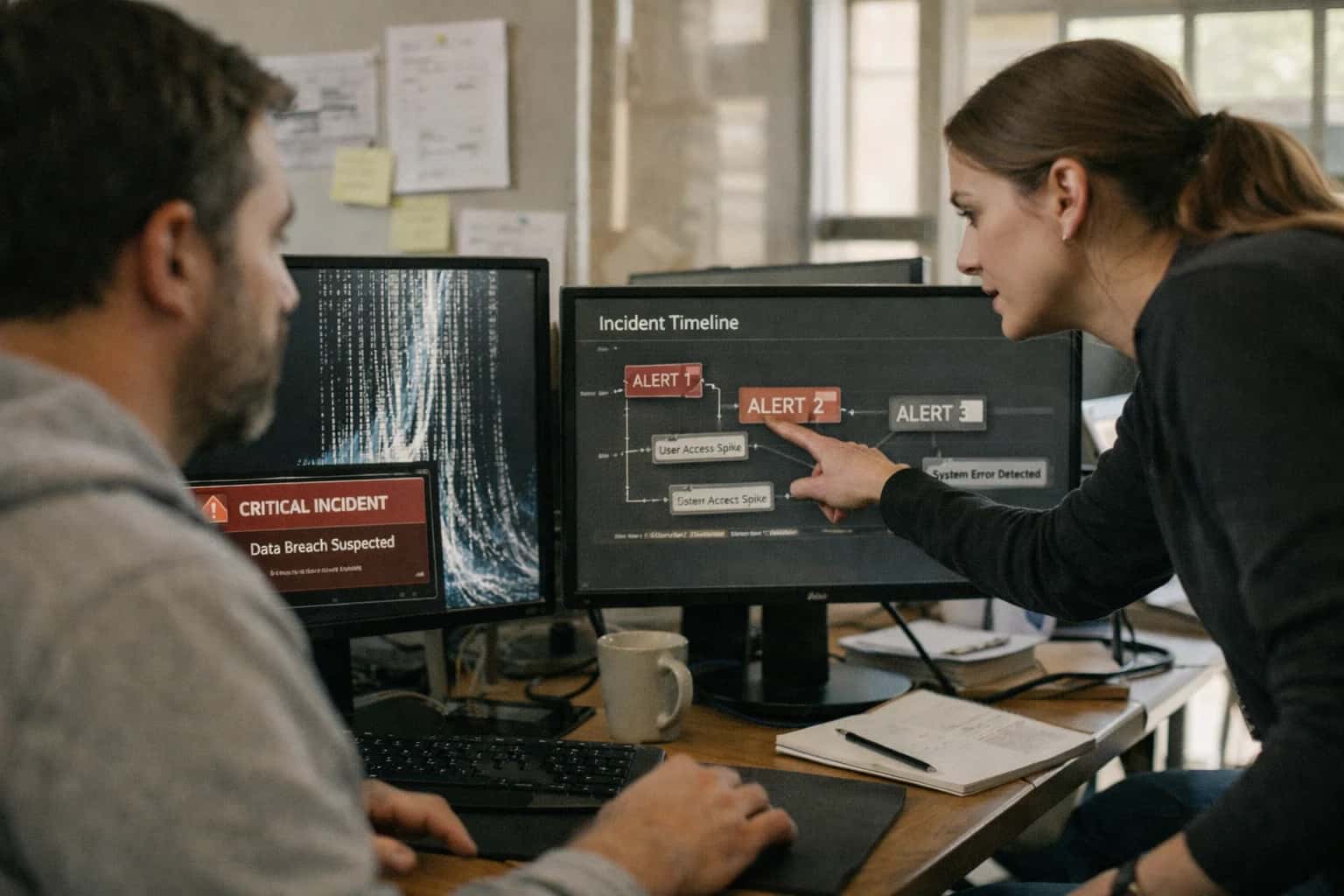
When AI-generated content fails, the damage spreads at digital speed. This guide provides the framework to respond decisively.
This guide will walk you through the critical steps: defining incident severity levels, assembling a cross-functional response team, establishing communication protocols, and conducting root-cause analysis. You'll learn to create a practical playbook that moves your organization from reactive panic to controlled, systematic response. This is not a theoretical exercise—it's an operational necessity for any team scaling AI-assisted content creation.
INCIDENT RESPONSE
Key Concepts: The Anatomy of an AI Content Incident
To launch an effective response plan, you must first understand the core components of an AI content failure. This breakdown defines the essential elements you'll need to identify and manage.
01
The Trigger Event
This is the initial failure that activates your response plan. Triggers are not always obvious and require clear detection mechanisms.
- Examples: A model hallucinates a false product claim that goes viral, an AI-generated social post violates brand safety, or a customer support agent provides harmful advice.
- Detection: Implement real-time monitoring for anomalies in content sentiment, factuality scores, or user engagement spikes.
02
Severity Classification
Not all incidents are equal. A clear severity framework dictates resource allocation and response speed.
- Tier 1 (Critical): Legal/regulatory violation, significant brand damage, or threat to human safety. Requires immediate, full-team response.
- Tier 2 (Major): Widespread misinformation or customer trust erosion. Respond within hours.
- Tier 3 (Minor): Isolated factual error or tone mismatch. Resolve within a business day. Define these tiers in your playbook with specific, measurable criteria.
03
The Response Team (SWAT)
A pre-defined, cross-functional team is mobilized based on incident severity. Roles must be assigned before an incident occurs.
- Technical Lead: Isolates the faulty model or pipeline.
- Comms/PR Lead: Manages external and internal messaging.
- Legal/Compliance Lead: Assesses regulatory exposure.
- Product/Content Owner: Authorizes corrections and updates. Run tabletop exercises to ensure this team can assemble and act within minutes.
04
Containment & Takedown
The immediate action to stop the incident from spreading. This is a technical and operational process.
- Technical Isolation: Deactivate the specific model endpoint, revert to a previous model version, or disable the automated workflow.
- Content Removal: Takedown live content from websites, social platforms, and syndication channels. Use API integrations for speed.
- Communication Freeze: Halt all scheduled AI-generated content until the root cause is understood.
05
Root Cause Analysis (RCA)
Investigating why the incident happened is critical to prevent recurrence. Move beyond the surface symptom.
- Analyze the Audit Trail: Examine the prompt, model version, source data, and any fine-tuning parameters that led to the output.
- Check Data Integrity: Was the model operating on corrupted, outdated, or biased training data?
- Review Guardrails: Did your content moderation or fact-checking pipelines fail? Were confidence thresholds set too low? Document findings in a blameless post-mortem.
06
Correction & Communication
How you fix the error and communicate about it defines long-term trust. This phase runs parallel to RCA.
- Public Correction: Issue clear, transparent updates. Correct the factual record where the erroneous content was published.
- Stakeholder Updates: Provide regular, factual briefings to internal leadership, partners, and affected customers.
- Process Update: Integrate lessons learned from the RCA back into your AI content governance roadmap and model training cycles to close the loop.
FOUNDATION
Step 1: Define Your Severity Matrix
The severity matrix is the cornerstone of your incident response plan. It provides the objective criteria your team will use to assess the impact of any AI content failure, ensuring a consistent and proportional response.
A severity matrix classifies incidents based on two axes: business impact (e.g., brand damage, legal risk, revenue loss) and content reach (e.g., viral spread, internal-only). This creates clear tiers—P0 (Critical) to P3 (Low)—that dictate response urgency and resource allocation. For example, a P0 incident is AI-generated misinformation published to your public blog, while a P3 is a minor tone inconsistency in a draft internal memo. This objective framework eliminates debate during a crisis.
To build your matrix, convene stakeholders from Legal, Comms, and Product to define thresholds for each tier. Document specific, measurable criteria: a P1 incident might be defined as a factual error in a customer-facing support article with 10k+ monthly views. Integrate this matrix into your Human-in-the-Loop (HITL) Governance Systems to automate initial triage and escalation, ensuring the right team is alerted with the correct priority every time.
TOOL COMPARISON
Incident Response Tools and Integration Matrix
A comparison of core platforms for orchestrating an AI content incident response, focusing on integration capabilities, automation, and reporting.
| Core Capability | Dedicated IR Platform (e.g., Splunk SOAR, Torq) | General Automation (e.g., Zapier, Make) | Custom-Built (Internal Dashboard) |
|---|---|---|---|
Pre-built AI Content Risk Playbooks | |||
Real-time Integration with LLM APIs (OpenAI, Anthropic) | |||
Automated Escalation to Human Review Queue | |||
Built-in Audit Trail & Immutable Logging | |||
Integration with CMS/Social Media for Takedown | |||
Executive Dashboard with Real-time Metrics | |||
Time to Deploy Initial Playbook | < 2 days | 1-3 days | 2+ weeks |
Primary Use Case | High-severity, complex incidents requiring audit | Low-severity, simple notification workflows | Full control for unique, high-volume environments |
Enabling Efficiency, Speed & Accuracy
Intelligent Analysis, Decision & Execution
We build AI systems for teams that need search across company data, workflow automation across tools, or AI features inside products and internal software.
Talk to Us
Search across company data
Give teams answers from docs, tickets, runbooks, and product data with sources and permissions.
Useful when people spend too long searching or get different answers from different systems.
Enterprise searchRAGPermissions
Read more
Automate internal workflows
Use AI to route work, draft outputs, trigger actions, and keep approvals and logs in place.
Useful when repetitive work moves across multiple tools and teams.
AI agentsWorkflow automationGovernance
Read more
Add AI to products and internal tools
Build assistants, guided actions, or decision support into the software your team or customers already use.
Useful when AI needs to be part of the product, not a separate tool.
AI integrationDecision supportModel routing
Read moreTROUBLESHOOTING GUIDE
Common Mistakes in AI Incident Response
When an AI content incident occurs, the initial response determines the outcome. This guide details the most frequent technical and procedural errors teams make, from misdiagnosing severity to failing to preserve forensic data, and provides actionable fixes.
An AI content incident is any event where AI-generated content causes reputational damage, legal risk, or operational harm. This includes viral misinformation, biased outputs, copyright violations, or data leaks.
Proper classification uses a severity matrix based on impact and velocity:
- Severity 1 (Critical): Active brand damage, legal violation, or safety risk. Requires immediate, full-team response.
- Severity 2 (Major): Significant inaccuracy or bias with potential to escalate. Requires response within hours.
- Severity 3 (Minor): Isolated error with low spread. Requires documentation and process review.
Mistake: Treating all incidents as 'urgent' leads to alert fatigue. Fix: Define clear, objective criteria for each level in your AI Content Governance Roadmap.

About the author
Prasad Kumkar
CEO & MD, Inference Systems
Prasad Kumkar is the CEO & MD of Inference Systems and writes about AI systems architecture, LLM infrastructure, model serving, evaluation, and production deployment. Over 5+ years, he has worked across computer vision models, L5 autonomous vehicle systems, and LLM research, with a focus on taking complex AI ideas into real-world engineering systems.
His work and writing cover AI systems, large language models, AI agents, multimodal systems, autonomous systems, inference optimization, RAG, evaluation, and production AI engineering.
LinkedIn
Limited slotsGet a Free AI Consultation
Partnered with leading AI, data, and software stack.





How We Work
Custom AI workflows for your Business
One-fit-all AI don't work for modern businesses. At Inferensys, we aim to understand your business & custom requirements; which we use to define most efficient agentic workflows, the data, and the tools for your business.
01
Review the use case
We understand the task, the users, and where AI can actually help.
Read more02
Pick the right approach
We define what needs search, automation, or product integration.
Read more03
Build the first useful version
We implement the part that proves the value first.
Read more04
Improve from there
We add the checks and visibility needed to keep it useful.
Read moreThe first call is a practical review of your use case and the right next step.
Talk to Us