An AI Content Governance Roadmap is a strategic plan that defines how your organization will create, manage, and oversee AI-generated content responsibly. It moves beyond ad-hoc tool usage to establish a structured framework encompassing policy definition, technology selection, and risk assessment. This roadmap aligns stakeholders, prioritizes initiatives, and establishes a phased rollout to mitigate the risks of 'AI slop'—low-quality, unverified, or brand-damaging outputs—while harnessing AI's creative potential.

Guide
How to Build an AI Content Governance Roadmap
A tactical, step-by-step framework for technical leaders to create a strategic roadmap for governing AI-generated content. This guide covers stakeholder alignment, risk assessment, policy definition, technology selection, and phased rollout.
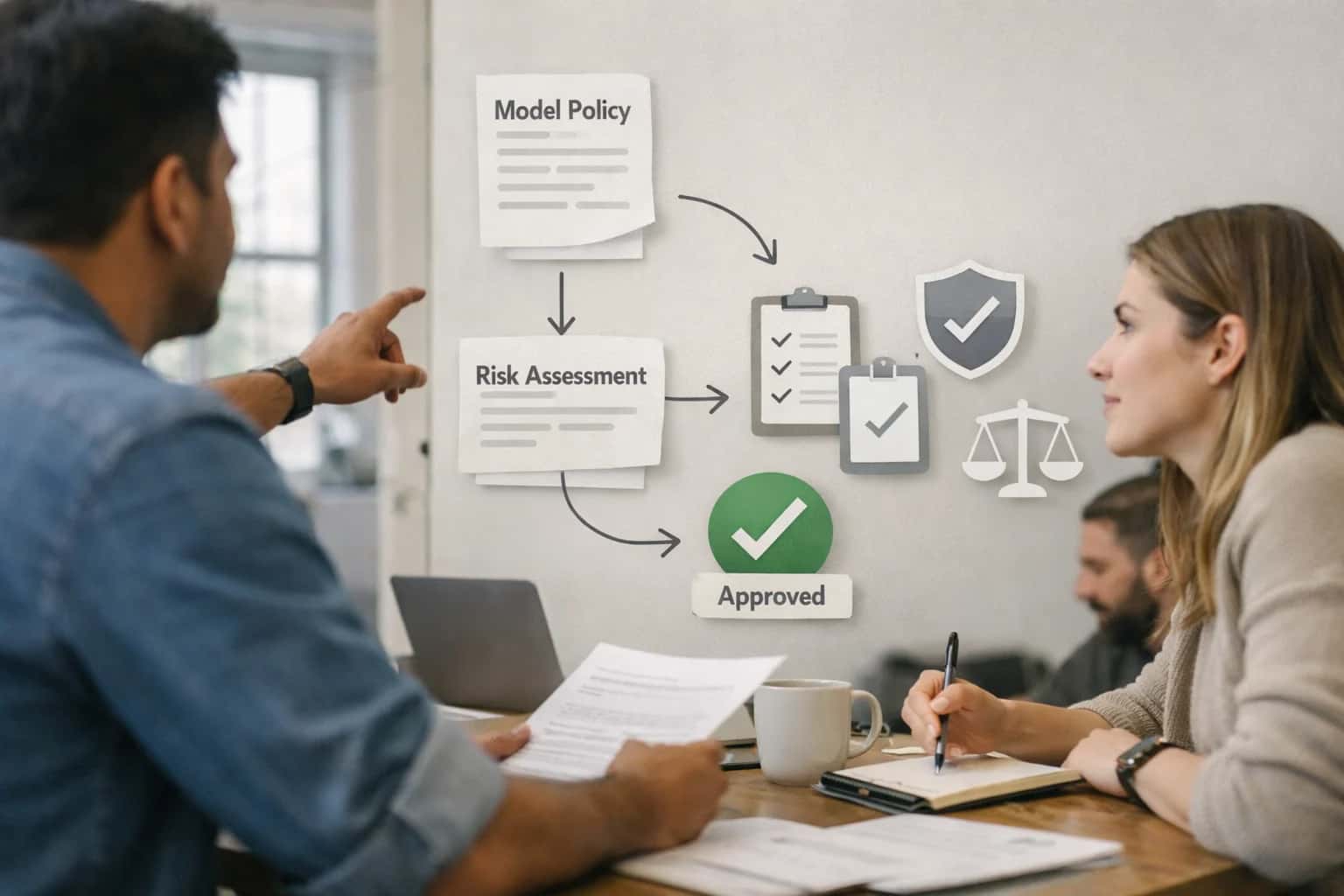
A strategic framework to govern AI-generated content, balancing innovation with control.
Building this roadmap requires a methodical approach. Start by forming a cross-functional team to assess current capabilities and risks. Then, define clear policies for acceptable use, accuracy, and brand voice. Finally, select and integrate the right Human-in-the-Loop (HITL) Governance Systems and verification tools, like those for AI Content Fact-Checking Pipelines, to create enforceable guardrails. This process ensures AI acts as a governed creative partner, not an uncontrolled replacement.
TECHNOLOGY COMPARISON
Step 4: Select and Architect Governance Technology
Comparison of core technology approaches for implementing AI content governance controls, from policy enforcement to audit trails.
| Core Capability | Integrated AI Platform (e.g., OpenAI, Anthropic) | Specialized Governance Layer (e.g., LangChain + Weights & Biases) | Custom-Built System |
|---|---|---|---|
Policy & Rule Enforcement | |||
Automated Fact-Checking & Hallucination Detection | Basic API filters | Agentic RAG pipelines | Fully customizable |
Audit Trail & Provenance Logging | Limited session history | Comprehensive with LangSmith | Complete control, e.g., blockchain |
Real-Time Moderation & Bias Scanning | ✅ via Moderation API | ✅ via integrated tools (Perspective API) | ✅ via custom models |
Human-in-the-Loop (HITL) Workflow Integration | Manual review only | ✅ Built-in queues & escalations | ✅ Fully configurable |
Time to Initial Deployment | < 1 week | 2-4 weeks | 3-6 months |
Ongoing Maintenance Overhead | Low | Medium | High |
Alignment with AI Content Governance Roadmap Phasing | Rapid MVP for Step 5 | Scalable foundation for Steps 5-7 | Long-term strategic control for all steps |
FROM STRATEGY TO EXECUTION
Step 5: Prioritize Initiatives and Create a Phased Rollout Plan
With your governance framework defined, this step translates strategy into a practical, risk-managed implementation timeline.
Prioritize initiatives using a weighted scoring matrix that evaluates each potential project against criteria like risk reduction, ROI, and implementation complexity. High-impact, low-effort quick wins—like deploying a basic hallucination detection system—build momentum. High-risk, foundational projects, such as architecting a cross-platform Human-in-the-Loop (HITL) Governance System, require more planning but are essential for long-term control. This objective ranking prevents resource misallocation and aligns stakeholders on what to build first.
Create a phased rollout plan that sequences initiatives into manageable sprints. Start with a controlled pilot in a single department, applying your new AI Content Quality Assurance Program. Use this phase to validate tools, refine confidence thresholds for automated approvals, and train your initial team. Subsequent phases expand scope, integrating lessons learned and scaling systems like your AI Content Verification System. This iterative approach balances innovation with control, allowing for continuous adjustment based on real-world feedback.
Enabling Efficiency, Speed & Accuracy
Intelligent Analysis, Decision & Execution
We build AI systems for teams that need search across company data, workflow automation across tools, or AI features inside products and internal software.
Talk to Us
Search across company data
Give teams answers from docs, tickets, runbooks, and product data with sources and permissions.
Useful when people spend too long searching or get different answers from different systems.
Enterprise searchRAGPermissions
Read more
Automate internal workflows
Use AI to route work, draft outputs, trigger actions, and keep approvals and logs in place.
Useful when repetitive work moves across multiple tools and teams.
AI agentsWorkflow automationGovernance
Read more
Add AI to products and internal tools
Build assistants, guided actions, or decision support into the software your team or customers already use.
Useful when AI needs to be part of the product, not a separate tool.
AI integrationDecision supportModel routing
Read moreAI CONTENT GOVERNANCE
Common Mistakes
Building an AI content governance roadmap is a strategic exercise. These are the most frequent technical and process-related pitfalls that derail implementation and undermine long-term success.
The most common failure point is treating governance as a purely technical or compliance checklist, not a business initiative. You must frame the roadmap in terms of risk mitigation and value creation.
Mistake: Presenting a list of technical controls without connecting them to business outcomes like brand reputation, legal liability, or content ROI.
Fix: Start with a cross-functional workshop. Map AI content use cases to specific business risks (e.g., "Marketing blog hallucinations could lead to FTC fines") and opportunities (e.g., "Personalized support content can reduce ticket volume by 30%"). Your roadmap's first phase should directly address the highest-priority risk or unlock a clear revenue opportunity to demonstrate value. Reference our guide on Human-in-the-Loop (HITL) Governance Systems for structuring approval workflows that involve stakeholders.

About the author
Prasad Kumkar
CEO & MD, Inference Systems
Prasad Kumkar is the CEO & MD of Inference Systems and writes about AI systems architecture, LLM infrastructure, model serving, evaluation, and production deployment. Over 5+ years, he has worked across computer vision models, L5 autonomous vehicle systems, and LLM research, with a focus on taking complex AI ideas into real-world engineering systems.
His work and writing cover AI systems, large language models, AI agents, multimodal systems, autonomous systems, inference optimization, RAG, evaluation, and production AI engineering.
LinkedIn
Limited slotsGet a Free AI Consultation
Partnered with leading AI, data, and software stack.





How We Work
Custom AI workflows for your Business
One-fit-all AI don't work for modern businesses. At Inferensys, we aim to understand your business & custom requirements; which we use to define most efficient agentic workflows, the data, and the tools for your business.
01
Review the use case
We understand the task, the users, and where AI can actually help.
Read more02
Pick the right approach
We define what needs search, automation, or product integration.
Read more03
Build the first useful version
We implement the part that proves the value first.
Read more04
Improve from there
We add the checks and visibility needed to keep it useful.
Read moreThe first call is a practical review of your use case and the right next step.
Talk to Us