An AI environmental disclosure governance framework establishes the policies, roles, and technical controls required for credible reporting. It moves sustainability from an ad-hoc effort to an auditable business process. This framework prevents greenwashing by enforcing data integrity from source systems—like cloud carbon APIs and energy monitors—through to final reports. Core components include a formal AI sustainability charter, defined roles for data stewards and disclosure officers, and integrated review workflows that align with broader ESG reporting standards.

Guide
Launching a Governance Framework for AI Environmental Disclosures
A technical guide to establishing the policies, roles, and controls needed for trustworthy AI environmental reporting. Build a governance model that ensures data accuracy, prevents greenwashing, and meets audit demands.
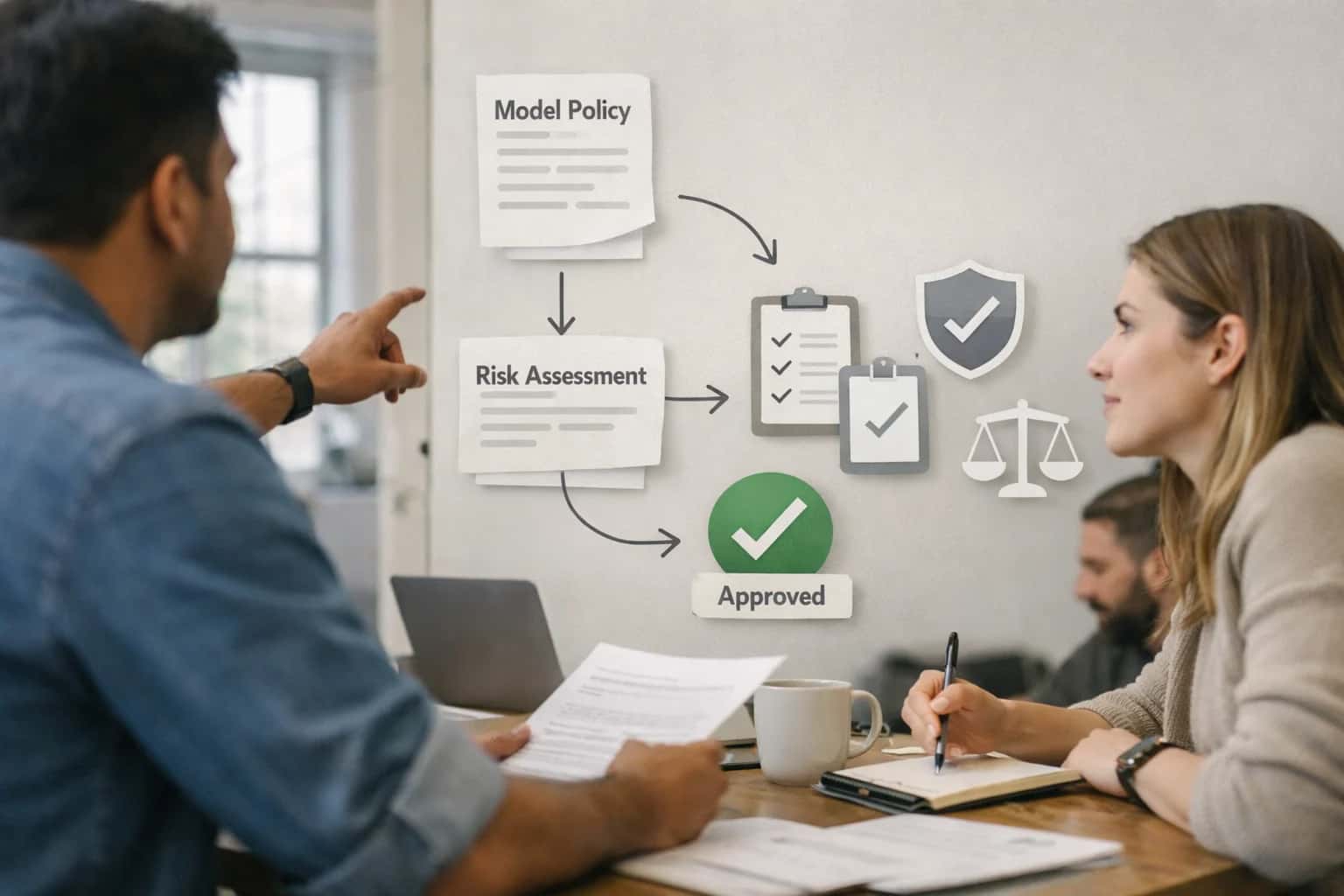
A governance framework is the essential control system that ensures AI environmental disclosures are accurate, consistent, and trustworthy.
Implementing this framework involves three actionable phases. First, draft the charter to set organizational principles and accountability. Second, define clear RACI matrices for data collection, validation, and attestation. Finally, implement technical controls, such as automated data lineage tracking and approval gates within your MLOps pipelines. This structured approach ensures disclosures meet the growing demands of internal audit, external assurance, and regulations like the EU CSRD, transforming environmental impact from a risk into a managed asset.
CONTROL TYPES
Governance Control Matrix
A comparison of governance control options for managing AI environmental disclosure data, from manual to fully automated.
| Control | Manual Process | Semi-Automated | Fully Automated & Agentic |
|---|---|---|---|
Data Collection & Ingestion | Manual spreadsheet entry from cloud bills | Scheduled API pulls with manual validation | Agentic systems autonomously query cloud APIs and validate data integrity |
Carbon Intensity Factor Application | Static annual average applied manually | Dynamic regional factors via API with quarterly updates | Real-time grid carbon intensity signals integrated via APIs like Electricity Maps |
Attestation & Review Workflow | Email-based approvals and manual sign-off | Ticketing system (e.g., Jira) with defined SLAs | Automated workflow in tools like ServiceNow or custom agentic review loops with human-in-the-loop (HITL) escalation |
Audit Trail & Provenance | Versioned documents in shared drives | Immutable logs in a centralized database | Digital provenance using blockchain or tamper-evident logs, integrated with a Software Bill of Materials (SBoM) for models |
Anomaly & Greenwashing Detection | Periodic manual audit by disclosure officer | Rule-based alerts on energy/cost ratio deviations | AI-powered anomaly detection agents monitoring for data drift and inconsistent reporting patterns |
Report Generation & Disclosure | Manual compilation into PDF/Word for ESG reports | Templated automation (e.g., R Markdown, Python scripts) | Agentic systems generate dynamic, compliant reports for frameworks like GRI and CSRD, ready for external assurance |
Policy Enforcement & Compliance Gates | Pre-production checklist | CI/CD pipeline gates that check for missing energy metadata | Autonomous agents enforce policy, blocking deployments that fail energy score or carbon budget thresholds |
GOVERNANCE FRAMEWORK
Step 5: Integrate with External Reporting Standards
This step connects your internal AI energy data to recognized external frameworks, transforming raw metrics into credible, auditable disclosures for regulators and investors.
Integration with standards like the Global Reporting Initiative (GRI) and Sustainability Accounting Standards Board (SASB) provides the structure and credibility your disclosures require. Map your collected AI energy and carbon data—from energy-to-solution metrics to hardware lifecycle assessments—to specific disclosure categories within these frameworks. This creates a defensible, standardized report that answers stakeholder demands for transparency and prevents accusations of greenwashing.
Practical implementation requires building an automated reporting pipeline. Use tools like Prefect or Airflow to orchestrate data flows from your monitoring system, apply the correct emission factors, and format outputs to match the GRI 305 (Emissions) or SASB TC-IS (Technology & Communications) standards. Establish a review workflow with your defined disclosure officers to validate data before submission, ensuring alignment with guides on How to Align AI Energy Scoring with ESG Reporting Standards and How to Automate AI Energy Data Collection and Reporting.
Enabling Efficiency, Speed & Accuracy
Intelligent Analysis, Decision & Execution
We build AI systems for teams that need search across company data, workflow automation across tools, or AI features inside products and internal software.
Talk to Us
Search across company data
Give teams answers from docs, tickets, runbooks, and product data with sources and permissions.
Useful when people spend too long searching or get different answers from different systems.
Enterprise searchRAGPermissions
Read more
Automate internal workflows
Use AI to route work, draft outputs, trigger actions, and keep approvals and logs in place.
Useful when repetitive work moves across multiple tools and teams.
AI agentsWorkflow automationGovernance
Read more
Add AI to products and internal tools
Build assistants, guided actions, or decision support into the software your team or customers already use.
Useful when AI needs to be part of the product, not a separate tool.
AI integrationDecision supportModel routing
Read moreGOVERNANCE FRAMEWORK
Common Mistakes
Launching a governance framework for AI environmental disclosures is critical for trustworthy reporting. These are the most frequent technical and procedural errors teams make, which can undermine data integrity and lead to accusations of greenwashing.
Treating governance as a project with a fixed end date creates a brittle system that fails as AI workloads and regulations evolve. Effective governance is a continuous operational process.
- Static policies cannot adapt to new model architectures, cloud regions, or reporting standards like the EU's CSRD.
- You must design for iterative refinement. This means implementing automated feedback loops where data from your AI lifecycle energy monitoring system triggers policy reviews.
- Establish a quarterly governance review cycle where the AI Ethics Officer, data stewards, and engineering leads assess control effectiveness and update charters and workflows.

About the author
Prasad Kumkar
CEO & MD, Inference Systems
Prasad Kumkar is the CEO & MD of Inference Systems and writes about AI systems architecture, LLM infrastructure, model serving, evaluation, and production deployment. Over 5+ years, he has worked across computer vision models, L5 autonomous vehicle systems, and LLM research, with a focus on taking complex AI ideas into real-world engineering systems.
His work and writing cover AI systems, large language models, AI agents, multimodal systems, autonomous systems, inference optimization, RAG, evaluation, and production AI engineering.
LinkedIn
Limited slotsGet a Free AI Consultation
Partnered with leading AI, data, and software stack.





How We Work
Custom AI workflows for your Business
One-fit-all AI don't work for modern businesses. At Inferensys, we aim to understand your business & custom requirements; which we use to define most efficient agentic workflows, the data, and the tools for your business.
01
Review the use case
We understand the task, the users, and where AI can actually help.
Read more02
Pick the right approach
We define what needs search, automation, or product integration.
Read more03
Build the first useful version
We implement the part that proves the value first.
Read more04
Improve from there
We add the checks and visibility needed to keep it useful.
Read moreThe first call is a practical review of your use case and the right next step.
Talk to Us