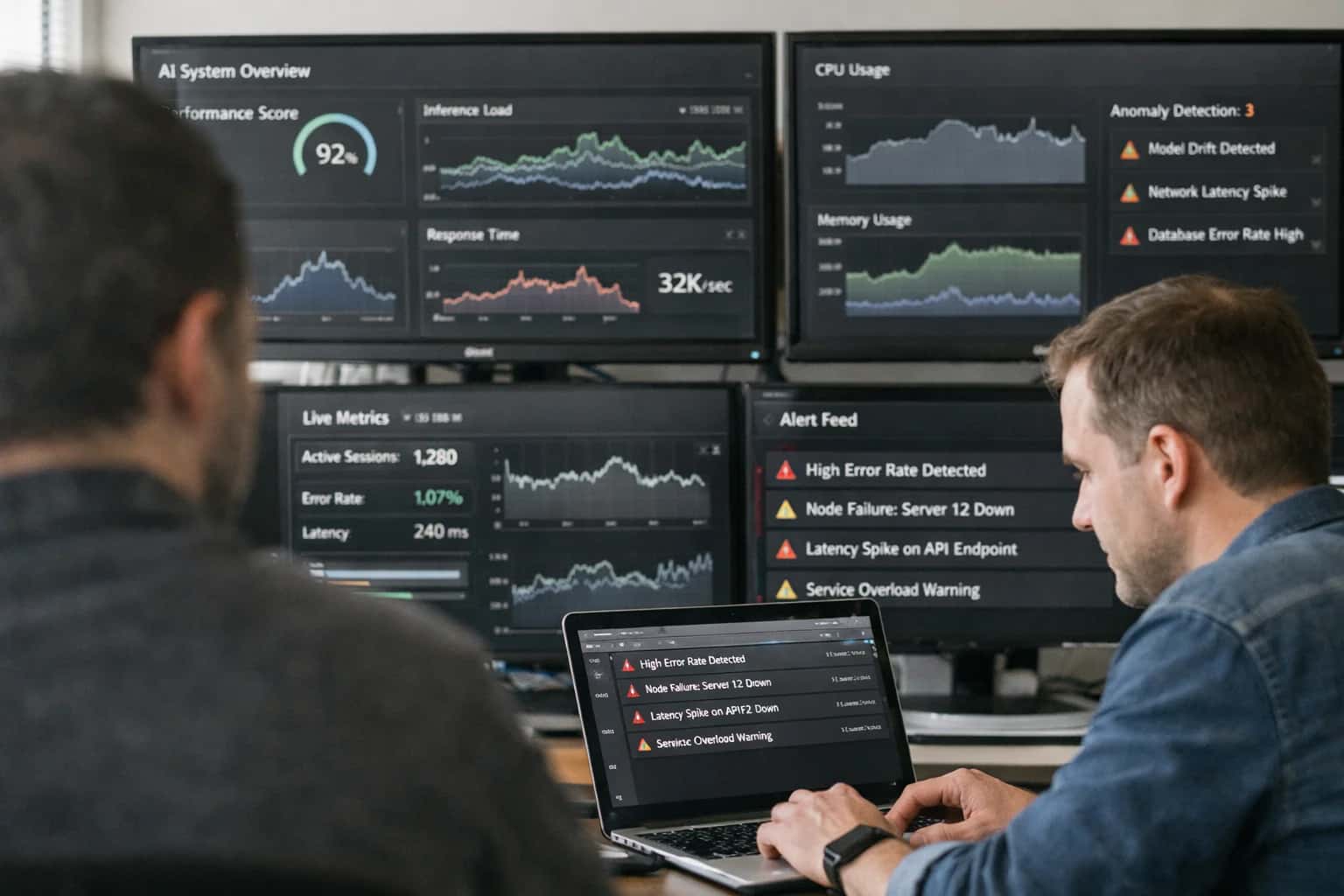
Execution monitoring is the real-time process of observing a robot's internal state and external environment during plan execution to detect deviations from expected outcomes or the occurrence of failures. It acts as a closed-loop feedback system, comparing predicted sensor readings and state transitions from the world model against actual observations. This continuous comparison enables the system to identify anomalies such as collisions, missed grasp attempts, or unexpected object movements, triggering replanning or error recovery routines.

Glossary
Execution Monitoring
Execution monitoring is the real-time process of observing a robot's state and environment during plan execution to detect failures or deviations from expected outcomes.
ROBOTICS & AUTONOMOUS SYSTEMS
What is Execution Monitoring?
Execution monitoring is a critical feedback mechanism in autonomous robotics, ensuring plans adapt to the unpredictable nature of the physical world.
The process is foundational for robust autonomy, bridging the gap between idealized planning assumptions and messy reality. Effective monitoring relies on state estimation from sensor fusion and predefined failure modes or anomaly detection thresholds. In hierarchical architectures, it operates at multiple levels, from low-level joint torque limits to high-level task success conditions, ensuring the system can gracefully degrade or request human intervention when necessary.
EXECUTION MONITORING
Key Components of an Execution Monitor
An execution monitor is a software subsystem that observes a robot's state and environment during plan execution. Its core components work together to detect deviations, assess failures, and trigger corrective actions.
01
State Estimator
The State Estimator fuses raw sensor data (e.g., from LiDAR, cameras, encoders, IMUs) to produce a consistent, real-time estimate of the robot's internal state and the state of key objects in its environment. It resolves sensor noise and uncertainty, often using probabilistic filters like a Kalman Filter or Particle Filter, to provide the single source of truth for the robot's pose, velocity, and object positions. This estimated state is the primary input for all subsequent monitoring logic.
02
Prediction Engine
This component forecasts the expected future state of the system based on the current plan. It uses the robot's dynamic model and the planned trajectory to simulate forward in time, generating a series of expected sensor readings, joint positions, or end-effector poses. The monitor continuously compares these predictions against the actual state reported by the State Estimator. Significant divergence indicates a potential execution failure, such as an unexpected obstacle or actuator slippage.
03
Condition Monitor
The Condition Monitor evaluates a set of logical and temporal predicates against the current and historical state. These predicates define the execution invariants and safety constraints that must hold true for the plan to remain valid. Examples include:
- Geometric Constraints: "End-effector must remain >10cm from the table surface."
- Temporal Constraints: "The grasp action must complete within 2 seconds."
- Logical Preconditions: "Object A must be securely held before moving to location B." Violation of any monitored condition triggers a fault.
04
Fault Classifier & Diagnoser
When a discrepancy is detected, this component analyzes its pattern to classify the fault type and diagnose the probable root cause. It moves beyond simple anomaly detection to reasoning. For instance, it distinguishes between:
- Perceptual Faults: A sensor failure or persistent occlusion.
- Actuation Faults: A motor stall or gripper slip.
- Environmental Faults: An object being moved by an external agent.
- Model Inaccuracy: A discrepancy between the robot's dynamic model and its real-world behavior. Accurate diagnosis is critical for selecting the appropriate recovery strategy.
05
Recovery Policy Selector
Based on the diagnosed fault and the current context, this component selects and parameterizes a recovery policy from a predefined library. The selection is a decision-making process that considers the severity of the fault, remaining task objectives, and available resources. Common recovery policies include:
- Replanning: Requesting a new plan from the task planner from the current state.
- Retrying: Re-executing the failed action, potentially with adjusted parameters.
- Escalation: Pausing execution and requesting human operator intervention.
- Graceful Degradation: Switching to a simplified, safer behavior mode.
06
Telemetry & Logging Interface
This is the observability backbone. It continuously streams timestamped telemetry data—including raw sensor readings, estimated states, predicted states, condition evaluations, and fault events—to persistent storage and dashboards. This data is essential for:
- Post-Mortem Analysis: Debugging failures and improving models.
- Performance Benchmarking: Measuring plan execution accuracy and monitor latency.
- Model Improvement: Providing labeled failure data to refine the robot's dynamic or perceptual models.
- Compliance & Audit: Providing a verifiable record of the system's decision-making process during operation.
ROBOTICS
How Execution Monitoring Works
Execution monitoring is the real-time process of verifying a robot's actions against its intended plan, ensuring safe and correct operation in dynamic environments.
Execution monitoring is the continuous, real-time process of comparing a robot's observed state and environmental feedback against the expected outcomes of its current plan. It functions as a closed-loop feedback system, using sensor data to detect deviations, failures, or unexpected conditions that could lead to task failure or unsafe operation. This process is fundamental to robust autonomy, allowing a system to recognize when its assumptions about the world no longer hold.
The system typically employs a state estimator to fuse sensor readings into a coherent world model and a set of monitors or watchdogs that check for specific failure modes. These can range from simple threshold checks on joint torque to complex logical conditions on task progress. When a fault or plan violation is detected, the system triggers a fault handler, which may initiate replanning, error recovery, or a safe stop. This creates a sense-plan-act-monitor cycle essential for reliable long-horizon task execution.
COMPARISON
Common Execution Monitoring Techniques
A comparison of primary methods for observing and verifying robotic plan execution, detailing their mechanisms, data requirements, and typical use cases.
| Technique | Mechanism | Primary Data Source | Detection Latency | Computational Overhead | Typical Use Case |
|---|---|---|---|---|---|
State-Based Monitoring | Compares current sensor readings (e.g., joint angles, end-effector pose) against expected values from the planned trajectory. | Joint encoders, IMU, forward kinematics | < 100 ms | Low | Detecting servo errors or kinematic constraint violations in controlled environments. |
Vision-Based Monitoring | Uses camera feeds to verify task completion (e.g., object presence/absence) or detect visual anomalies using pre-trained models or template matching. | RGB/RGB-D cameras | 100-500 ms | Medium-High | Verifying pick-and-place operations, checking assembly state, or detecting spilled items. |
Force/Torque Monitoring | Monitors contact forces and torques at the end-effector or joints to detect unexpected collisions, jams, or loss of contact. | Force-Torque sensors, current sensing | < 10 ms | Low | Precision insertion tasks, collaborative robotics (cobots), and grinding/polishing operations. |
Temporal Monitoring | Tracks the duration of actions and overall plan execution time, flagging significant deviations from expected time windows. | System clock, action timestamps | Variable | Very Low | Identifying system stalls, process bottlenecks, or failures in time-critical assembly lines. |
Logic-Based Monitoring | Evaluates predefined logical predicates or conditions (e.g., 'gripper_is_closed', 'part_is_assembled') that must hold true at specific plan steps. | Any sensor or system state variable | < 50 ms | Low | High-level task verification in hierarchical plans, often integrated with symbolic planners. |
Anomaly Detection (Learned) | Uses machine learning models (e.g., autoencoders, one-class SVM) trained on nominal execution data to identify statistical deviations in multi-modal sensor streams. | Multi-sensor fusion (vision, force, proprioception) | 200-1000 ms | High | Detecting novel, unforeseen failure modes in complex, unstructured environments. |
Plan Consistency Checking | Continuously validates that the preconditions for the next action in the plan are satisfied by the current world state before execution. | World model / belief state | < 100 ms | Medium | Ensuring the logical soundness of plan execution, preventing actions in invalid states. |
EXECUTION MONITORING
Use Cases and Examples
Execution monitoring is the real-time process of observing a robot's state and environment during plan execution to detect deviations from expected outcomes or failures. These cards illustrate its critical applications across robotics and autonomous systems.
01
Collision Avoidance in Dynamic Warehouses
In automated fulfillment centers, execution monitoring systems track the planned path of Autonomous Mobile Robots (AMRs) against real-time LiDAR and camera feeds. Deviation detection algorithms identify unexpected obstacles—like a fallen pallet or a human worker—triggering an immediate replanning request. This real-time feedback loop prevents costly collisions and ensures continuous operation, with systems often achieving sub-100 millisecond reaction times to initiate evasive maneuvers.
< 100 ms
Typical Reaction Time
02
Precision Assembly Line Verification
For robotic arms performing delicate assembly tasks (e.g., inserting a circuit board), execution monitoring compares expected end-effector pose and force-torque sensor readings against live data. Temporal logic monitors check if sub-tasks complete within specified time windows. A deviation, such as excessive resistance indicating a misaligned part, triggers a predefined recovery behavior (e.g., a gentle retry) or halts the line, preventing part damage. This is a key component of error detection and recovery (EDR) systems in manufacturing.
03
Autonomous Vehicle Safety Driver
In self-driving cars, execution monitoring acts as a continuous safety supervisor. It validates that the vehicle's perceived state (from cameras, radar) aligns with the planned trajectory and that all safety envelopes (e.g., minimum following distance, maximum curvature) are respected. If the system detects a perception-planning mismatch—such as an object appearing where none was predicted—or a violation of a safety rule, it can initiate a minimal risk condition (MRC), like a controlled stop. This layer is critical for functional safety standards like ISO 26262.
ISO 26262
Safety Standard
04
Surgical Robot Procedural Adherence
In robot-assisted surgery, execution monitoring ensures the robotic system adheres strictly to the surgeon's pre-operative plan. It tracks instrument tip positions in real-time against a 3D model of the patient's anatomy. Geofencing virtual fixtures create software-defined boundaries that prevent the tool from moving into critical, no-fly zones. Any attempt to breach these boundaries triggers haptic feedback to the surgeon and can automatically dampen or stop motor commands, providing a vital safety interlock during high-precision operations.
05
Long-Duration Planetary Rover Operations
For rovers on Mars, communication delays make real-time human intervention impossible. Execution monitoring is the rover's primary safeguard. It continuously checks system health telemetry (power, temperature), verifies that observed terrain matches expectations from local maps, and confirms that each commanded action (e.g., a wheel turn) produces the expected odometry change. Upon detecting a fault—like a wheel digging in unexpectedly—the monitor triggers a fault protection response, such as stopping all motion and entering a safe state to await new instructions from Earth.
20+ min
One-Way Comms Delay (Earth-Mars)
06
Multi-Robot Fleet Coordination
In a coordinated fleet of drones or ground robots, execution monitoring occurs at both the individual agent and fleet level. Each robot monitors its own task progress, while a central or distributed supervisor monitors for inter-agent conflicts (e.g., two robots heading to the same resource) and global constraint violations (e.g., exceeding a total power budget). Detected conflicts trigger re-allocation or negotiation protocols among agents. This ensures the overall mission's temporal and spatial constraints are maintained despite individual uncertainties.
EXECUTION MONITORING
Frequently Asked Questions
Execution monitoring is the critical real-time process of observing a robot's state and environment during plan execution to detect deviations, failures, or unexpected conditions. This FAQ addresses core concepts for robotics software architects.
Execution monitoring is the continuous, real-time process of observing a robot's internal state (e.g., joint positions, battery level) and external environment (e.g., sensor readings, object positions) during the physical enactment of a planned sequence of actions. Its primary function is to compare the observed state against the expected state predicted by the plan to detect deviations, failures, or the occurrence of unexpected conditions that could lead to task failure or unsafe operation. This is distinct from, but complementary to, plan validation, which occurs before execution. Monitoring provides the essential feedback loop that triggers replanning, error recovery, or safe shutdown procedures.
Enabling Efficiency, Speed & Accuracy
Intelligent Analysis, Decision & Execution
We build AI systems for teams that need search across company data, workflow automation across tools, or AI features inside products and internal software.
Talk to Us
Search across company data
Give teams answers from docs, tickets, runbooks, and product data with sources and permissions.
Useful when people spend too long searching or get different answers from different systems.
Enterprise searchRAGPermissions
Read more
Automate internal workflows
Use AI to route work, draft outputs, trigger actions, and keep approvals and logs in place.
Useful when repetitive work moves across multiple tools and teams.
AI agentsWorkflow automationGovernance
Read more
Add AI to products and internal tools
Build assistants, guided actions, or decision support into the software your team or customers already use.
Useful when AI needs to be part of the product, not a separate tool.
AI integrationDecision supportModel routing
Read more
About the author
Prasad Kumkar
CEO & MD, Inference Systems
Prasad Kumkar is the CEO & MD of Inference Systems and writes about AI systems architecture, LLM infrastructure, model serving, evaluation, and production deployment. Over 5+ years, he has worked across computer vision models, L5 autonomous vehicle systems, and LLM research, with a focus on taking complex AI ideas into real-world engineering systems.
His work and writing cover AI systems, large language models, AI agents, multimodal systems, autonomous systems, inference optimization, RAG, evaluation, and production AI engineering.
LinkedIn
Limited slotsGet a Free AI Consultation
Partnered with leading AI, data, and software stack.





How We Work
Custom AI workflows for your Business
One-fit-all AI don't work for modern businesses. At Inferensys, we aim to understand your business & custom requirements; which we use to define most efficient agentic workflows, the data, and the tools for your business.
01
Review the use case
We understand the task, the users, and where AI can actually help.
Read more02
Pick the right approach
We define what needs search, automation, or product integration.
Read more03
Build the first useful version
We implement the part that proves the value first.
Read more04
Improve from there
We add the checks and visibility needed to keep it useful.
Read moreThe first call is a practical review of your use case and the right next step.
Talk to Us