Sensor fusion integrates heterogeneous data streams—like LiDAR point clouds, camera images, and IMU readings—into a unified, consistent state estimate. Algorithms such as the Kalman filter or particle filter are core to this process, statistically merging observations to reduce uncertainty and compensate for individual sensor weaknesses like noise, occlusion, or drift. This is foundational for real-time robotic perception in autonomous systems.

Glossary
Sensor Fusion
Sensor fusion is the algorithmic process of combining data from multiple disparate sensors to produce a more accurate, complete, and reliable estimate of the state of the environment than is possible with any single sensor alone.
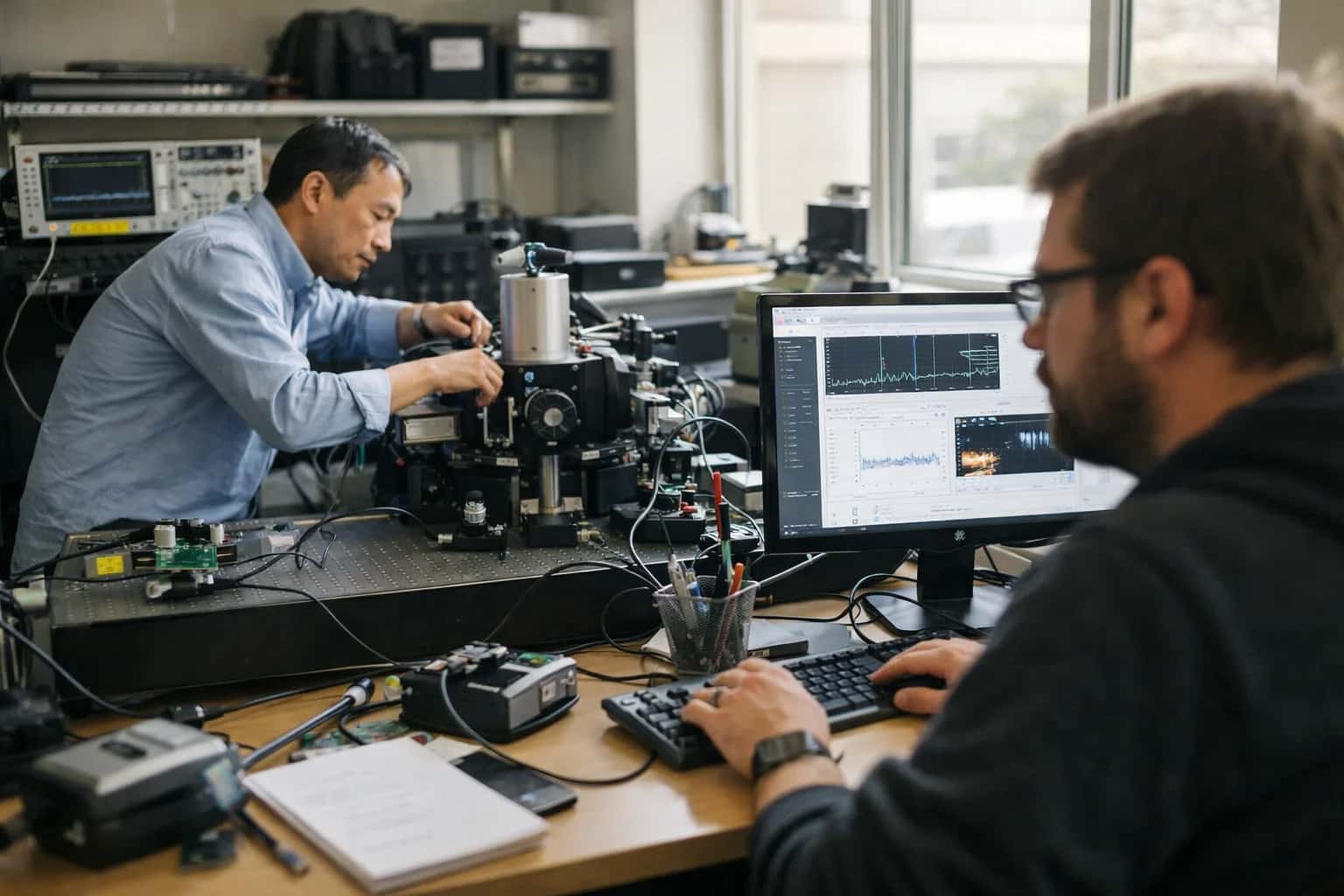
REAL-TIME ROBOTIC PERCEPTION
What is Sensor Fusion?
Sensor fusion is the algorithmic process of combining data from multiple disparate sensors to produce a more accurate, complete, and reliable estimate of the state of the environment than is possible with any single sensor alone.
In practice, fusion occurs at different levels: low-level (data fusion) directly combines raw signals, while high-level (decision fusion) merges processed outputs like detected objects. For embodied AI and vision-language-action models, accurate fusion creates the robust world model necessary for safe task and motion planning and dexterous manipulation. It directly addresses the sim-to-real transfer challenge by making perception resilient to real-world noise.
FUNDAMENTAL CONCEPTS
Core Principles of Sensor Fusion
Sensor fusion combines data from multiple sensors to create a more accurate, complete, and reliable environmental state estimate than any single sensor can provide. These core principles govern its algorithmic design.
01
Complementary vs. Redundant Fusion
This principle categorizes how sensors contribute to the fused estimate.
- Complementary Fusion: Sensors measure different physical properties. For example, a camera provides rich texture and color data but no direct depth, while a LiDAR provides precise 3D point clouds but lacks semantic information. Fusion combines these disparate data types to create a more complete picture.
- Redundant Fusion: Multiple sensors measure the same physical property (e.g., two GPS units). Fusion is used to reduce noise and uncertainty, increasing the robustness and reliability of the measurement. A common example is using multiple microphones for beamforming in audio systems.
02
Centralized vs. Decentralized Architectures
This defines the data flow and processing topology of the fusion system.
- Centralized Fusion: All raw sensor data is sent to a single processing node (the fusion center). This architecture has access to all information, allowing for theoretically optimal estimation, but creates a single point of failure and requires high-bandwidth communication.
- Decentralized (Distributed) Fusion: Each sensor or a local group of sensors performs some level of processing (e.g., generating a local track or state estimate). These local estimates are then communicated and fused. This is more robust to node failure, reduces communication bandwidth, and is scalable, but may be sub-optimal compared to a centralized approach. Common in multi-robot systems.
03
The Estimation Loop: Predict & Update
Most probabilistic fusion algorithms, like the Kalman Filter, operate on a two-step recursive loop:
- Predict: The system uses a known motion model to predict the future state based on the previous estimate. This prediction incorporates process noise, representing model uncertainty.
- Update (Correct): When a new sensor measurement arrives, it is compared to the prediction. The difference (innovation) is used to correct the predicted state. The correction is weighted by the relative confidence (covariance) in the prediction versus the new measurement.
This loop continuously refines the state estimate, blending prior knowledge with new evidence.
04
Probabilistic Frameworks & Uncertainty
Sensor fusion is fundamentally about managing uncertainty. Algorithms model sensor noise and system dynamics probabilistically.
- Gaussian Assumptions (KF, EKF): The Kalman Filter family assumes noise and state distributions are Gaussian, represented by a mean (the estimate) and a covariance matrix (the uncertainty). Fusion is achieved through elegant linear algebra.
- Non-Gaussian Methods (Particle Filter): For highly nonlinear systems or non-Gaussian noise, methods like the Particle Filter represent the state distribution with a set of random samples (particles). Fusion involves weighting these particles based on how well they explain the new sensor data.
- Covariance Intersection: A method used in decentralized systems when the correlation between local estimates is unknown, providing a conservative fused estimate that guarantees consistency.
05
Temporal & Spatial Alignment (Synchronization & Calibration)
For fusion to be valid, data from different sensors must be comparable. This requires two critical pre-processing steps:
- Temporal Alignment (Synchronization): Sensors sample at different rates and with different latencies. Data must be aligned to a common timestamp, often using hardware triggers or software interpolation (e.g., recording IMU data at camera frame timestamps).
- Spatial Alignment (Calibration): Each sensor has its own coordinate frame (e.g., camera optical center, LiDAR origin). Extrinsic calibration determines the precise rigid transformation (rotation and translation) between these frames. Intrinsic calibration corrects for sensor-specific distortions (e.g., camera lens distortion). Without accurate calibration, fusion produces geometrically inconsistent results.
06
Sensor Modalities & Fusion Levels
Fusion can occur at different stages of the perception pipeline, trading abstraction for robustness:
- Low-Level (Data/Feature-Level) Fusion: Raw data or extracted features (e.g., pixel intensities, LiDAR points, SIFT keypoints) are combined before any high-level interpretation. Visual-Inertial Odometry (VIO) is a prime example, fusing IMU readings with raw visual features for pose estimation. This preserves the most information but is computationally intensive.
- High-Level (Decision-Level) Fusion: Each sensor stream is processed independently to produce a decision or object hypothesis (e.g., "camera detects a car," "radar detects a vehicle"). These decisions are then fused. This is more modular and fault-tolerant but loses the richness of raw data correlation. Often used in automotive perception stacks.
REAL-TIME ROBOTIC PERCEPTION
How Does Sensor Fusion Work?
Sensor fusion is the algorithmic core of real-time robotic perception, combining disparate sensor data into a unified, reliable state estimate.
Sensor fusion is the algorithmic process of combining data from multiple, heterogeneous sensors to produce a more accurate, complete, and reliable estimate of a system's state or its environment than is possible with any single sensor source. It operates on the principle that different sensors have complementary strengths and weaknesses; for instance, a camera provides rich texture but is sensitive to lighting, while LiDAR offers precise depth but sparse data. By mathematically merging these streams, fusion algorithms like the Kalman filter or particle filter compensate for individual sensor noise, latency, and failures, creating a robust perceptual foundation for autonomous decision-making.
The technical workflow involves data alignment (temporal synchronization and spatial calibration), state prediction using system dynamics, and measurement update where new sensor observations correct the prediction. For embodied AI systems, this often means fusing visual odometry from cameras with inertial data from an IMU in a Visual Inertial Odometry (VIO) pipeline to achieve precise, low-drift localization. Advanced methods employ probabilistic frameworks or deep learning to model complex correlations, directly outputting a consolidated representation—such as an occupancy grid or object list—for downstream task and motion planning modules.
INDUSTRY USE CASES
Real-World Applications of Sensor Fusion
Sensor fusion is the critical technology enabling machines to perceive and interact with complex, dynamic environments. These applications demonstrate its transformative impact across industries.
CORE FILTERS
Sensor Fusion: Algorithm Comparison
A comparison of the primary algorithmic frameworks used to combine data from disparate sensors (e.g., camera, LiDAR, IMU) for state estimation in robotics and autonomous systems.
| Algorithm / Feature | Kalman Filter (KF) | Extended Kalman Filter (EKF) | Unscented Kalman Filter (UKF) | Particle Filter (PF) |
|---|---|---|---|---|
Core Mathematical Principle | Linear Gaussian optimal estimation | First-order Taylor linearization of nonlinear models | Deterministic sampling (unscented transform) of nonlinear models | Sequential Monte Carlo sampling |
Handles Nonlinear Systems | ||||
Handles Non-Gaussian Noise | ||||
Computational Complexity | O(n³) | O(n³) | O(n³) | O(N * n) where N >> n |
Typical State Dimension | Small (< 20) | Small to Medium (< 100) | Small to Medium (< 100) | Low to Medium (2-10) |
Memory Footprint | Low | Low | Low | High (scales with particle count) |
Primary Use Case | Linear dynamics & measurements (e.g., basic tracking) | Mildly nonlinear robotics (e.g., Visual-Inertial Odometry) | Strongly nonlinear systems (e.g., orientation estimation) | Multi-modal, non-Gaussian estimation (e.g., global localization) |
Implementation Difficulty | Low | Medium (requires Jacobians) | Medium (requires function evaluations) | High (requires careful tuning of resampling) |
SENSOR FUSION
Frequently Asked Questions
Sensor fusion is the algorithmic core of real-time robotic perception, combining data from disparate sensors to create a unified, reliable, and actionable world model. These FAQs address the core concepts, methods, and applications critical for embedded systems and robotics engineers.
Sensor fusion is the algorithmic process of combining data from multiple, often heterogeneous, sensors to produce a more accurate, complete, and reliable estimate of a system's state or its environment than is possible with any single sensor alone. It works by leveraging the complementary strengths and weaknesses of different sensing modalities—such as a camera's rich visual data, an Inertial Measurement Unit (IMU)'s high-frequency motion data, and LiDAR's precise depth information—within a probabilistic framework. Core algorithms like the Kalman Filter (for linear systems) and the Particle Filter (for non-linear, non-Gaussian problems) recursively predict a system's state and then correct it with new observations, fusing measurements based on their estimated uncertainty. The output is a unified state estimate, such as a robot's precise 6D pose (position and orientation), which is essential for stable navigation and manipulation.
Enabling Efficiency, Speed & Accuracy
Intelligent Analysis, Decision & Execution
We build AI systems for teams that need search across company data, workflow automation across tools, or AI features inside products and internal software.
Talk to Us
Search across company data
Give teams answers from docs, tickets, runbooks, and product data with sources and permissions.
Useful when people spend too long searching or get different answers from different systems.
Enterprise searchRAGPermissions
Read more
Automate internal workflows
Use AI to route work, draft outputs, trigger actions, and keep approvals and logs in place.
Useful when repetitive work moves across multiple tools and teams.
AI agentsWorkflow automationGovernance
Read more
Add AI to products and internal tools
Build assistants, guided actions, or decision support into the software your team or customers already use.
Useful when AI needs to be part of the product, not a separate tool.
AI integrationDecision supportModel routing
Read more
About the author
Prasad Kumkar
CEO & MD, Inference Systems
Prasad Kumkar is the CEO & MD of Inference Systems and writes about AI systems architecture, LLM infrastructure, model serving, evaluation, and production deployment. Over 5+ years, he has worked across computer vision models, L5 autonomous vehicle systems, and LLM research, with a focus on taking complex AI ideas into real-world engineering systems.
His work and writing cover AI systems, large language models, AI agents, multimodal systems, autonomous systems, inference optimization, RAG, evaluation, and production AI engineering.
LinkedIn
Limited slotsGet a Free AI Consultation
Partnered with leading AI, data, and software stack.





How We Work
Custom AI workflows for your Business
One-fit-all AI don't work for modern businesses. At Inferensys, we aim to understand your business & custom requirements; which we use to define most efficient agentic workflows, the data, and the tools for your business.
01
Review the use case
We understand the task, the users, and where AI can actually help.
Read more02
Pick the right approach
We define what needs search, automation, or product integration.
Read more03
Build the first useful version
We implement the part that proves the value first.
Read more04
Improve from there
We add the checks and visibility needed to keep it useful.
Read moreThe first call is a practical review of your use case and the right next step.
Talk to Us