A digital twin is a virtual, data-driven model of a physical entity or process that is synchronized via a continuous data feed from sensors, IoT devices, and operational systems. This bidirectional link allows the twin to mirror the real-world counterpart's state, condition, and behavior in real-time, enabling predictive analytics and what-if scenario testing. It serves as a foundational component for sim-to-real transfer and embodied intelligence systems, bridging digital planning with physical execution.

Glossary
Digital Twin
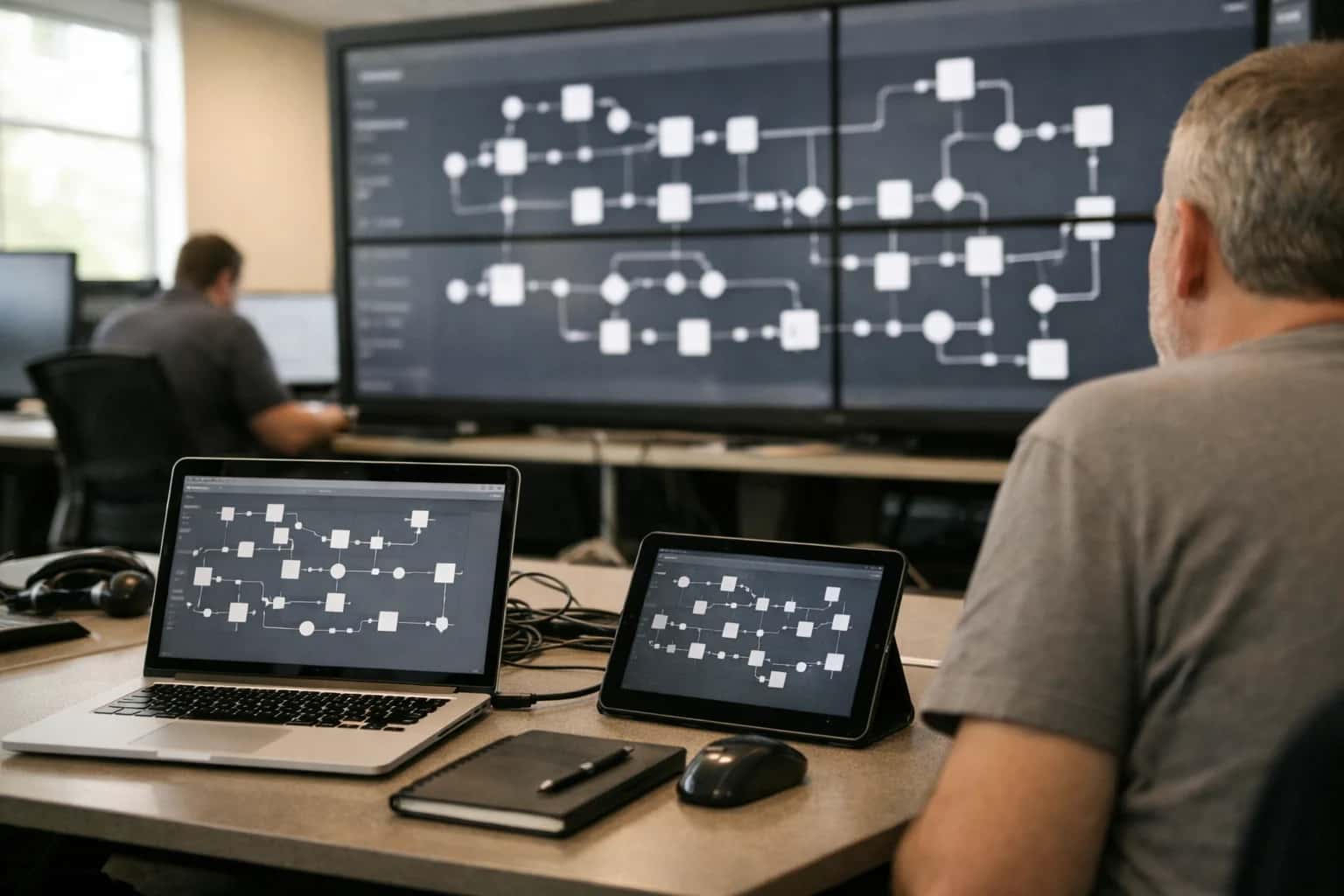
A digital twin is a virtual, dynamic representation of a physical system, continuously synchronized with real-world data via sensors for simulation, analysis, and control.
EMBODIED AI FRAMEWORKS
What is a Digital Twin?
A digital twin is a virtual, dynamic representation of a physical system (like a robot or factory) that is continuously updated with real-world data, used for simulation, analysis, monitoring, and control.
In robotics and manufacturing, digital twins are implemented within simulation platforms like NVIDIA Isaac Sim or Gazebo to train reinforcement learning agents, validate control policies, and perform hardware-in-the-loop (HIL) testing before physical deployment. By creating a high-fidelity virtual replica, engineers can optimize performance, conduct predictive maintenance, and orchestrate complex systems like heterogeneous fleets without operational downtime or risk.
DEFINITIONAL FRAMEWORK
Core Characteristics of a Digital Twin
A digital twin is defined by its core architectural and functional attributes that distinguish it from a simple static 3D model or offline simulation. These characteristics enable its role in monitoring, analysis, and control.
01
Bi-Directional Data Synchronization
The defining feature of a digital twin is the continuous, closed-loop data flow between the physical asset and its virtual counterpart. This involves:
- Real-time telemetry ingestion from IoT sensors, PLCs, and control systems.
- Downstream actuation where insights or commands from the virtual model can be sent back to influence the physical system's operation.
- This creates a living model that is never stale, enabling true real-time monitoring and interactive control.
02
High-Fidelity Virtual Representation
The digital twin is a comprehensive virtual model that accurately mirrors the physical entity across multiple domains:
- Geometric & Spatial: Precise 3D CAD geometry and spatial relationships.
- Physical & Dynamic: Incorporates physics (e.g., stress, thermal, fluid dynamics) to simulate behavior.
- Logical & Stateful: Models the system's operational states, rules, and dependencies (e.g., a production line's sequence).
- This multi-fidelity representation allows for predictive simulation and "what-if" analysis that a simple schematic cannot provide.
03
Lifecycle Concurrency & Historical Context
A digital twin exists concurrently with its physical counterpart throughout its entire operational lifecycle—from design and commissioning to decommissioning. This enables:
- Longitudinal data tracking to analyze performance degradation, maintenance history, and usage patterns.
- Root-cause analysis by replaying past operational states leading up to a failure.
- Provenance and audit trails for compliance and validation.
- Unlike a design-time simulation, the twin accumulates a living history that informs future decisions.
04
Simulation & Predictive Analytics Layer
Beyond mirroring the present state, a core function is to run forward-looking simulations using the current synchronized data as the initial condition. This includes:
- What-if scenario testing: Safely evaluating the impact of process changes, failures, or new control strategies.
- Predictive maintenance: Using physics-based or ML models to forecast component failures before they occur.
- Optimization loops: Automatically tuning system parameters (e.g., setpoints, schedules) for efficiency, quality, or throughput.
- This transforms the twin from a passive dashboard into an active decision-support engine.
05
Integration with AI/ML & Autonomous Systems
Modern digital twins are AI-native platforms that serve as the virtual testbed and runtime environment for autonomous systems, particularly in embodied AI. Key integrations include:
- Training embodied agents: Reinforcement learning policies for robots can be trained safely and at scale within the simulated twin environment (sim-to-real transfer).
- Vision-language-action models: The twin provides the structured 3D scene and physics context for models that link perception, language instructions, and motor control.
- Anomaly detection: ML models continuously analyze telemetry streams to identify deviations from normal operation.
- This characteristic bridges the gap between traditional industrial IoT and next-generation autonomous intelligence.
06
Scalability & Composability
Digital twins are architected to be hierarchical and composable. A single complex asset (e.g., a factory) is modeled as a system-of-systems:
- Component Twins: Individual parts (e.g., a motor, a valve).
- Asset Twins: Assembled machines (e.g., a robotic arm, a CNC machine).
- System Twins: Interconnected systems (e.g., a production line).
- Process Twins: End-to-end workflows spanning multiple systems.
- This modularity allows for focused analysis at different levels of abstraction and enables the simulation of emergent behaviors from component interactions.
MECHANISM
How Does a Digital Twin Work?
A digital twin operates through a continuous, bidirectional data flow between a physical asset and its virtual counterpart, enabling simulation, analysis, and control.
A digital twin functions via a closed-loop data pipeline. Sensors on the physical asset stream real-time telemetry—such as temperature, vibration, and position—to the virtual model. This synchronization updates the twin's state, creating a live, high-fidelity representation. The virtual model, built using CAD data, physics engines, and machine learning, then runs simulations, performs diagnostics, or predicts future states based on this incoming data stream.
The twin's analytical outputs are fed back to the physical system. This can involve sending optimized control parameters to actuators, triggering predictive maintenance alerts, or proposing new operational setpoints. The core mechanism is this bidirectional coupling, where the virtual model not only mirrors reality but also influences it. This loop enables tasks like what-if scenario testing, performance optimization, and remote monitoring without disrupting the live physical operation.
APPLICATIONS
Digital Twin Use Cases in AI & Robotics
A digital twin is a virtual, dynamic representation of a physical system, continuously synchronized with real-world data. In AI and robotics, it serves as a foundational tool for simulation, optimization, and autonomous decision-making.
01
Training & Sim-to-Real Transfer
Digital twins provide a physically realistic simulation environment for training AI agents, particularly for reinforcement learning (RL) and imitation learning. By training in a virtual replica, robots can master complex tasks—like dexterous manipulation or navigation—without the cost, risk, or time constraints of physical trials. Techniques like domain randomization are applied within the twin to bridge the sim-to-real gap, ensuring policies are robust to real-world variations before deployment.
02
Predictive Maintenance & Health Monitoring
By ingesting real-time sensor data (vibration, temperature, power draw), a digital twin creates a live model of a robot's or production line's physical state. Machine learning models analyze this stream against historical and simulated failure modes to:
- Predict component failures before they occur.
- Identify anomalous behavior indicative of wear.
- Optimize maintenance schedules, reducing downtime. This transforms maintenance from a reactive to a predictive and prescriptive process.
03
Real-Time Control & Optimization
A digital twin acts as a high-fidelity predictive model for Model Predictive Control (MPC) and other advanced controllers. Before sending commands to the physical robot, the controller can:
- Test thousands of potential action sequences in the twin within milliseconds.
- Predict outcomes and select the optimal trajectory.
- Continuously re-plan based on the twin's updated state. This is critical for dynamic tasks like autonomous vehicle navigation, robotic welding, and agile manufacturing where conditions change rapidly.
04
System Design & Virtual Commissioning
Engineers use digital twins to design, prototype, and validate entire robotic workcells or factories before any physical hardware is built. This allows for:
- Virtual commissioning: Testing PLC logic, robot programs, and communication networks in simulation.
- Layout optimization: Simulating workflow to maximize throughput and minimize collisions.
- What-if analysis: Stress-testing the system against extreme scenarios, demand spikes, or potential failures to validate resilience and identify bottlenecks early in the design phase.
05
Fleet Orchestration & Multi-Agent Coordination
For fleets of Autonomous Mobile Robots (AMRs) or heterogeneous robotic systems, a centralized digital twin provides a unified, real-time view of the entire operational environment. AI orchestration platforms use this twin to:
- Dynamically assign tasks and optimize global routes.
- Simulate and resolve potential agent conflicts (e.g., traffic jams at intersections).
- Re-allocate resources in response to disruptions, such as a blocked path or a robot going offline, ensuring continuous system-wide efficiency.
06
Human-Robot Collaboration (HRC)
Digital twins enhance safety and efficiency in shared workspaces. By simulating both the robot's and human worker's digital avatars, the system can:
- Predict and preemptively avoid potential collisions.
- Optimize robot trajectories for ergonomic human interaction.
- Use the twin as an interface for programming by demonstration, where a human teaches a task in the virtual space, which is then transferred to the physical robot. This creates a safe sandbox for designing and validating collaborative workflows.
ARCHITECTURAL COMPARISON
Digital Twin vs. Related Concepts
A technical comparison of the Digital Twin paradigm against other key simulation and modeling frameworks used in robotics and embodied AI, highlighting core architectural and operational differences.
| Feature / Metric | Digital Twin | Physics Simulation (e.g., Gazebo, MuJoCo) | World Model (AI) | CAD / Static 3D Model |
|---|---|---|---|---|
Primary Purpose | Bidirectional synchronization for monitoring, analysis, prediction, and control of a physical counterpart | Forward simulation of physics for training, testing, and validation of algorithms | Learned latent environment model for prediction and planning within an AI agent | Static design and engineering documentation of a system's geometry and components |
Data Link to Physical System | Continuous, real-time or near-real-time data ingestion (IoT/telemetry) | None or one-time parameter initialization; operates in open loop | Trained on historical or simulated data; no live link after deployment | None; represents an ideal design state |
State Representation | Dynamic, data-driven virtual instance mirroring the current state of a specific physical asset | Configurable initial state within a generalized physics sandbox | Compressed latent space representation enabling fast forward prediction | Fixed geometric and material properties without runtime state |
Core Function | Analysis, optimization, prognostics, and remote control | Training reinforcement learning policies, testing perception, and validating controllers | Enabling model-based RL and planning by predicting future states from actions | Design, manufacturing specification, and static visualization |
Update Mechanism | Cybernetic loop: Sensors -> Twin -> Insights/Commands -> Actuators | Deterministic or stochastic integration of physics equations | Neural network inference based on current latent state and action | Manual engineering updates via CAD software |
Fidelity & Accuracy | High functional fidelity to a specific instance; accuracy depends on sensor data and model calibration | High physical fidelity (forces, contacts); may have a reality gap vs. real hardware | Task-specific predictive fidelity; may sacrifice physical accuracy for speed | High geometric and tolerancing fidelity to design intent |
Temporal Dimension | Operates in sync with wall-clock time of the physical system | Simulation time, which can be faster, slower, or equal to real-time | Abstracted time steps within the latent model's prediction horizon | Atemporal; represents a single moment in the design lifecycle |
Instance Specificity | Unique to a single physical asset (e.g., Robot Serial #1234) | Generic environment for a class of robots or scenarios | Often generic to a task domain, but can be fine-tuned | Generic to a product model or design variant |
Use in Sim-to-Real | Serves as the high-fidelity target for transfer; can be used for domain adaptation | Primary training environment; requires techniques like domain randomization to bridge the gap | Can be trained in sim and deployed as a component of a real-world agent's policy | Source for initial geometric meshes and kinematics imported into a simulator |
DIGITAL TWIN
Frequently Asked Questions
A digital twin is a foundational concept in Embodied AI and Industry 4.0. This FAQ addresses its core mechanisms, relationship to simulation, and its critical role in robotics and physical system development.
A digital twin is a virtual, dynamic representation of a physical system (like a robot, factory, or power grid) that is continuously synchronized with its real-world counterpart using data from sensors, telemetry, and operational logs. It works by creating a bi-directional data link: real-world data flows into the virtual model to update its state, while insights, predictions, and control commands can be sent from the digital twin back to the physical asset. This closed-loop system enables simulation, monitoring, predictive analytics, and what-if scenario testing without disrupting the actual system.
Core components include:
- Physical Entity: The real-world object or process.
- Virtual Model: A high-fidelity software representation, often incorporating physics engines and system dynamics.
- Data Pipeline: The real-time or near-real-time flow of sensor data and operational information.
- Analytics & AI Layer: Algorithms that process the data for insights, anomaly detection, and optimization.
- Integration Services: APIs and middleware that enable interaction between the digital and physical worlds.
Enabling Efficiency, Speed & Accuracy
Intelligent Analysis, Decision & Execution
We build AI systems for teams that need search across company data, workflow automation across tools, or AI features inside products and internal software.
Talk to Us
Search across company data
Give teams answers from docs, tickets, runbooks, and product data with sources and permissions.
Useful when people spend too long searching or get different answers from different systems.
Enterprise searchRAGPermissions
Read more
Automate internal workflows
Use AI to route work, draft outputs, trigger actions, and keep approvals and logs in place.
Useful when repetitive work moves across multiple tools and teams.
AI agentsWorkflow automationGovernance
Read more
Add AI to products and internal tools
Build assistants, guided actions, or decision support into the software your team or customers already use.
Useful when AI needs to be part of the product, not a separate tool.
AI integrationDecision supportModel routing
Read more
About the author
Prasad Kumkar
CEO & MD, Inference Systems
Prasad Kumkar is the CEO & MD of Inference Systems and writes about AI systems architecture, LLM infrastructure, model serving, evaluation, and production deployment. Over 5+ years, he has worked across computer vision models, L5 autonomous vehicle systems, and LLM research, with a focus on taking complex AI ideas into real-world engineering systems.
His work and writing cover AI systems, large language models, AI agents, multimodal systems, autonomous systems, inference optimization, RAG, evaluation, and production AI engineering.
LinkedIn
Limited slotsGet a Free AI Consultation
Partnered with leading AI, data, and software stack.





How We Work
Custom AI workflows for your Business
One-fit-all AI don't work for modern businesses. At Inferensys, we aim to understand your business & custom requirements; which we use to define most efficient agentic workflows, the data, and the tools for your business.
01
Review the use case
We understand the task, the users, and where AI can actually help.
Read more02
Pick the right approach
We define what needs search, automation, or product integration.
Read more03
Build the first useful version
We implement the part that proves the value first.
Read more04
Improve from there
We add the checks and visibility needed to keep it useful.
Read moreThe first call is a practical review of your use case and the right next step.
Talk to Us