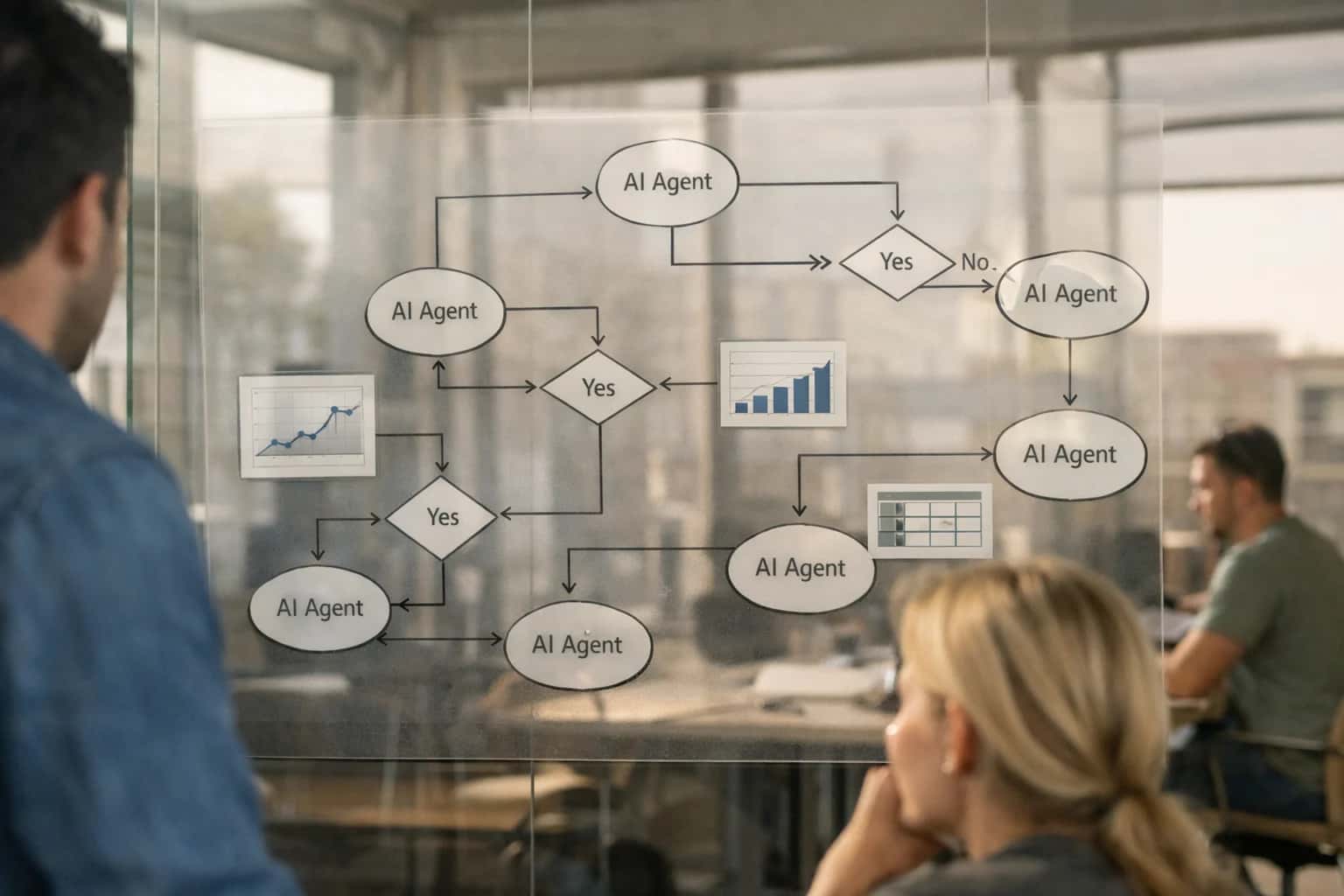
An orchestration engine is a software system that centrally manages the execution, sequencing, and state of complex, multi-step workflows involving distributed services or tasks. It acts as a central controller, directing the flow of operations, handling failures, and ensuring the overall process completes reliably. In AI agent systems, it sequences tool calls, manages API execution, and maintains workflow state across potentially long-running processes.

Glossary
Orchestration Engine
An orchestration engine is a software system that manages the execution, sequencing, and state of complex, multi-step workflows, often involving distributed services or tasks.
GLOSSARY
What is an Orchestration Engine?
A core software system for managing complex, multi-step workflows in AI and distributed computing.
The engine typically implements patterns like Directed Acyclic Graphs (DAGs) for dependency management and state machines for workflow logic. It provides critical infrastructure for resilience through circuit breakers, retry logic, and checkpointing. This enables reliable execution of business processes that span multiple microservices, databases, and external APIs, forming the backbone of agentic and autonomous system architectures.
ARCHITECTURAL PATTERNS
Core Characteristics of an Orchestration Engine
An orchestration engine is a centralized software system that manages the execution, sequencing, and state of complex, multi-step workflows. Its defining characteristics enable reliable, scalable, and observable automation of distributed tasks.
01
Centralized Control Plane
An orchestration engine operates as a central controller that dictates the execution flow of a workflow. Unlike decentralized choreography, where services communicate directly via events, the orchestrator holds the business process logic and explicitly commands each step. This provides a single source of truth for workflow state, simplifies debugging, and makes the system's behavior more deterministic and easier to reason about. Common implementations include state machines and Directed Acyclic Graphs (DAGs).
02
Durable State Management
Orchestration engines are designed to manage long-running processes that may span seconds, hours, or even days. They achieve this through durable execution, which involves checkpointing the workflow's state (inputs, outputs, and execution position) to persistent storage after each step. This allows the engine to recover from failures—such as process crashes or network partitions—by reloading the last checkpoint and resuming execution, ensuring atomicity guarantees for the overall workflow. Platforms like Temporal and Azure Durable Functions are built on this principle.
03
Resilient Error Handling
Robust orchestration requires sophisticated strategies to handle the inevitable failures in distributed systems. Key patterns include:
- Retry Logic with Exponential Backoff: Automatically reattempt failed operations with increasing delays to handle transient faults.
- Circuit Breaker: Temporarily stops calling a failing service to prevent cascading failures and allow recovery.
- Compensating Transactions (Saga Pattern): Executes a series of reversible local transactions, with defined rollback actions if a step fails, to maintain data consistency across services without distributed locks.
04
Declarative Workflow Definition
Workflows are typically defined declaratively, meaning developers specify the desired end state and the dependencies between tasks, not the imperative step-by-step code for execution. The orchestrator's reconciliation loop is responsible for interpreting this definition and driving the system to the target state. This separation of concerns makes workflows more portable, testable, and easier to visualize. Definitions are often written in YAML/JSON or domain-specific languages (DSLs) and describe tasks, their order, error policies, and timeouts.
05
Observability and Auditability
A core responsibility is providing full visibility into workflow execution. This is achieved through:
- Distributed Tracing: Correlating logs and timing data across all services involved in a single workflow instance.
- Immutable Audit Logging: Recording every tool invocation, its parameters, results, and errors for security, compliance, and debugging.
- Real-time Monitoring: Exposing metrics on workflow duration, success/failure rates, and queue depths. This telemetry is critical for agentic observability, allowing engineers to understand autonomous system behavior and performance.
06
Scalable Task Dispatching
The engine must efficiently schedule and execute tasks, which may be heterogeneous in nature (e.g., API calls, database queries, code functions). It employs patterns like fan-out to distribute independent tasks to multiple workers for parallel processing, and fan-in to aggregate the results. It manages worker pools, load balancing, and queueing to handle high throughput. This dispatching layer often integrates with container orchestration platforms like Kubernetes to dynamically scale the execution environment based on demand.
ORCHESTRATION ENGINE
Frequently Asked Questions
An orchestration engine is the central nervous system for complex, multi-step AI workflows. It manages task sequencing, state, error handling, and integration with external tools and APIs. This FAQ addresses key concepts for architects and engineers designing these critical control planes.
An orchestration engine is a software system that manages the execution, sequencing, and state of complex, multi-step workflows, often involving distributed services or tasks. It works by defining workflows as a series of steps (or tasks) with explicit dependencies. The engine interprets this definition, schedules tasks for execution (often on remote workers), manages the flow of data between steps, persists workflow state, and handles failures through retries or compensation logic. It acts as the central controller, ensuring the entire process completes reliably according to the defined business logic, even across long timeframes and system restarts.
Enabling Efficiency, Speed & Accuracy
Intelligent Analysis, Decision & Execution
We build AI systems for teams that need search across company data, workflow automation across tools, or AI features inside products and internal software.
Talk to Us
Search across company data
Give teams answers from docs, tickets, runbooks, and product data with sources and permissions.
Useful when people spend too long searching or get different answers from different systems.
Enterprise searchRAGPermissions
Read more
Automate internal workflows
Use AI to route work, draft outputs, trigger actions, and keep approvals and logs in place.
Useful when repetitive work moves across multiple tools and teams.
AI agentsWorkflow automationGovernance
Read more
Add AI to products and internal tools
Build assistants, guided actions, or decision support into the software your team or customers already use.
Useful when AI needs to be part of the product, not a separate tool.
AI integrationDecision supportModel routing
Read more
About the author
Prasad Kumkar
CEO & MD, Inference Systems
Prasad Kumkar is the CEO & MD of Inference Systems and writes about AI systems architecture, LLM infrastructure, model serving, evaluation, and production deployment. Over 5+ years, he has worked across computer vision models, L5 autonomous vehicle systems, and LLM research, with a focus on taking complex AI ideas into real-world engineering systems.
His work and writing cover AI systems, large language models, AI agents, multimodal systems, autonomous systems, inference optimization, RAG, evaluation, and production AI engineering.
LinkedIn
Limited slotsGet a Free AI Consultation
Partnered with leading AI, data, and software stack.





How We Work
Custom AI workflows for your Business
One-fit-all AI don't work for modern businesses. At Inferensys, we aim to understand your business & custom requirements; which we use to define most efficient agentic workflows, the data, and the tools for your business.
01
Review the use case
We understand the task, the users, and where AI can actually help.
Read more02
Pick the right approach
We define what needs search, automation, or product integration.
Read more03
Build the first useful version
We implement the part that proves the value first.
Read more04
Improve from there
We add the checks and visibility needed to keep it useful.
Read moreThe first call is a practical review of your use case and the right next step.
Talk to Us