Orchestration is a centralized approach to service coordination where a central controller, known as an orchestrator, directs the execution sequence, manages state, and handles errors across a workflow of distributed services or tasks. In AI systems, this involves sequencing tool calls, managing API interactions, and enforcing business logic, often modeled using a Directed Acyclic Graph (DAG). The orchestrator provides a single point of control, making workflows deterministic, auditable, and easier to debug compared to decentralized patterns.

Glossary
Orchestration
Orchestration is a centralized approach to service coordination where a central controller (orchestrator) directs the execution sequence and manages the state of participating services in a workflow.
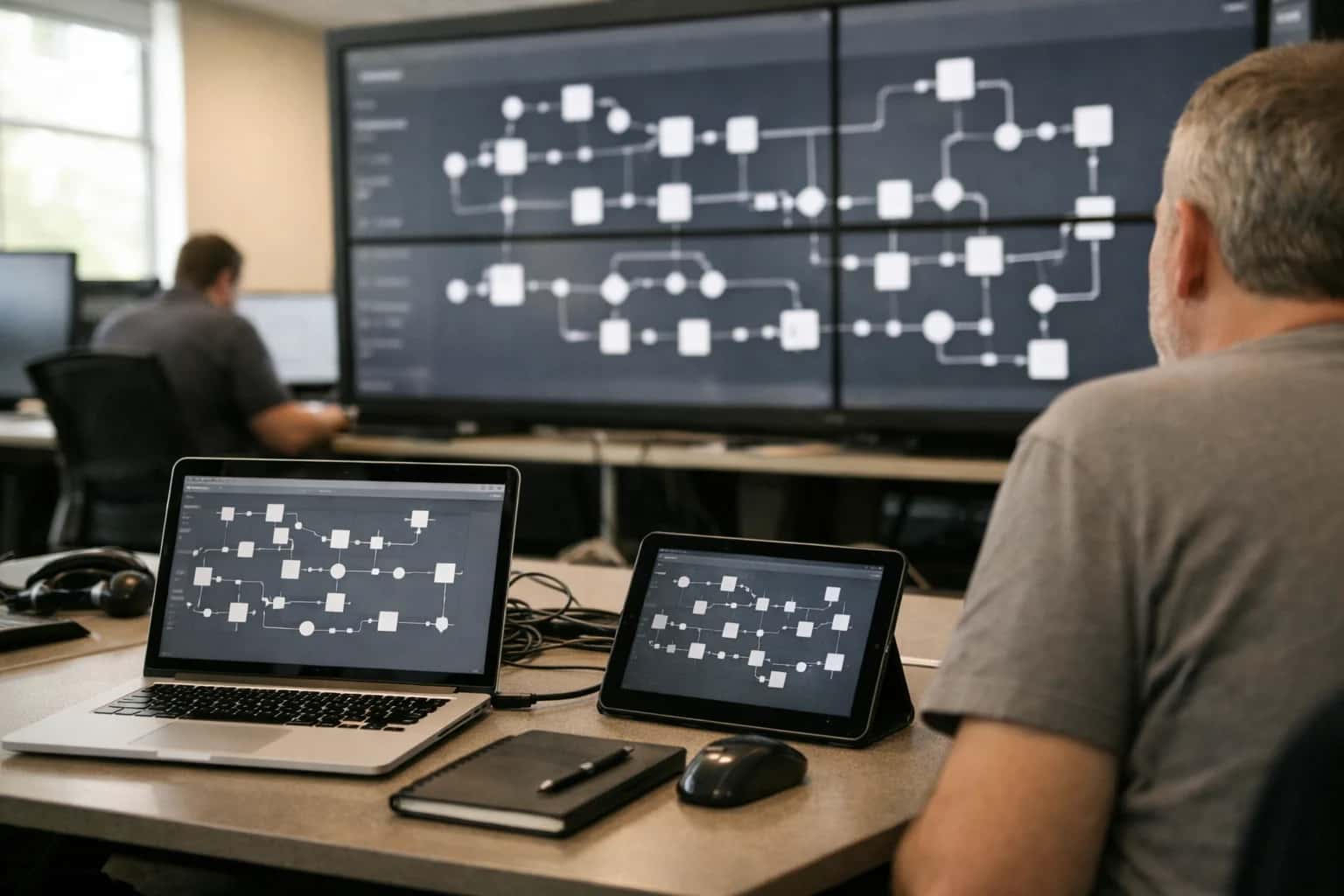
ORCHESTRATION LAYER DESIGN
What is Orchestration?
Orchestration is the centralized, programmatic management of complex, multi-step workflows, particularly within AI agent systems and distributed software architectures.
Key mechanisms include state machines for managing workflow logic, checkpointing for resilience, and patterns like the Saga pattern for maintaining data consistency across distributed transactions. Orchestration is fundamental to long-running processes, enabling features like automatic retries with exponential backoff and providing atomicity guarantees. This contrasts with choreography, a decentralized model where services coordinate via events without a central conductor.
ARCHITECTURAL PATTERNS
Core Characteristics of Orchestration
Orchestration is defined by a central controller that manages the execution sequence and state of distributed services within a workflow. These characteristics distinguish it from decentralized coordination models like choreography.
01
Centralized Control Plane
The orchestrator acts as the single source of truth for workflow logic and state. It issues commands to participating services, tracks their progress, and manages the overall execution flow. This contrasts with choreography, where services communicate peer-to-peer via events.
- Example: An AI agent workflow where a central engine sequences a tool call to a database, processes the result with an LLM, and then invokes an external API, all while maintaining the session state.
02
Stateful Workflow Management
Orchestrators are responsible for durable state persistence across potentially long-running processes. They manage checkpoints, handle failures, and ensure execution can be resumed or compensated.
- Key Mechanisms: Checkpointing, Event Sourcing, and the Saga Pattern with compensating transactions.
- Benefit: Enables complex, multi-step business transactions that are resilient to system crashes and network partitions.
03
Declarative & Imperative Execution
Orchestration allows workflows to be defined declaratively (describing the desired end state and dependencies) or imperatively (specifying exact procedural steps). The orchestrator then executes the plan.
- Declarative: Often modeled as a Directed Acyclic Graph (DAG) of tasks.
- Imperative: Coded as a state machine or procedural script.
- Platform Example: Temporal and Azure Durable Functions use imperative code but provide a runtime that handles durability and fault tolerance declaratively.
04
Resilience & Fault Tolerance
A core function is to manage failures transparently. Orchestrators implement patterns like retries with exponential backoff, circuit breakers, and timeouts to ensure workflow completion despite transient errors.
- Idempotency: Critical for safe retries. Orchestrators often attach idempotency keys to outgoing commands.
- Outcome: The system exhibits eventual consistency for the overall workflow, even if individual steps fail and are retried.
05
Observability & Auditability
Centralized control provides a natural point for distributed tracing, logging, and monitoring. Every command, event, and state change can be recorded to an immutable audit log.
- Essential For: Debugging complex flows, compliance reporting, and understanding the root cause of failures.
- Telemetry: Enables metrics on workflow duration, success rates, and step latency, which is crucial for Agentic Observability.
06
API Abstraction & Security Enforcement
The orchestrator acts as a policy enforcement point and abstraction layer between AI agents and backend services. It handles:
- API Authentication Flows (OAuth, API keys).
- Request/Response Validation against schemas.
- Permission and Scope Management for the agent.
- Can integrate with a Zero-Trust API Gateway for additional security. This isolates agents from direct access to sensitive systems.
ARCHITECTURAL PATTERN COMPARISON
Orchestration vs. Choreography
A comparison of the two primary architectural patterns for coordinating services and tasks within a distributed workflow, particularly relevant to AI agent tool-calling and API execution.
| Architectural Feature | Orchestration (Centralized) | Choreography (Decentralized) |
|---|---|---|
Control Flow | Explicitly defined and managed by a central orchestrator (e.g., an orchestration engine). | Implicitly defined by the publication and consumption of events between services. |
Workflow Logic Location | Centralized within the orchestrator. The orchestrator is the 'brain' of the workflow. | Distributed across the participating services. Each service knows which events to react to. |
Coupling | Services are loosely coupled to each other but are tightly coupled to the orchestrator's API and expectations. | Services are loosely coupled, communicating only via events. No service knows about the orchestrator. |
Visibility & Observability | High. The orchestrator has a complete, global view of the workflow state, progress, and failures, simplifying distributed tracing. | Low. Understanding the overall workflow requires aggregating logs and events from all services, which is more complex. |
Error Handling & Compensation | Centralized and straightforward. The orchestrator can implement Saga patterns, retry logic (exponential backoff), and circuit breakers globally. | Complex and distributed. Each service must handle its own failures and may need to publish compensation events, risking incomplete rollbacks. |
Modifiability | Easier to modify. Changing the workflow sequence requires updating the central orchestrator's logic only. | Harder to modify. Changing the workflow may require updating event contracts and logic across multiple independent services. |
Scalability | The orchestrator can become a performance bottleneck or single point of failure if not designed for high availability. | Inherently more scalable and resilient, as there is no central coordinator. Failure of one service does not halt the entire system. |
Best Suited For | Complex, long-running processes with strict sequencing, compensation requirements, and where a global state view is critical (e.g., multi-step AI agent tool chains). | Event-driven, reactive systems where services are highly autonomous, scalability is paramount, and workflows are simple or emergent. |
ORCHESTRATION
Frequently Asked Questions
Centralized workflow management is critical for deterministic AI agent execution. These questions address the core concepts, patterns, and trade-offs involved in designing and operating an orchestration layer.
Orchestration is a centralized approach to service coordination where a central controller (the orchestrator) directs the execution sequence, manages state, and handles errors for all participating services in a workflow. In contrast, choreography is a decentralized pattern where services communicate via events without a central controller; each service reacts to events and emits its own, defining the workflow logic implicitly through event exchange. The key distinction is control: orchestration offers explicit, manageable control flow ideal for complex, multi-step business transactions, while choreography promotes loose coupling and scalability but can be harder to debug and monitor at the workflow level.
Enabling Efficiency, Speed & Accuracy
Intelligent Analysis, Decision & Execution
We build AI systems for teams that need search across company data, workflow automation across tools, or AI features inside products and internal software.
Talk to Us
Search across company data
Give teams answers from docs, tickets, runbooks, and product data with sources and permissions.
Useful when people spend too long searching or get different answers from different systems.
Enterprise searchRAGPermissions
Read more
Automate internal workflows
Use AI to route work, draft outputs, trigger actions, and keep approvals and logs in place.
Useful when repetitive work moves across multiple tools and teams.
AI agentsWorkflow automationGovernance
Read more
Add AI to products and internal tools
Build assistants, guided actions, or decision support into the software your team or customers already use.
Useful when AI needs to be part of the product, not a separate tool.
AI integrationDecision supportModel routing
Read more
About the author
Prasad Kumkar
CEO & MD, Inference Systems
Prasad Kumkar is the CEO & MD of Inference Systems and writes about AI systems architecture, LLM infrastructure, model serving, evaluation, and production deployment. Over 5+ years, he has worked across computer vision models, L5 autonomous vehicle systems, and LLM research, with a focus on taking complex AI ideas into real-world engineering systems.
His work and writing cover AI systems, large language models, AI agents, multimodal systems, autonomous systems, inference optimization, RAG, evaluation, and production AI engineering.
LinkedIn
Limited slotsGet a Free AI Consultation
Partnered with leading AI, data, and software stack.





How We Work
Custom AI workflows for your Business
One-fit-all AI don't work for modern businesses. At Inferensys, we aim to understand your business & custom requirements; which we use to define most efficient agentic workflows, the data, and the tools for your business.
01
Review the use case
We understand the task, the users, and where AI can actually help.
Read more02
Pick the right approach
We define what needs search, automation, or product integration.
Read more03
Build the first useful version
We implement the part that proves the value first.
Read more04
Improve from there
We add the checks and visibility needed to keep it useful.
Read moreThe first call is a practical review of your use case and the right next step.
Talk to Us