Container orchestration is the automated deployment, management, scaling, and networking of containerized applications. It provides a control plane that handles the complex operational tasks required to run containers reliably across a cluster of machines. This includes scheduling containers onto nodes, managing their lifecycle, ensuring desired state, and handling failures automatically. Key platforms include Kubernetes, Docker Swarm, and Amazon ECS.

Glossary
Container Orchestration
Container orchestration is the automated process of deploying, managing, scaling, and networking containerized applications across a cluster of machines.
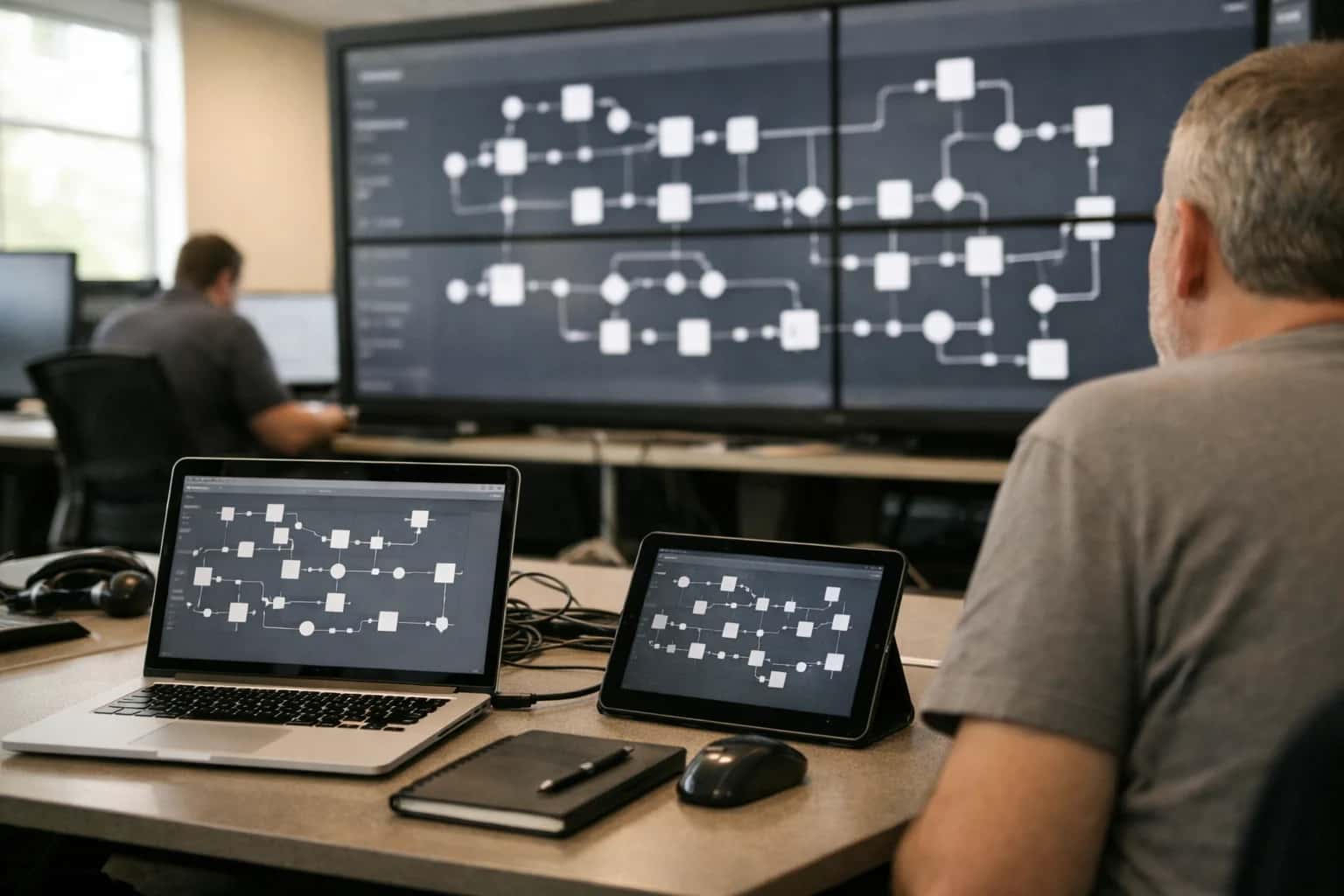
ORCHESTRATION LAYER DESIGN
What is Container Orchestration?
Container orchestration is the automated process of managing the lifecycle, scaling, networking, and availability of containerized applications, typically using platforms like Kubernetes.
The orchestrator acts as the central brain for a distributed system, implementing core patterns like service discovery, load balancing, secret management, and storage orchestration. It uses a declarative configuration model, where operators define the desired state (e.g., "run five replicas of this service"), and the orchestrator's reconciliation loop continuously works to achieve and maintain it. This automation is essential for achieving scalability, resilience, and efficient resource utilization in modern microservices and AI agent deployments.
CONTAINER ORCHESTRATION
Core Capabilities of an Orchestrator
Container orchestration platforms automate the deployment, management, scaling, and networking of containerized applications. These core capabilities are what enable reliable, scalable, and efficient operations in modern, distributed environments.
01
Automated Scheduling & Placement
The orchestrator's scheduler is responsible for placing containers onto physical or virtual nodes in a cluster. It makes decisions based on declarative requirements like:
- Resource requests and limits (CPU, memory)
- Node selectors and affinity/anti-affinity rules to control co-location
- Taints and tolerations to repel or allow workloads on specific nodes
- Resource availability and bin-packing efficiency
This automated placement ensures optimal cluster utilization and meets application constraints without manual intervention.
02
Self-Healing & Desired State Management
Orchestrators continuously monitor the cluster's actual state and compare it against the user's declarative desired state. This reconciliation loop enables automatic self-healing actions:
- Restarting containers that fail their health checks (liveness probes)
- Rescheduling pods onto healthy nodes if a node fails
- Killing and recreating containers that become unresponsive
- Scaling replicas back to the defined number if they crash
This capability is fundamental to maintaining application availability and resilience.
03
Service Discovery & Load Balancing
Orchestrators provide an internal DNS-based service discovery mechanism. When a set of containers (a Pod) is defined as a Service, the orchestrator:
- Assigns it a stable IP address (ClusterIP) and DNS name.
- Automatically tracks the dynamic IPs of all healthy pod endpoints.
- Distributes network traffic to those endpoints using load balancing (e.g., round-robin at the network or connection level).
This abstracts away the ephemeral nature of containers, allowing services to find and communicate with each other using a consistent name, regardless of their current location or instance count.
04
Horizontal & Vertical Scaling
Orchestrators enable dynamic scaling of applications to match demand:
- Horizontal Pod Autoscaling (HPA): Automatically increases or decreases the number of pod replicas based on observed CPU utilization, memory consumption, or custom metrics.
- Vertical Pod Autoscaling (VPA): Automatically adjusts the CPU and memory requests/limits for containers within a pod based on usage history.
- Cluster Autoscaling: Adds or removes worker nodes from the cluster itself when there are insufficient resources for pending pods or when nodes are underutilized.
This multi-level scaling ensures efficient resource use and application responsiveness.
05
Rolling Updates & Rollbacks
Orchestrators manage the safe deployment of new application versions using controlled update strategies:
- Rolling Update: Gradually replaces old pod instances with new ones, ensuring a specified number of pods remain available throughout the process. This is the default strategy in platforms like Kubernetes.
- Blue-Green Deployment: Maintains two identical environments (blue and green). Traffic is switched from the old (blue) to the new (green) version instantly after validation.
- Canary Release: Deploys the new version to a small subset of users or traffic first for testing before a full rollout.
If a deployment fails health checks, the orchestrator can automatically rollback to the previous known-good version, minimizing downtime and risk.
06
Storage Orchestration
Containers are inherently stateless. Orchestrators provide abstractions to attach persistent storage to stateful applications. Key concepts include:
- PersistentVolumes (PV): A piece of networked storage (e.g., NFS, cloud disk) in the cluster that has been provisioned by an administrator.
- PersistentVolumeClaims (PVC): A user's request for storage (size, access modes). The orchestrator binds a PVC to a suitable PV.
- StorageClass: Allows dynamic provisioning of PVs on-demand, based on the PVC, using predefined cloud or on-prem storage types.
This allows databases and other stateful workloads to run reliably in a containerized environment, surviving pod rescheduling.
SYSTEM ARCHITECTURE
How Container Orchestration Works
Container orchestration automates the deployment, management, scaling, and networking of containerized applications across a cluster of machines.
Container orchestration is the automated management of containerized applications across a distributed cluster of hosts. A central orchestrator, like Kubernetes, acts as a control plane, receiving declarative manifests that define the desired application state. It then schedules containers onto available worker nodes, manages their lifecycle, and continuously reconciles the actual state with the declared intent through a reconciliation loop. This ensures applications remain available and scalable despite node failures or traffic spikes.
The orchestrator handles core operational concerns: service discovery and load balancing to route traffic, auto-scaling based on metrics, storage orchestration for persistent volumes, and secret management for credentials. It enforces resource limits, performs rolling updates and canary deployments for safe releases, and provides comprehensive observability through logs and metrics. This automation abstracts the underlying infrastructure, allowing developers to define what should run, not how to run it.
CONTAINER ORCHESTRATION
Frequently Asked Questions
Container orchestration automates the deployment, management, scaling, and networking of containerized applications. This FAQ addresses core concepts for architects and engineers designing the control plane for AI agent workflows.
Container orchestration is the automated process of managing the lifecycle, networking, scaling, and availability of containerized applications across a cluster of machines. It works by using a declarative configuration file (e.g., a Kubernetes YAML manifest) that describes the desired state of the application—such as the number of replicas, resource limits, and network policies. A central orchestration engine, like the Kubernetes control plane, continuously runs a reconciliation loop, observing the actual state of the cluster and issuing commands to container runtimes to align the system with the declared desired state. This involves scheduling containers onto healthy nodes, restarting failed instances, scaling workloads based on demand, and managing service discovery and load balancing.
Enabling Efficiency, Speed & Accuracy
Intelligent Analysis, Decision & Execution
We build AI systems for teams that need search across company data, workflow automation across tools, or AI features inside products and internal software.
Talk to Us
Search across company data
Give teams answers from docs, tickets, runbooks, and product data with sources and permissions.
Useful when people spend too long searching or get different answers from different systems.
Enterprise searchRAGPermissions
Read more
Automate internal workflows
Use AI to route work, draft outputs, trigger actions, and keep approvals and logs in place.
Useful when repetitive work moves across multiple tools and teams.
AI agentsWorkflow automationGovernance
Read more
Add AI to products and internal tools
Build assistants, guided actions, or decision support into the software your team or customers already use.
Useful when AI needs to be part of the product, not a separate tool.
AI integrationDecision supportModel routing
Read more
About the author
Prasad Kumkar
CEO & MD, Inference Systems
Prasad Kumkar is the CEO & MD of Inference Systems and writes about AI systems architecture, LLM infrastructure, model serving, evaluation, and production deployment. Over 5+ years, he has worked across computer vision models, L5 autonomous vehicle systems, and LLM research, with a focus on taking complex AI ideas into real-world engineering systems.
His work and writing cover AI systems, large language models, AI agents, multimodal systems, autonomous systems, inference optimization, RAG, evaluation, and production AI engineering.
LinkedIn
Limited slotsGet a Free AI Consultation
Partnered with leading AI, data, and software stack.





How We Work
Custom AI workflows for your Business
One-fit-all AI don't work for modern businesses. At Inferensys, we aim to understand your business & custom requirements; which we use to define most efficient agentic workflows, the data, and the tools for your business.
01
Review the use case
We understand the task, the users, and where AI can actually help.
Read more02
Pick the right approach
We define what needs search, automation, or product integration.
Read more03
Build the first useful version
We implement the part that proves the value first.
Read more04
Improve from there
We add the checks and visibility needed to keep it useful.
Read moreThe first call is a practical review of your use case and the right next step.
Talk to Us