Integration testing is a software testing level where individual units or modules are combined and tested as a group to verify they interact correctly through their defined interfaces. It focuses on exposing faults in the interaction between integrated components, such as data format mismatches, API contract violations, or incorrect assumptions about shared state. This testing phase sits between unit testing (isolated components) and end-to-end testing (complete system workflows).

Glossary
Integration Testing
Integration testing is a software testing level where individual modules are combined and tested as a group to verify they interact correctly through their defined interfaces.
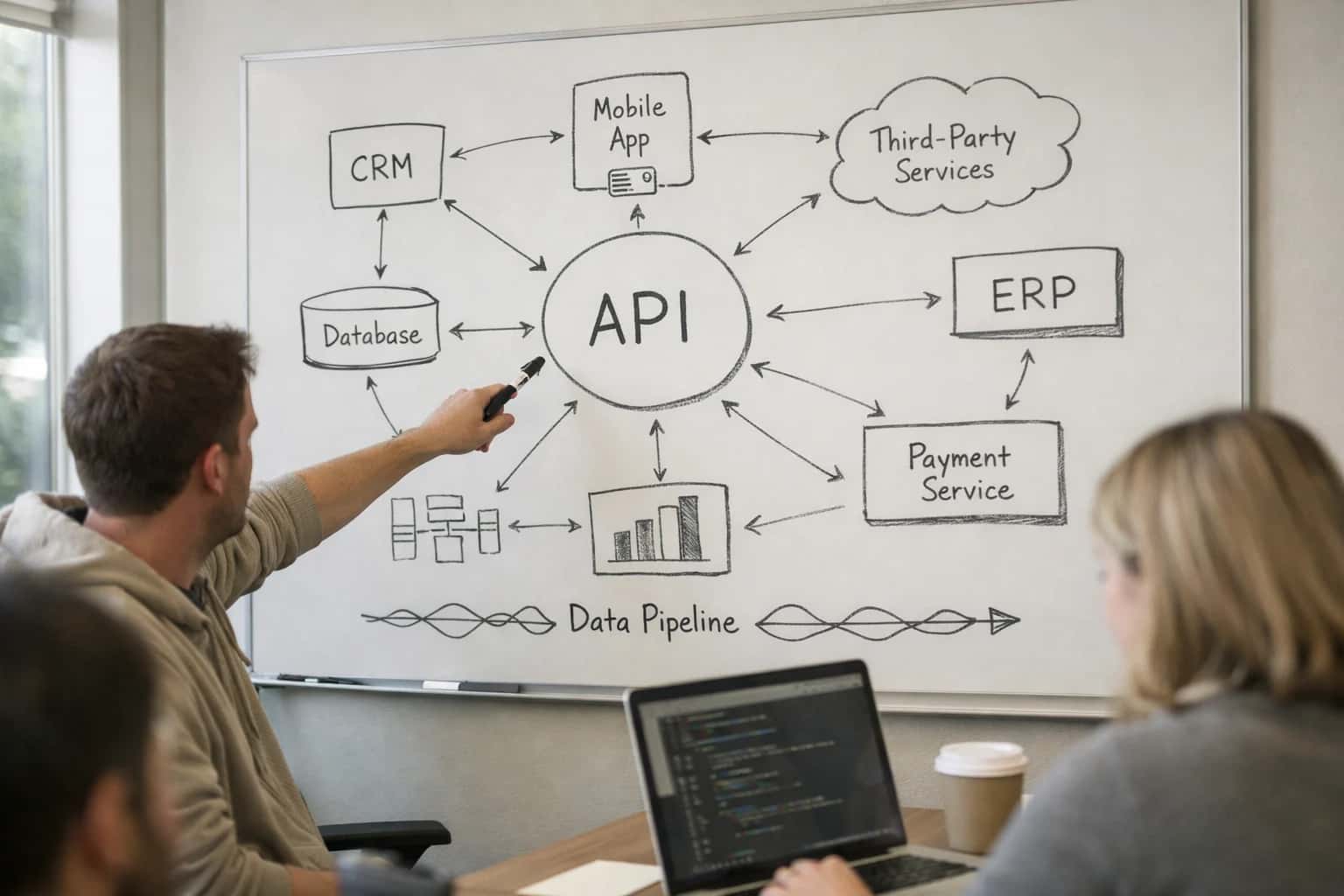
SOFTWARE TESTING
What is Integration Testing?
Integration testing is a critical phase of software testing that validates the interactions between combined software modules.
In modern architectures, especially those involving AI agents and API-driven services, integration testing validates that autonomous systems correctly call external tools, parse responses, and handle errors. It often employs test doubles like mocks and stubs to isolate the system under test from external dependencies. Effective integration testing is essential for continuous testing pipelines, ensuring that new code integrates seamlessly without breaking existing functionality, a core concern for DevOps and QA automation engineers.
AUTOMATED API TESTING SUITES
Key Integration Testing Approaches
Integration testing validates the interactions between combined software modules. In the context of AI agents and APIs, these approaches ensure that autonomous tool calls and data exchanges function correctly within a larger system.
01
Big Bang Integration Testing
A non-incremental approach where all modules or components are integrated simultaneously and tested as a complete system. This method is high-risk and complex to debug, as isolating the source of a failure is difficult when many new interactions are introduced at once.
- Best for: Small systems or after major development milestones.
- Primary Risk: Fault localization is challenging, leading to longer debug cycles.
- AI Agent Context: Simulates the agent's full deployment environment with all external tools (APIs, databases) connected, testing the complete orchestration layer in one go.
02
Incremental Integration Testing
A systematic approach where modules are integrated and tested one or a few at a time, using stubs and drivers to simulate missing components. This allows for earlier defect detection and easier fault isolation.
- Top-Down: Integration starts from the main control module (the AI agent's core) and proceeds downward to submodules. Stubs simulate lower-level tool calls.
- Bottom-Up: Integration begins with the lowest-level modules (e.g., individual API clients) and proceeds upward. Drivers simulate higher-level calling modules.
- Sandwich/Hybrid: A combination of top-down and bottom-up approaches, integrating towards a middle layer (often the orchestration logic).
03
API Contract Testing
A variant of integration testing that focuses on the formal agreement—the contract—between a service consumer (AI agent) and a service provider (external API). It validates that requests and responses conform to a shared specification like an OpenAPI Schema.
- Consumer-Driven: The AI agent's expected calls define the contract, which the API provider must fulfill.
- Provider-Driven: The API's published schema defines the contract, which the AI agent must adhere to.
- Tools: Frameworks like Pact or Spring Cloud Contract automate the generation and verification of these contracts, ensuring the agent's tool-calling logic remains compatible with API evolution.
04
Scenario-Based Integration Testing
Testing is organized around specific user journeys or business workflows that span multiple integrated components. This validates that the system delivers correct end-to-end behavior for key use cases.
- Focus: Business logic and data flow across module boundaries.
- Example for AI Agents: Testing the complete workflow of "Process Customer Support Ticket," which involves the agent calling a CRM API, a knowledge base search, and a ticket update API in sequence.
- Outcome: Ensures not just that individual connections work, but that the orchestrated sequence of tool calls achieves the intended business outcome.
05
Continuous Integration (CI) Pipeline Testing
The practice of automatically executing integration tests within a CI/CD pipeline whenever code changes are merged. This provides rapid feedback on the compatibility of new AI agent logic or API client updates with the existing integrated system.
- Triggers: Code commits, pull requests, or scheduled runs.
- Environment: Uses a dedicated, production-like staging environment with mocked or sandboxed external services.
- Goal: To prevent integration debt and catch breaking changes in interdependent modules before they reach production. This is critical for maintaining the reliability of autonomous agent systems.
06
Risk-Based Integration Testing
An approach that prioritizes integration efforts based on the assessed risk of failure and the criticality of specific component interactions. Resources are focused on the most complex and business-critical integrations first.
- High-Risk Factors:
- Complex Dependencies: Modules with many interactions (e.g., the core agent orchestrator).
- External Services: Third-party APIs with unstable SLAs or frequent changes.
- Data Sensitivity: Integrations handling PII or financial transactions.
- Application: Guides test planning and resource allocation, ensuring that the most vital connections in an AI agent's toolset are the most rigorously validated.
COMPARISON
Integration Testing vs. Other Test Levels
This table compares the primary characteristics of integration testing against other fundamental levels of software testing, highlighting their distinct purposes, scopes, and typical execution contexts.
| Characteristic | Unit Testing | Integration Testing | End-to-End (E2E) Testing |
|---|---|---|---|
Primary Objective | Validate the correctness of individual functions or modules in isolation. | Verify the correct interaction and data flow between integrated modules or services. | Validate the complete system workflow from a user's perspective against business requirements. |
Scope Under Test | A single unit, class, or function. | Interfaces and interactions between two or more units, services, or databases. | The entire, fully assembled application and its external dependencies. |
Test Double Usage | Heavy use of mocks, stubs, and fakes to isolate the unit. | Strategic use of mocks for external dependencies; real components for those being integrated. | Minimal use; relies on production-like services and data where possible. |
Execution Speed | Very fast (milliseconds). | Moderate (seconds to minutes). | Slow (minutes to hours). |
Failure Indication | A bug within the specific unit's logic. | An interface mismatch, protocol error, or data schema incompatibility. | A breakdown in the user journey, system integration, or environmental issue. |
Primary Contributor | Developers. | Developers and QA Automation Engineers. | QA Engineers and SDETs. |
Feedback Cycle | Immediate, during development. | Post-commit, within CI/CD pipeline. | Later-stage, often pre-release or in staging. |
Cost to Maintain | Low. | Moderate. | High. |
INTEGRATION TESTING
Frequently Asked Questions
Integration testing is a critical phase in software development where combined modules are validated as a group. This FAQ addresses common questions about its role in ensuring reliable AI-agent-driven API integrations.
Integration testing is a level of software testing where individually developed modules or services are combined and tested as a group to verify they interact correctly through their defined interfaces. It works by assembling these components incrementally—using strategies like top-down, bottom-up, or big-bang integration—and executing test cases that simulate real interactions, such as API calls and data exchanges, to uncover interface defects, data flow errors, and protocol mismatches that unit testing cannot detect.
In the context of AI agents and tool calling, integration testing validates that the agent correctly parses an OpenAPI schema, constructs a valid HTTP request with proper authentication (e.g., OAuth tokens), handles the live API's response, and processes any errors according to the defined orchestration layer logic.
Enabling Efficiency, Speed & Accuracy
Intelligent Analysis, Decision & Execution
We build AI systems for teams that need search across company data, workflow automation across tools, or AI features inside products and internal software.
Talk to Us
Search across company data
Give teams answers from docs, tickets, runbooks, and product data with sources and permissions.
Useful when people spend too long searching or get different answers from different systems.
Enterprise searchRAGPermissions
Read more
Automate internal workflows
Use AI to route work, draft outputs, trigger actions, and keep approvals and logs in place.
Useful when repetitive work moves across multiple tools and teams.
AI agentsWorkflow automationGovernance
Read more
Add AI to products and internal tools
Build assistants, guided actions, or decision support into the software your team or customers already use.
Useful when AI needs to be part of the product, not a separate tool.
AI integrationDecision supportModel routing
Read more
About the author
Prasad Kumkar
CEO & MD, Inference Systems
Prasad Kumkar is the CEO & MD of Inference Systems and writes about AI systems architecture, LLM infrastructure, model serving, evaluation, and production deployment. Over 5+ years, he has worked across computer vision models, L5 autonomous vehicle systems, and LLM research, with a focus on taking complex AI ideas into real-world engineering systems.
His work and writing cover AI systems, large language models, AI agents, multimodal systems, autonomous systems, inference optimization, RAG, evaluation, and production AI engineering.
LinkedIn
Limited slotsGet a Free AI Consultation
Partnered with leading AI, data, and software stack.





How We Work
Custom AI workflows for your Business
One-fit-all AI don't work for modern businesses. At Inferensys, we aim to understand your business & custom requirements; which we use to define most efficient agentic workflows, the data, and the tools for your business.
01
Review the use case
We understand the task, the users, and where AI can actually help.
Read more02
Pick the right approach
We define what needs search, automation, or product integration.
Read more03
Build the first useful version
We implement the part that proves the value first.
Read more04
Improve from there
We add the checks and visibility needed to keep it useful.
Read moreThe first call is a practical review of your use case and the right next step.
Talk to Us