An audit trail is an immutable, chronological record of all events and actions taken within a system, providing a verifiable history for security, compliance, and forensic analysis. In the context of AI tool calling and API execution, it captures every agent invocation—including the function called, parameters passed, credentials used, and the result returned—creating a complete chain of evidence for autonomous operations. This tamper-evident log is essential for non-repudiation, ensuring no action can be denied after the fact.

Glossary
Audit Trail
An audit trail is an immutable, chronological record of all events and actions taken within a system, providing a verifiable history for security, compliance, and forensic analysis.
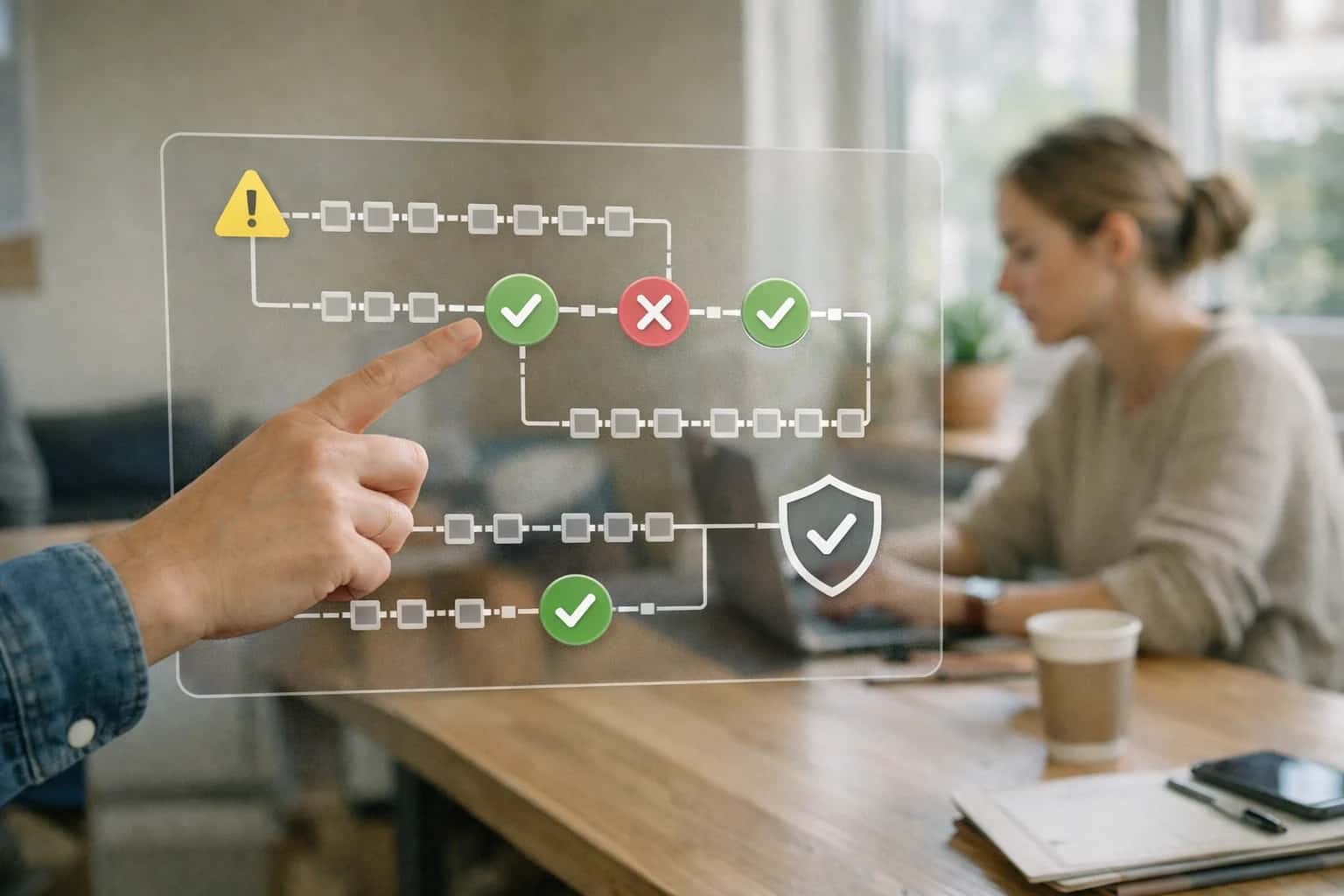
GLOSSARY
What is an Audit Trail?
A foundational concept in secure AI operations and compliance, the audit trail is the definitive record of system activity.
Engineers implement audit trails using immutable logs and event sourcing patterns, often writing to Write-Once Read-Many (WORM) storage. For observability, these logs are enriched with context and correlated using distributed tracing IDs. The primary use cases are compliance logging for regulations like GDPR or HIPAA, security information and event management (SIEM) for threat detection, and root cause analysis (RCA) for debugging failed agent workflows. A robust log retention policy governs the lifecycle of this critical telemetry data.
ARCHITECTURAL ELEMENTS
Core Components of an AI Audit Trail
An AI audit trail is a composite system built from several critical, interdependent components. Each component serves a distinct function in capturing, securing, and making sense of autonomous agent activity.
01
Immutable Log Store
The foundational write-once, read-many (WORM) storage layer where all audit events are permanently recorded. This component ensures data integrity by preventing the alteration or deletion of log entries after creation. It is typically implemented using:
- Append-only databases or specialized log stores.
- Cryptographic hashing (e.g., Merkle trees) to create a tamper-evident chain of entries.
- Write-ahead logs (WAL) from database systems or dedicated services like Apache Kafka with retention policies. Its primary purpose is to provide an indisputable, chronological record for forensic analysis and compliance evidence.
02
Structured Event Schema
A predefined, machine-readable data model that defines the exact format and semantics of every logged event. This schema enforces consistency and enables automated analysis. A robust schema for AI tool use includes:
- Universal fields: Timestamp (ISO 8601), unique event ID, agent/session ID, trace ID for distributed tracing.
- Tool invocation context: Tool name, provider, version, and the full API endpoint called.
- Input/Output payloads: The exact parameters sent and the raw response received, often stored as JSON.
- Execution metadata: Latency, status code (success, error), token usage, and the model's reasoning trace if available.
- Security context: User identity (with PII redaction), authorization scope, and originating IP address.
03
Instrumentation & Telemetry Agents
The lightweight software components embedded within the AI agent runtime that automatically capture and emit audit events. These agents are responsible for the real-time observability of autonomous actions. Key implementations include:
- SDK hooks within orchestration layers (e.g., LangChain, LlamaIndex) that intercept all tool calls.
- Sidecar proxies in a service mesh that inspect and log outbound API traffic from agents.
- OpenTelemetry (OTel) instrumentation, exporting spans and events as trace data to a collector.
- Function wrappers/decorators that execute around each tool call to capture timing, inputs, and outputs. This component ensures comprehensive coverage without requiring manual logging in business logic.
04
Cryptographic Integrity Mechanisms
The cryptographic protocols that provide non-repudiation and prove the log's authenticity. These mechanisms prevent and detect tampering, making the audit trail legally defensible. Core techniques involve:
- Digital Signatures: Each log entry or batch is signed with a private key, allowing any party to verify its origin and integrity with the corresponding public key.
- Hash Chains: The cryptographic hash of each log entry includes the hash of the previous entry, creating an immutable sequence. Altering any entry breaks the chain.
- Trusted Timestamping: Using a Trusted Timestamp Authority (TSA) to cryptographically bind a hash of the log to a verifiable point in time.
- Sealed Storage: Leveraging hardware security modules (HSMs) or trusted execution environments (TEEs) for key management and signing operations.
05
Query & Analysis Engine
The processing layer that enables security teams and engineers to interrogate the audit trail. It transforms raw log data into actionable intelligence. This engine provides:
- High-performance indexing on critical fields like timestamp, user, tool name, and status code.
- A query language (e.g., SQL, Lucene-based) for complex, ad-hoc investigations (e.g., "Show all database writes by Agent X in the last hour").
- Real-time streaming for anomaly detection and alerting on suspicious patterns (e.g., rapid-fire failed authentication attempts).
- Aggregation and dashboarding to visualize metrics like tool call volume, latency percentiles, and error rates over time.
- Integration with Security Information and Event Management (SIEM) systems for correlation with other security logs.
06
Retention & Lifecycle Manager
The policy enforcement system that governs the storage duration, archival, and secure deletion of audit data. This component operationalizes the log retention policy to balance utility, cost, and legal obligations. Its functions include:
- Automated tiering: Moving older logs from hot storage (for querying) to cold/archival storage (e.g., Amazon S3 Glacier) based on time-to-live (TTL) rules.
- Legal hold: Isolating and preserving logs relevant to an active investigation or litigation, overriding standard deletion rules.
- Secure deletion: Using cryptographic erasure or physical destruction methods for data at end-of-life to meet privacy regulations like GDPR's "right to be forgotten."
- Compliance reporting: Generating attestations and proof of adherence to retention requirements for standards like PCI DSS (minimum 1 year) or HIPAA (6 years).
AUDIT TRAIL
Frequently Asked Questions
An audit trail is a foundational component of secure and compliant AI operations. These questions address its core purpose, technical implementation, and critical role in enterprise governance.
An audit trail is an immutable, chronological record of all events and actions taken within an AI system, providing a verifiable history for security, compliance, and forensic analysis. In the context of tool calling and API execution, it specifically logs every invocation of an external function, including the parameters sent, the identity of the invoking agent, the timestamp, the API response, and any errors encountered. This creates a chain of custody for AI-driven actions, enabling teams to reconstruct exactly what happened, debug failures, prove compliance with regulations like GDPR or HIPAA, and detect anomalous or malicious behavior. It is the core data source for agentic observability and is often implemented using immutable logs or event sourcing patterns.
Enabling Efficiency, Speed & Accuracy
Intelligent Analysis, Decision & Execution
We build AI systems for teams that need search across company data, workflow automation across tools, or AI features inside products and internal software.
Talk to Us
Search across company data
Give teams answers from docs, tickets, runbooks, and product data with sources and permissions.
Useful when people spend too long searching or get different answers from different systems.
Enterprise searchRAGPermissions
Read more
Automate internal workflows
Use AI to route work, draft outputs, trigger actions, and keep approvals and logs in place.
Useful when repetitive work moves across multiple tools and teams.
AI agentsWorkflow automationGovernance
Read more
Add AI to products and internal tools
Build assistants, guided actions, or decision support into the software your team or customers already use.
Useful when AI needs to be part of the product, not a separate tool.
AI integrationDecision supportModel routing
Read more
About the author
Prasad Kumkar
CEO & MD, Inference Systems
Prasad Kumkar is the CEO & MD of Inference Systems and writes about AI systems architecture, LLM infrastructure, model serving, evaluation, and production deployment. Over 5+ years, he has worked across computer vision models, L5 autonomous vehicle systems, and LLM research, with a focus on taking complex AI ideas into real-world engineering systems.
His work and writing cover AI systems, large language models, AI agents, multimodal systems, autonomous systems, inference optimization, RAG, evaluation, and production AI engineering.
LinkedIn
Limited slotsGet a Free AI Consultation
Partnered with leading AI, data, and software stack.





How We Work
Custom AI workflows for your Business
One-fit-all AI don't work for modern businesses. At Inferensys, we aim to understand your business & custom requirements; which we use to define most efficient agentic workflows, the data, and the tools for your business.
01
Review the use case
We understand the task, the users, and where AI can actually help.
Read more02
Pick the right approach
We define what needs search, automation, or product integration.
Read more03
Build the first useful version
We implement the part that proves the value first.
Read more04
Improve from there
We add the checks and visibility needed to keep it useful.
Read moreThe first call is a practical review of your use case and the right next step.
Talk to Us