The EON Compiler is a model optimization tool within the Edge Impulse platform that applies compression techniques like quantization and pruning to reduce a neural network's size and latency for deployment on resource-constrained edge devices. It performs hardware-aware optimizations, analyzing the target microcontroller's memory and compute profile to generate the most efficient executable code, often outputting a C array model or FlatBuffer for direct firmware integration.

Glossary
EON Compiler
The EON Compiler is a model optimization tool within the Edge Impulse platform that applies compression techniques like quantization and pruning to reduce model size and latency for edge deployment.
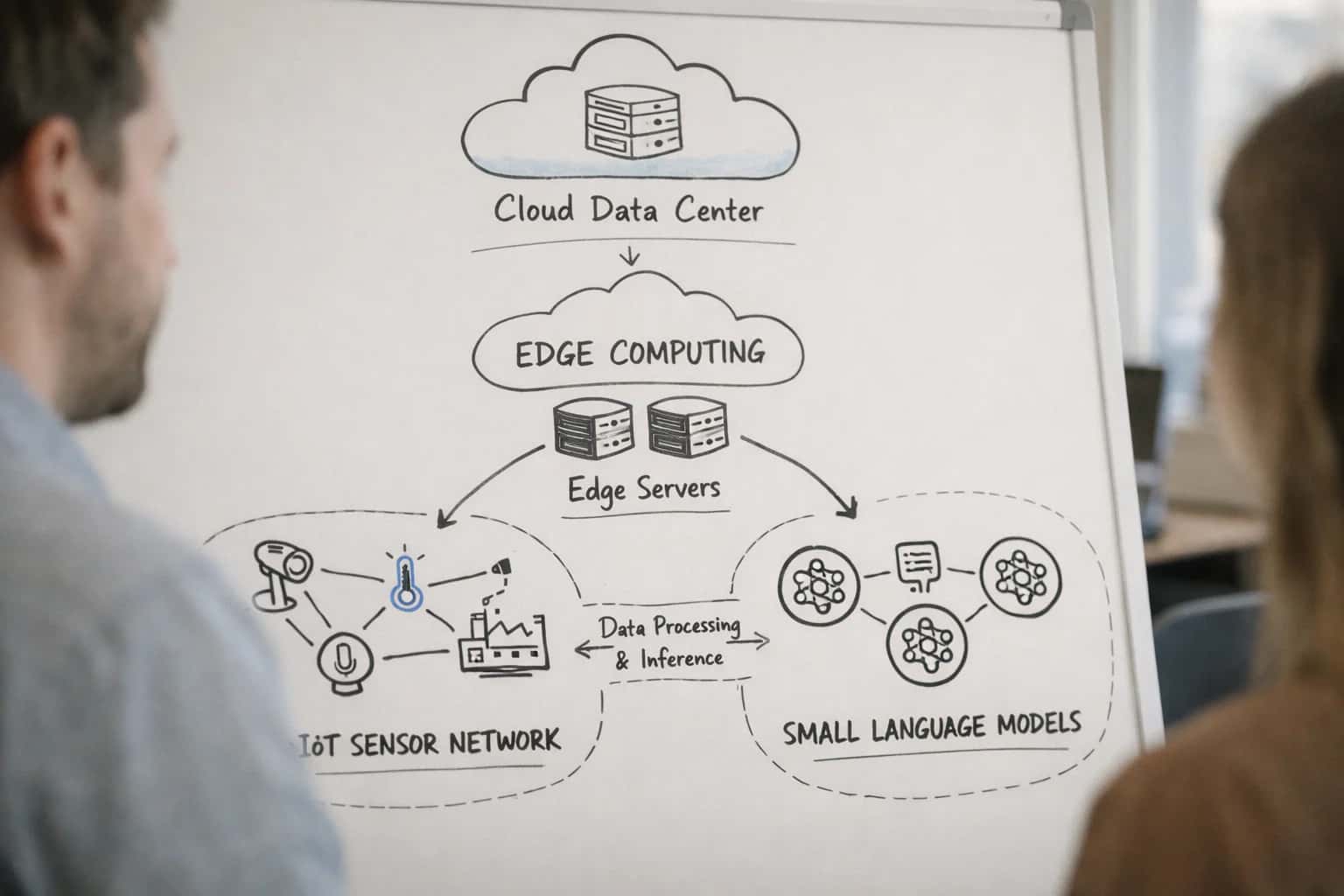
TINYML FRAMEWORK
What is the EON Compiler?
A specialized model optimization tool within the Edge Impulse platform for deploying neural networks to microcontrollers.
Operating as a core component of the TinyML deployment workflow, EON Compiler enables graph optimization and operator fusion to minimize RAM usage and CPU cycles. It works in conjunction with embedded ML frameworks like TensorFlow Lite Micro, transforming a trained model into a form that can run efficiently within the severe kilobyte-scale memory budgets typical of microcontrollers, facilitating the transition from cloud-based training to on-device inference.
TINYML FRAMEWORKS
Key Features of the EON Compiler
The EON Compiler is the core model optimization engine within the Edge Impulse platform, transforming trained neural networks into highly efficient code for deployment on microcontrollers and other edge devices.
01
Automated Model Optimization
The EON Compiler applies a suite of post-training optimization techniques to reduce model size and latency without requiring retraining. Key techniques include:
- Quantization: Converts model weights and activations from 32-bit floating-point to 8-bit integers (int8), drastically reducing memory footprint and accelerating computation on MCUs that lack FPUs.
- Pruning: Identifies and removes redundant or less important neurons and connections from the network, creating a sparser, more efficient model.
- Weight Clustering: Groups similar weight values together, enabling more efficient storage and potentially leveraging specialized hardware instructions. These optimizations are applied automatically based on the target hardware profile, balancing accuracy loss against performance gains.
02
Hardware-Aware Compilation
The compiler generates code specifically tuned for the target microcontroller's architecture. It performs hardware-aware optimizations such as:
- Selecting the most efficient kernel implementations (e.g., using CMSIS-NN libraries for Arm Cortex-M cores).
- Optimizing memory layout to minimize costly RAM accesses and leverage faster memory regions.
- Planning the tensor arena (memory for intermediate activations) to use a single, statically allocated buffer, eliminating dynamic allocation overhead. This process ensures the compiled model exploits the specific capabilities (and works within the constraints) of chips like the Nordic nRF52, STM32, or ESP32 series.
03
Output as Portable C/C++ Libraries
The final output of the EON Compiler is not a generic model file but a self-contained, portable C/C++ library. This library includes:
- The optimized model weights and architecture as a constant C array embedded in the source code.
- A minimal, dependency-free inference API (e.g.,
run_inference()). - All necessary kernel functions for the model's operations. This library can be directly imported into standard embedded development environments like Arduino, Mbed, or STM32CubeIDE and linked with the main firmware application, simplifying integration.
04
Integrated Performance Profiling
Before deployment, the EON Compiler provides a detailed resource consumption profile for the optimized model. This profile is critical for embedded developers and includes predictions for:
- Flash/RAM Usage: Breakdown of memory required for the model weights (ROM), tensor arena (RAM), and code.
- Latency: Estimated inference time per prediction on the target hardware.
- Peak Memory Usage: The maximum RAM consumed during execution. This profiling allows engineers to verify the model fits within the device's kilobyte-scale memory budget and meets real-time latency requirements before committing to firmware integration.
05
Support for Heterogeneous Targets
The compiler supports a wide range of deployment targets, from standard microcontrollers to devices with specialized AI accelerators. This includes:
- CPU-Only MCUs (e.g., Arm Cortex-M0+/M4): Generates optimized C code leveraging DSP extensions.
- MicroNPU-Accelerated Chips (e.g., with Arm Ethos-U55): Can partition the model graph, compiling layers to run on the AI coprocessor while others run on the CPU for maximum efficiency.
- DSP Cores: Optimizes certain operations for available digital signal processing units. This flexibility ensures developers can get the best performance from their specific hardware, whether it's a generic MCU or a system-on-chip with dedicated AI silicon.
06
Seamless Integration with Edge Impulse Studio
The EON Compiler is not a standalone tool but is deeply integrated into the Edge Impulse Studio workflow. This integration enables:
- One-Click Deployment: After model training and testing in the studio, a single click triggers the EON Compiler and packages the output as a downloadable library or full firmware binary.
- Continuous Validation: The compiler's performance estimates are cross-referenced with actual profiling data from the studio's test suite, ensuring accuracy.
- Versioning & Reproducibility: Each compiled model is tied to a specific project version, guaranteeing reproducible builds. This creates a closed-loop, MLOps-like pipeline for TinyML, from data collection to deployed optimized model.
FEATURE COMPARISON
EON Compiler vs. Other TinyML Compilers
A technical comparison of the EON Compiler's capabilities against other common TinyML compilation and optimization toolchains.
| Feature / Metric | EON Compiler (Edge Impulse) | TensorFlow Lite Micro (TFLM) | STM32Cube.AI | MicroTVM (Apache TVM) |
|---|---|---|---|---|
Primary Optimization Goal | Minimize latency & memory for real-time sensor inference | Portability & framework compatibility across MCUs | Maximize performance on STM32 MCU families | Hardware-agnostic performance via TVM intermediate representation |
Quantization Support | Int8, Int16, Float32 (automatic during export) | Int8, Int16, Float32 (requires post-training or QAT) | Int8, Int16, Float32 (via conversion tool) | Int4, Int8, Int16, Float32 (via relay quantization passes) |
Pruning & Structural Sparsity | ||||
Automatic Kernel Fusion | ||||
Memory Planning | Static tensor arena with optimal allocation | Static or greedy allocator (depends on build) | Static allocation determined during conversion | Advanced static planning via TVM's memory allocator |
Hardware-Specific Optimizations | Generic ARM Cortex-M; leverages CMSIS-NN if available | Reference kernels; relies on CMSIS-NN for Arm optimization | Extensive STM32-specific kernel libraries & CRC integration | Target-specific via TVM schedules and vendor integrations |
Model Format Input | .tflite, .onnx (via Edge Impulse Studio) | .tflite (primary), limited .keras | Keras, TFLite, ONNX, Lasagne, Caffe | .tflite, .onnx, PyTorch, Keras, MXNet (via relay frontends) |
Output Format | Optimized C++ library with project files | C++ API with FlatBuffer model or C array | Generated C code with IDE project files | Generated C runtime code or minimal TVM runtime |
Integrated Profiling & Estimation | Detailed RAM/ROM/flash estimates pre-deployment | Basic benchmark tool (model benchmark) | Resource consumption report after conversion | Advanced cost modeling and profiling via TVM |
End-to-End Platform Integration | Full cloud-to-device workflow in Edge Impulse Studio | Standalone library; integration into larger TF ecosystem | Integrated into STM32CubeMX IDE & toolchain | Standalone compiler; requires integration into custom toolchain |
License | Proprietary (free tier available) | Apache 2.0 (open source) | Proprietary (free with STM32 products) | Apache 2.0 (open source) |
EON COMPILER
Frequently Asked Questions
The EON Compiler is a core component of the Edge Impulse platform, specializing in the transformation and optimization of machine learning models for deployment on highly constrained microcontroller units (MCUs).
The EON Compiler is a model optimization and deployment tool within the Edge Impulse platform that transforms trained neural networks into highly efficient, deployable code for microcontrollers. It works by ingesting a model from a standard framework like TensorFlow or PyTorch and applying a series of hardware-aware optimizations. The process involves graph optimization (e.g., operator fusion, constant folding), post-training quantization to convert weights and activations to 8-bit integers, and memory planning to minimize RAM usage. Finally, it outputs a C array model or a FlatBuffer model linked with an optimized inference runtime (like TensorFlow Lite Micro) ready for compilation into the target device's firmware.
Enabling Efficiency, Speed & Accuracy
Intelligent Analysis, Decision & Execution
We build AI systems for teams that need search across company data, workflow automation across tools, or AI features inside products and internal software.
Talk to Us
Search across company data
Give teams answers from docs, tickets, runbooks, and product data with sources and permissions.
Useful when people spend too long searching or get different answers from different systems.
Enterprise searchRAGPermissions
Read more
Automate internal workflows
Use AI to route work, draft outputs, trigger actions, and keep approvals and logs in place.
Useful when repetitive work moves across multiple tools and teams.
AI agentsWorkflow automationGovernance
Read more
Add AI to products and internal tools
Build assistants, guided actions, or decision support into the software your team or customers already use.
Useful when AI needs to be part of the product, not a separate tool.
AI integrationDecision supportModel routing
Read more
About the author
Prasad Kumkar
CEO & MD, Inference Systems
Prasad Kumkar is the CEO & MD of Inference Systems and writes about AI systems architecture, LLM infrastructure, model serving, evaluation, and production deployment. Over 5+ years, he has worked across computer vision models, L5 autonomous vehicle systems, and LLM research, with a focus on taking complex AI ideas into real-world engineering systems.
His work and writing cover AI systems, large language models, AI agents, multimodal systems, autonomous systems, inference optimization, RAG, evaluation, and production AI engineering.
LinkedIn
Limited slotsGet a Free AI Consultation
Partnered with leading AI, data, and software stack.





How We Work
Custom AI workflows for your Business
One-fit-all AI don't work for modern businesses. At Inferensys, we aim to understand your business & custom requirements; which we use to define most efficient agentic workflows, the data, and the tools for your business.
01
Review the use case
We understand the task, the users, and where AI can actually help.
Read more02
Pick the right approach
We define what needs search, automation, or product integration.
Read more03
Build the first useful version
We implement the part that proves the value first.
Read more04
Improve from there
We add the checks and visibility needed to keep it useful.
Read moreThe first call is a practical review of your use case and the right next step.
Talk to Us