Edge Impulse is a cloud-based development platform that provides an end-to-end workflow for building, optimizing, and deploying machine learning models to microcontroller and edge device targets. It abstracts the complexity of TinyML development by offering integrated tools for data collection, labeling, model training, and performance validation, all through a web interface. The platform is designed to enable firmware developers and embedded engineers to create sensor data processing applications without deep expertise in machine learning.

Glossary
Edge Impulse
Edge Impulse is a cloud-based development platform that provides an end-to-end workflow for building, optimizing, and deploying machine learning models to microcontroller and edge device targets.
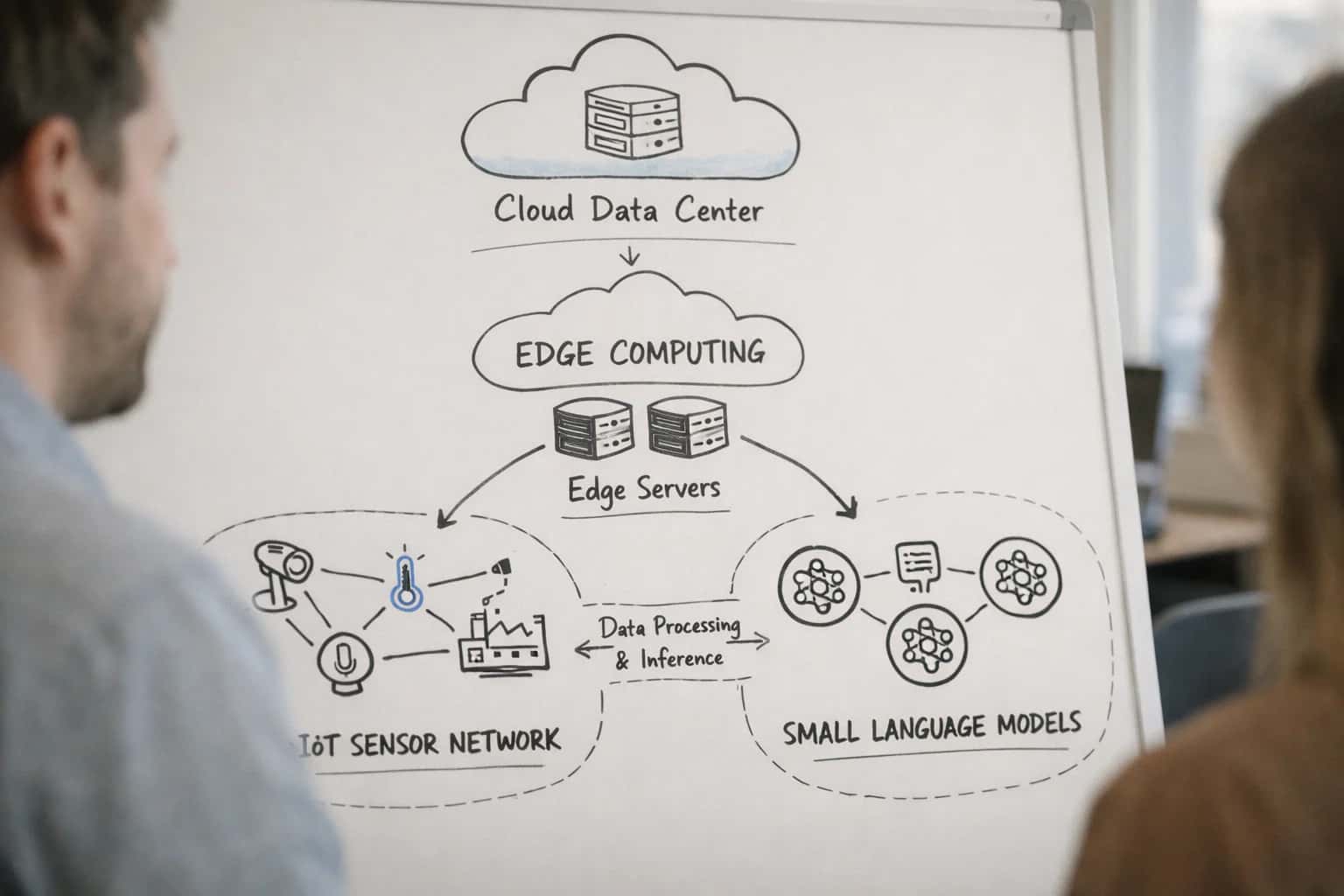
TINYML FRAMEWORKS
What is Edge Impulse?
Edge Impulse is a cloud-based development platform that provides an end-to-end workflow for building, optimizing, and deploying machine learning models to microcontroller and edge device targets.
The platform's core value lies in its deployment workflow, which includes the proprietary EON Compiler for model optimization and automatic code generation for over 30 hardware targets, from Arm Cortex-M microcontrollers to Linux-based systems. It outputs production-ready C++ libraries or full firmware projects, integrating directly with common embedded ML frameworks like TensorFlow Lite Micro. This closed-loop system ensures models meet the severe memory, latency, and power constraints of edge AI architectures.
TINYML DEVELOPMENT PLATFORM
Key Features of Edge Impulse
Edge Impulse provides a cloud-based, end-to-end workflow for developing, optimizing, and deploying machine learning models to microcontroller and edge devices.
PLATFORM COMPARISON
Edge Impulse vs. Other TinyML Frameworks
A feature-by-feature comparison of the Edge Impulse development platform against other prominent TinyML frameworks and toolchains, highlighting differences in workflow, hardware support, and optimization capabilities.
| Feature / Metric | Edge Impulse | TensorFlow Lite Micro (TFLM) | Vendor SDKs (e.g., STM32Cube.AI) |
|---|---|---|---|
Primary Interface | Cloud-based web IDE & CLI | Library (C++ API) & Python tools | Desktop GUI & CLI tools |
End-to-End Workflow | |||
Integrated Data Ingestion & Labeling | |||
Automated Model Optimization (EON) | |||
Deployment Target Portability | Multi-vendor, cloud-compiled | Portable C++ library | Vendor-specific, locked-in |
Real Device Performance Profiling | |||
Fleet Management & MLOps | |||
Open Source Core Runtime | |||
Dedicated AI Accelerator Support | Limited (via custom blocks) | Via external delegates | Native & optimized |
TINYML DEPLOYMENT
Common Use Cases for Edge Impulse
Edge Impulse's cloud-based platform streamlines the development of machine learning for embedded systems. Its primary applications address real-world sensing, classification, and anomaly detection on resource-constrained hardware.
EDGE IMPULSE
Frequently Asked Questions
Edge Impulse is a cloud-based development platform providing an end-to-end workflow for building, optimizing, and deploying machine learning models to microcontrollers and edge devices.
Edge Impulse is a cloud-based development platform that provides an end-to-end workflow for building, optimizing, and deploying machine learning models to microcontroller and edge device targets. It functions as a machine learning operations (MLOps) pipeline for embedded systems, abstracting the complexity of model conversion, hardware-aware optimization, and firmware integration. The workflow begins with data acquisition from connected devices or uploaded datasets, proceeds to impulse design (feature engineering and model architecture selection), and culminates in model deployment as optimized C++ libraries, Arduino libraries, or pre-built firmware binaries. The platform's core innovation is its EON Compiler, which applies techniques like int8 quantization, weight pruning, and operator fusion to shrink models for deployment on devices with as little as 256KB of RAM.
Enabling Efficiency, Speed & Accuracy
Intelligent Analysis, Decision & Execution
We build AI systems for teams that need search across company data, workflow automation across tools, or AI features inside products and internal software.
Talk to Us
Search across company data
Give teams answers from docs, tickets, runbooks, and product data with sources and permissions.
Useful when people spend too long searching or get different answers from different systems.
Enterprise searchRAGPermissions
Read more
Automate internal workflows
Use AI to route work, draft outputs, trigger actions, and keep approvals and logs in place.
Useful when repetitive work moves across multiple tools and teams.
AI agentsWorkflow automationGovernance
Read more
Add AI to products and internal tools
Build assistants, guided actions, or decision support into the software your team or customers already use.
Useful when AI needs to be part of the product, not a separate tool.
AI integrationDecision supportModel routing
Read more
About the author
Prasad Kumkar
CEO & MD, Inference Systems
Prasad Kumkar is the CEO & MD of Inference Systems and writes about AI systems architecture, LLM infrastructure, model serving, evaluation, and production deployment. Over 5+ years, he has worked across computer vision models, L5 autonomous vehicle systems, and LLM research, with a focus on taking complex AI ideas into real-world engineering systems.
His work and writing cover AI systems, large language models, AI agents, multimodal systems, autonomous systems, inference optimization, RAG, evaluation, and production AI engineering.
LinkedIn
Limited slotsGet a Free AI Consultation
Partnered with leading AI, data, and software stack.





How We Work
Custom AI workflows for your Business
One-fit-all AI don't work for modern businesses. At Inferensys, we aim to understand your business & custom requirements; which we use to define most efficient agentic workflows, the data, and the tools for your business.
01
Review the use case
We understand the task, the users, and where AI can actually help.
Read more02
Pick the right approach
We define what needs search, automation, or product integration.
Read more03
Build the first useful version
We implement the part that proves the value first.
Read more04
Improve from there
We add the checks and visibility needed to keep it useful.
Read moreThe first call is a practical review of your use case and the right next step.
Talk to Us