Model distillation is a model compression technique where a smaller, more efficient 'student' model is trained to replicate the predictions and often the internal representations of a larger, more complex 'teacher' model. The process transfers the teacher's learned 'knowledge'—its softened output probabilities (logits) and sometimes intermediate feature maps—to the student, enabling the compact model to achieve accuracy closer to the teacher's while being drastically smaller and faster. This is fundamental for deploying capable models on resource-constrained devices like microcontrollers.

Glossary
Model Distillation
Model distillation is a compression technique where a compact 'student' model is trained to replicate the predictions and knowledge of a larger, more complex 'teacher' model.
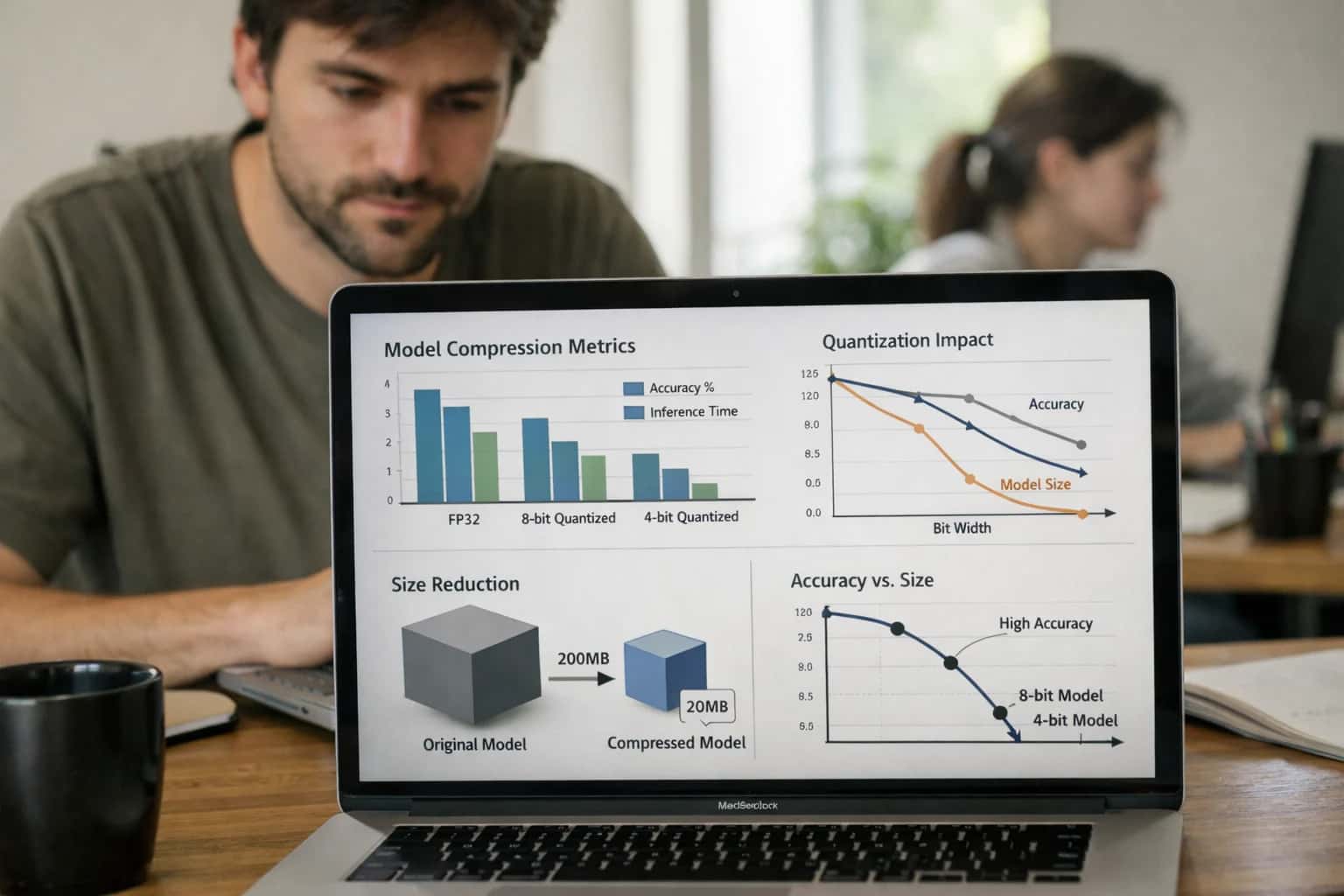
MODEL COMPRESSION
What is Model Distillation?
Model distillation, also known as knowledge distillation, is a core technique for creating compact, deployable machine learning models from larger, more powerful ones.
In TinyML deployment, distillation is critical for creating tiny language models that can run on edge hardware. The student model's architecture is designed for severe constraints, and training uses a combined loss function that minimizes the difference between student and teacher outputs (distillation loss) and the student's error on the true labels (task loss). This technique is often combined with quantization and pruning for maximum compression. The result is a highly portable model that retains much of the teacher's reasoning capability for on-device inference.
TINY LANGUAGE MODELS
Key Components of Distillation
Model distillation, or knowledge distillation, transfers learned representations from a large, complex teacher model to a compact student model suitable for microcontroller deployment. This process involves several core technical mechanisms.
01
Teacher Model
The teacher model is a large, pre-trained, and highly accurate neural network (e.g., BERT, GPT) that serves as the source of knowledge. Its role is to provide soft targets—probability distributions over output classes—which are richer training signals than hard labels. For language models, the teacher's knowledge is often encapsulated in its final logits and intermediate hidden layer representations.
02
Student Model
The student model is a significantly smaller, more efficient neural network architecture designed for constrained hardware. Its goal is to replicate the teacher's predictive behavior and internal representations. Common architectures for TinyML include MobileBERT, DistilBERT, or custom Transformer variants with fewer layers, hidden dimensions, and attention heads. The student is trained from scratch or initialized from a small pre-trained checkpoint.
03
Distillation Loss
The distillation loss is the objective function that guides the student's learning. It is a weighted combination of:
- Kullback-Leibler (KL) Divergence Loss: Measures the difference between the teacher's and student's output probability distributions (soft targets).
- Task-Specific Loss (e.g., Cross-Entropy): Ensures the student also learns from the original hard labels in the dataset.
- Hint or Feature Loss: Aligns the student's intermediate feature maps or attention matrices with the teacher's, transferring representational knowledge.
04
Temperature Scaling
Temperature scaling is a critical hyperparameter applied to the softmax function of the teacher's logits. A temperature parameter (T > 1) softens the probability distribution, making it less 'peaky'. This reveals the teacher's relative confidence across classes—the 'dark knowledge'—providing a richer training signal for the student. During final inference, the student uses a standard softmax (T=1).
05
Progressive & Layer-Wise Distillation
These are advanced strategies to improve distillation efficacy:
- Progressive Distillation: Iteratively distills a large teacher into a slightly smaller model, which then becomes the teacher for the next, even smaller student, in a multi-step process.
- Layer-Wise Distillation: Directly matches the outputs of specific intermediate layers between teacher and student, often using a Mean Squared Error (MSE) loss between their hidden states or attention maps, forcing the student to internalize the teacher's internal representations.
06
Dataset & Training Regime
The distillation process requires a carefully designed training regime.
- Transfer Set: The dataset used for distillation, which can be the original training data, unlabeled data, or a specialized dataset.
- Optimization: The student is trained using standard optimizers (e.g., AdamW) with the combined distillation loss. Training often requires fewer epochs than training from scratch.
- Co-distillation: A variant where multiple models teach each other in a peer-to-peer manner, without a fixed teacher-student hierarchy.
TECHNICAL OVERVIEW
How Does Model Distillation Work?
Model distillation, also known as knowledge distillation, is a compression technique that transfers learned representations from a large, complex model to a smaller, more efficient one.
Model distillation trains a compact student model to replicate the predictive behavior of a larger teacher model. The process typically uses the teacher's softened output probabilities (logits), generated via a high temperature parameter in the final softmax layer, as training targets. This soft label distribution contains richer inter-class relationship information than hard one-hot labels, enabling the student to learn the teacher's generalization capabilities and internal representations more effectively.
The training objective combines a distillation loss, which minimizes the difference between student and teacher logits, with a standard cross-entropy loss against the true labels. This dual objective ensures the student model not only mimics the teacher but also learns directly from the original data. For TinyML deployment, this process is critical for creating highly accurate, minimal-footprint models capable of running inference on microcontrollers with severe memory and power constraints, where the original teacher model could never execute.
COMPARISON
Distillation vs. Other Compression Techniques
A feature comparison of knowledge distillation against other primary model compression methods, highlighting their distinct mechanisms, hardware requirements, and typical use cases for TinyML deployment.
| Feature / Metric | Knowledge Distillation | Quantization | Pruning |
|---|---|---|---|
Primary Mechanism | Mimics teacher model's output/logit distributions | Reduces numerical precision of weights/activations | Removes redundant parameters (weights/neurons) |
Typical Model Size Reduction | 30-70% (via smaller student architecture) | 75% (FP32 -> INT8) to 93.75% (FP32 -> INT4) | 50-90% (depending on sparsity target) |
Inference Speedup | Moderate (smaller network) | High (integer arithmetic, reduced memory bandwidth) | Variable (requires sparse compute support for full benefit) |
Accuracy Preservation | High (can match or exceed teacher via regularization) | Moderate-High (with QAT), Moderate (with PTQ) | High (with iterative pruning & fine-tuning) |
Retraining Required | Yes (student model training) | Optional (PTQ requires none; QAT requires retraining) | Yes (fine-tuning after pruning is essential) |
Hardware/Software Dependencies | Standard integer/floating-point units | Requires integer arithmetic support (common) | Requires sparse linear algebra support for efficiency |
Output Change | New, separate student model | Same model architecture, lower precision | Same model architecture, sparse weights |
Best For TinyML Use Case | Creating a new, compact model from a large pre-trained expert | Maximizing speed & minimizing memory on standard MCU cores | Maximizing sparsity for extreme compression on specialized accelerators |
DEPLOYMENT STRATEGIES
Common Use Cases for Model Distillation
Model distillation enables the transfer of complex knowledge from a large teacher model to a compact student model. This process is critical for deploying capable AI on devices with severe memory, power, and compute constraints.
01
Edge & Microcontroller Deployment
The primary use case for distillation is creating models that can execute directly on microcontrollers (MCUs) and edge devices. A large, cloud-based teacher model (e.g., a 175B parameter LLM) is distilled into a tiny language model (TinyLM) with just a few million parameters. This enables on-device inference for applications like keyword spotting, anomaly detection in sensor data, or simple natural language tasks without cloud connectivity, ensuring low latency, data privacy, and minimal power consumption.
02
Efficient Model Serving
Distillation reduces inference cost and latency in server environments. By replacing a large, slow teacher model with a distilled student, organizations can serve more requests per second with the same hardware. This is crucial for high-throughput APIs and real-time applications like live translation or content moderation. The student model retains much of the teacher's accuracy while dramatically lowering computational complexity and memory bandwidth requirements, leading to direct infrastructure savings.
03
Privacy-Preserving Federated Learning
Distillation is a key component in privacy-preserving and federated learning systems. Instead of sharing raw user data or large model updates, a central server can distill knowledge from a global teacher model into a small student model. This compact student is then deployed to edge devices (e.g., smartphones) for on-device learning or inference. The technique minimizes the amount of sensitive information exchanged, aligning with regulations like GDPR and enabling AI personalization without centralizing private data.
04
Specialized Domain Adaptation
A general-purpose, large teacher model (pre-trained on broad internet data) can be distilled to create a specialized, efficient student for a specific domain. For example, a massive medical LLM can be distilled into a small model optimized for clinical note summarization that runs on a hospital's local server. This combines the teacher's broad knowledge with the student's efficiency, creating a deployable tool that understands domain-specific jargon and workflows without the prohibitive cost of running the full teacher model.
05
Multi-Model Ensemble Compression
Knowledge distillation can compress an ensemble of several large models (teachers) into a single, efficient student model. The ensemble's combined predictive power and robustness are transferred, avoiding the runtime cost of running multiple models. This is valuable when model robustness and calibration are critical, such as in financial forecasting or medical diagnosis. The student learns to approximate the averaged or weighted predictions of the ensemble, capturing collective wisdom in a single, deployable package.
06
Progressive Education & Curriculum Learning
Distillation can be applied in stages using a progressive or multi-step strategy. A moderately-sized model, first distilled from a large teacher, can itself become the teacher for an even smaller student. This teacher-assistant paradigm helps bridge large capability gaps. Furthermore, distillation can be combined with curriculum learning, where the student is first trained on easy examples or softened teacher outputs before gradually handling harder cases, leading to more stable training and better final performance for the compact model.
MODEL DISTILLATION
Frequently Asked Questions
Model distillation, or knowledge distillation, is a core technique for creating compact, efficient models from larger, more powerful ones. This FAQ addresses its mechanisms, applications, and role in TinyML deployment.
Model distillation, also known as knowledge distillation, is a model compression technique where a smaller, more efficient student model is trained to mimic the behavior and output distributions of a larger, more accurate teacher model. The process transfers the teacher's learned 'knowledge'—its ability to generalize and make nuanced predictions—into a deployable form suitable for resource-constrained environments like microcontrollers. Unlike simply training a small model on raw data, distillation leverages the teacher's softened probability outputs (logits) as training targets, which often contain richer relational information between classes than hard labels. This enables the student to achieve higher accuracy than if it were trained directly on the original dataset, effectively condensing the teacher's capabilities into a smaller computational footprint.
Enabling Efficiency, Speed & Accuracy
Intelligent Analysis, Decision & Execution
We build AI systems for teams that need search across company data, workflow automation across tools, or AI features inside products and internal software.
Talk to Us
Search across company data
Give teams answers from docs, tickets, runbooks, and product data with sources and permissions.
Useful when people spend too long searching or get different answers from different systems.
Enterprise searchRAGPermissions
Read more
Automate internal workflows
Use AI to route work, draft outputs, trigger actions, and keep approvals and logs in place.
Useful when repetitive work moves across multiple tools and teams.
AI agentsWorkflow automationGovernance
Read more
Add AI to products and internal tools
Build assistants, guided actions, or decision support into the software your team or customers already use.
Useful when AI needs to be part of the product, not a separate tool.
AI integrationDecision supportModel routing
Read more
About the author
Prasad Kumkar
CEO & MD, Inference Systems
Prasad Kumkar is the CEO & MD of Inference Systems and writes about AI systems architecture, LLM infrastructure, model serving, evaluation, and production deployment. Over 5+ years, he has worked across computer vision models, L5 autonomous vehicle systems, and LLM research, with a focus on taking complex AI ideas into real-world engineering systems.
His work and writing cover AI systems, large language models, AI agents, multimodal systems, autonomous systems, inference optimization, RAG, evaluation, and production AI engineering.
LinkedIn
Limited slotsGet a Free AI Consultation
Partnered with leading AI, data, and software stack.





How We Work
Custom AI workflows for your Business
One-fit-all AI don't work for modern businesses. At Inferensys, we aim to understand your business & custom requirements; which we use to define most efficient agentic workflows, the data, and the tools for your business.
01
Review the use case
We understand the task, the users, and where AI can actually help.
Read more02
Pick the right approach
We define what needs search, automation, or product integration.
Read more03
Build the first useful version
We implement the part that proves the value first.
Read more04
Improve from there
We add the checks and visibility needed to keep it useful.
Read moreThe first call is a practical review of your use case and the right next step.
Talk to Us