Quantization is a model compression technique that reduces the numerical precision of a neural network's weights and activations, typically converting them from 32-bit floating-point values to lower-bit integer or fixed-point representations. This process dramatically decreases the model's memory footprint and accelerates inference by enabling more efficient integer arithmetic operations on supporting hardware like CPUs, GPUs, and specialized Neural Processing Units (NPUs). The primary goal is to maintain predictive accuracy while achieving significant gains in storage, latency, and power efficiency, which is critical for microcontroller deployment and edge AI.

Glossary
Quantization
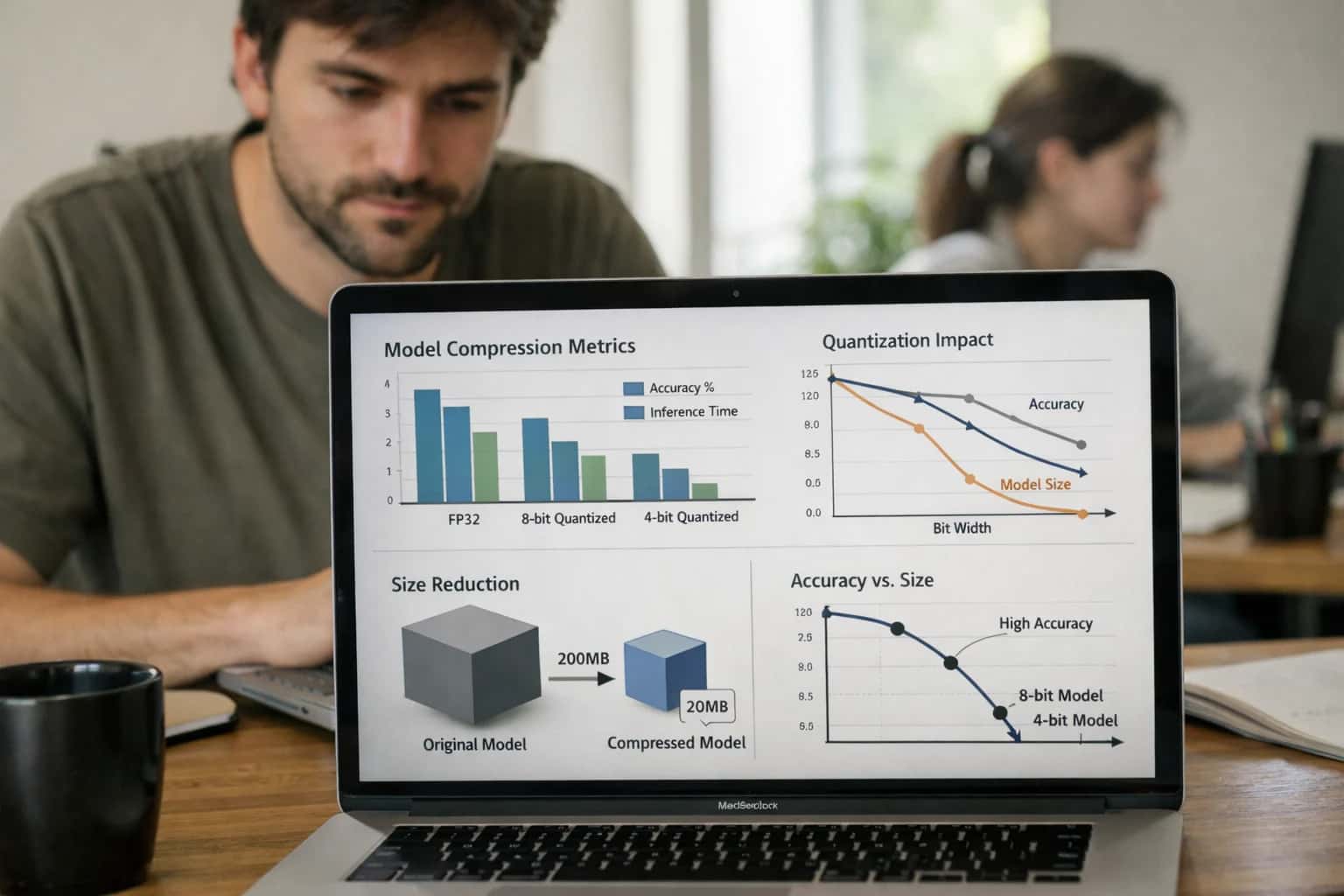
Quantization is a model compression technique that reduces the numerical precision of a neural network's weights and activations to decrease model size and accelerate inference.
MODEL COMPRESSION TECHNIQUE
What is Quantization?
Quantization is a fundamental technique for deploying neural networks on resource-constrained hardware, enabling the transition from research to production in embedded and edge computing.
The technique operates by mapping a continuous range of floating-point values to a finite set of discrete integer levels. Common approaches include Post-Training Quantization (PTQ), which calibrates a pre-trained model using a representative dataset, and Quantization-Aware Training (QAT), which simulates quantization during training for greater accuracy retention. Advanced methods like mixed-precision quantization assign different bit-widths (e.g., 8-bit, 4-bit) to different layers to optimize the trade-off. Quantization is a core enabler for TinyML, allowing complex models to run on devices with severe memory constraints measured in kilobytes.
MODEL COMPRESSION
Key Quantization Techniques
Quantization reduces the numerical precision of a model's parameters and computations. These are the primary methodologies for implementing it, each with distinct trade-offs in accuracy, complexity, and hardware compatibility.
03
Static vs. Dynamic Quantization
This distinction defines when activation ranges are determined, impacting runtime overhead and hardware optimization potential.
-
Static Quantization: Activation ranges are determined once during calibration (PTQ) or training (QAT). The scale/zero-point for each tensor becomes a constant.
- Advantage: Enables deep hardware optimizations like operator fusion and constant folding. Zero runtime overhead for range calculation.
- Typical Use: Deployment on microcontrollers, DSPs, and AI accelerators.
-
Dynamic Quantization: Weights are pre-quantized, but activation ranges are computed on-the-fly for each input during inference.
- Advantage: Handles inputs with highly variable ranges (e.g., in some NLP models) without a calibration set.
- Trade-off: Introduces runtime overhead for range calculation, limiting hardware optimization.
04
Integer-Only Quantization
Integer-Only Quantization aims to eliminate all floating-point arithmetic during inference, crucial for microcontrollers lacking FPUs.
- Goal: Execute the entire inference graph using integer operations (INT8, INT16) or fixed-point arithmetic.
- Challenge: Operations like requantization (mapping between integer bit-widths) and non-linear activation functions (e.g., sigmoid, softmax) traditionally require floating-point math.
- Solution: Use lookup tables (LUTs) for activations or integer polynomial approximations. Frameworks like TensorFlow Lite for Microcontrollers implement these.
- Result: Enables pure C/C++ deployment on bare-metal devices, maximizing speed and minimizing power and binary size.
05
Mixed-Precision Quantization
Mixed-Precision Quantization assigns different numerical precisions to different parts of a model to optimize the accuracy-efficiency trade-off.
- Principle: Not all layers contribute equally to accuracy loss from quantization. Sensitive layers (e.g., first and last layers) can be kept at higher precision (FP16, INT16), while robust layers are aggressively quantized (INT8, INT4).
- Methodology: Sensitivity is analyzed via hessian-based analysis or layer-wise error profiling. Precision assignment can be automated via reinforcement learning or differentiable NAS.
- Benefit: Achieves a better Pareto frontier of model size/ latency vs. accuracy than uniform quantization.
- Example: Keeping embedding and classification layers at higher precision while quantizing most convolutional blocks to INT8.
06
Weight-Only vs. Full-Integer Quantization
This spectrum defines which tensors are quantized, directly impacting the computational kernel used.
-
Weight-Only Quantization: Only the model weights are stored in low precision (e.g., INT4). Activations remain in floating-point.
- Benefit: Reduces model memory footprint (storage/loading) significantly. Computation uses FP math, so accuracy loss is minimal.
- Use: Primarily for memory-bound deployments where loading large weights is a bottleneck, but compute is not.
-
Full-Integer Quantization: Both weights and activations are quantized to integers.
- Benefit: Enables the use of highly efficient integer linear algebra kernels (e.g., INT8 matrix multiplication), accelerating computation by 2-4x on supporting hardware.
- Use: Standard for compute-bound deployments on edge devices, AI accelerators, and mobile SoCs.
MODEL COMPRESSION
How Quantization Works
Quantization is a fundamental model compression technique that reduces the numerical precision of a neural network's parameters and computations to enable efficient deployment on resource-constrained hardware.
Quantization is the process of mapping continuous, high-precision values (typically 32-bit floating-point numbers) to a discrete, finite set of lower-precision values (e.g., 8-bit integers). This transformation applies to a model's weights and activations. The core mechanism involves determining a scale factor and a zero-point to linearly map the floating-point range to the integer range. For example, a common target is INT8 quantization, which reduces the storage footprint by 4x and can replace floating-point multiplications with faster integer operations, dramatically accelerating inference on supporting hardware like CPUs, NPUs, and microcontrollers.
The process typically involves calibration, where a representative dataset is passed through the model to observe the dynamic ranges of activations. These ranges define the quantization parameters. Post-Training Quantization (PTQ) applies this mapping after training is complete, while Quantization-Aware Training (QAT) simulates quantization noise during training, allowing the model to adapt and preserve accuracy. Advanced techniques like mixed-precision quantization assign different bit-widths (e.g., 4-bit, 8-bit) to different layers to optimize the trade-off between compression and performance loss, a critical consideration for TinyML deployment on microcontrollers.
QUANTIZATION PRECISION LEVELS
Precision Formats & Trade-offs
A comparison of common numerical precision formats used in model quantization, detailing their impact on model size, inference speed, hardware support, and accuracy.
| Feature / Metric | 32-bit Float (FP32) | 16-bit Float/BFloat16 | 8-bit Integer (INT8) | 4-bit Integer (INT4) |
|---|---|---|---|---|
Bit Width (per parameter) | 32 bits | 16 bits | 8 bits | 4 bits |
Theoretical Size Reduction | 1x (Baseline) | 2x | 4x | 8x |
Primary Arithmetic Unit | Floating-Point Unit (FPU) | Tensor Core / Half-Precision FPU | Integer ALU / Vector Unit | Specialized Integer Unit |
Typical Accuracy Retention | 100% (Baseline) |
| 95-99% | 90-98% |
Hardware Support (MCU/CPU) | ||||
Hardware Support (NPU/GPU) | ||||
Inference Speedup (vs FP32) | 1x | 2-3x | 3-10x | 5-15x |
Energy Efficiency (vs FP32) | 1x | ~2x | ~4x | ~6x |
Common Use Case | Training, High-Precision Inference | Training, High-Throughput Inference | Post-Training Deployment | Extreme Size-Constrained Deployment |
Requires Calibration Dataset | ||||
Prone to Overflow/Underflow |
QUANTIZATION
Primary Use Cases & Applications
Quantization is not merely a compression technique; it is an enabling technology that makes advanced machine learning feasible in highly constrained environments. Its primary applications directly address the core challenges of modern AI deployment.
02
Mobile & On-Device AI Acceleration
For smartphones and tablets, quantization drastically reduces inference latency and power consumption. Mobile processors like the Apple Neural Engine and Qualcomm Hexagon DSP have dedicated hardware (NPUs) optimized for low-precision integer math. Quantized models enable real-time applications such as:
- Computational Photography: HDR, portrait mode, and night mode.
- Augmented Reality: Real-time object tracking and plane detection.
- Live Translation & Transcription: On-device speech-to-text for privacy. By keeping inference local, quantization enhances user privacy and eliminates network latency.
4-6x
Typical Latency Reduction
03
High-Throughput Cloud Inference
In data centers, quantization is a primary lever for cost reduction and scalability. Running INT8 models instead of FP32 can double or quadruple the number of inferences per server, directly lowering infrastructure costs. Key applications include:
- Recommendation Systems: Processing millions of user queries per second.
- Content Moderation: Scanning images, video, and text at scale.
- Real-Time Fraud Detection: Analyzing transaction streams with minimal added latency. Frameworks like TensorRT and OpenVINO perform layer fusion and kernel optimization specifically for quantized graphs, maximizing throughput on GPUs and CPUs.
2-4x
Throughput Increase
05
Efficient Large Language Model Serving
Running billion-parameter LLMs requires aggressive quantization to be practical. 4-bit and 8-bit quantization (e.g., GPTQ, AWQ) is essential for deploying models like Llama or Mistral on consumer GPUs or for affordable API serving. Applications include:
- Retrieval-Augmented Generation (RAG): Local, private querying of enterprise documents.
- Code Completion: Low-latency suggestions in integrated development environments.
- Chat Assistants: Cost-effective, scalable backend for conversational AI. Group-wise and KV Cache quantization are advanced techniques that further reduce the memory footprint of attention mechanisms during generation.
06
Privacy-Preserving & Secure Inference
Quantization interfaces directly with cryptographic techniques for privacy. Homomorphic Encryption (HE) and Secure Multi-Party Computation (MPC) operate natively on integers; quantizing a model to low-bit integers makes encrypted inference orders of magnitude faster. This enables:
- Medical Diagnosis: Running models on encrypted patient data without decryption.
- Financial Risk Assessment: Evaluating loan applications using private client data.
- Federated Learning: Transmitting smaller, quantized model updates reduces communication overhead and can obscure precise weight values, enhancing security.
QUANTIZATION
Frequently Asked Questions
Quantization is a cornerstone technique for deploying machine learning models on microcontrollers. These questions address its core mechanisms, trade-offs, and implementation for embedded systems engineers.
Quantization is a model compression technique that reduces the numerical precision of a neural network's weights and activations, typically converting them from 32-bit floating-point values to lower-bit integer or fixed-point representations (e.g., INT8, INT4). This process decreases the model's memory footprint and accelerates inference by leveraging efficient integer arithmetic operations, which are natively supported and faster on most microcontrollers and hardware accelerators compared to floating-point math.
For example, converting from FP32 to INT8 reduces the storage per parameter by 4x, from 32 bits to 8 bits. This is critical for TinyML deployment, where SRAM and flash memory are measured in kilobytes. The primary trade-off is a potential, managed reduction in model accuracy due to the loss of precision from rounding continuous values to a discrete set of levels.
Enabling Efficiency, Speed & Accuracy
Intelligent Analysis, Decision & Execution
We build AI systems for teams that need search across company data, workflow automation across tools, or AI features inside products and internal software.
Talk to Us
Search across company data
Give teams answers from docs, tickets, runbooks, and product data with sources and permissions.
Useful when people spend too long searching or get different answers from different systems.
Enterprise searchRAGPermissions
Read more
Automate internal workflows
Use AI to route work, draft outputs, trigger actions, and keep approvals and logs in place.
Useful when repetitive work moves across multiple tools and teams.
AI agentsWorkflow automationGovernance
Read more
Add AI to products and internal tools
Build assistants, guided actions, or decision support into the software your team or customers already use.
Useful when AI needs to be part of the product, not a separate tool.
AI integrationDecision supportModel routing
Read more
About the author
Prasad Kumkar
CEO & MD, Inference Systems
Prasad Kumkar is the CEO & MD of Inference Systems and writes about AI systems architecture, LLM infrastructure, model serving, evaluation, and production deployment. Over 5+ years, he has worked across computer vision models, L5 autonomous vehicle systems, and LLM research, with a focus on taking complex AI ideas into real-world engineering systems.
His work and writing cover AI systems, large language models, AI agents, multimodal systems, autonomous systems, inference optimization, RAG, evaluation, and production AI engineering.
LinkedIn
Limited slotsGet a Free AI Consultation
Partnered with leading AI, data, and software stack.





How We Work
Custom AI workflows for your Business
One-fit-all AI don't work for modern businesses. At Inferensys, we aim to understand your business & custom requirements; which we use to define most efficient agentic workflows, the data, and the tools for your business.
01
Review the use case
We understand the task, the users, and where AI can actually help.
Read more02
Pick the right approach
We define what needs search, automation, or product integration.
Read more03
Build the first useful version
We implement the part that proves the value first.
Read more04
Improve from there
We add the checks and visibility needed to keep it useful.
Read moreThe first call is a practical review of your use case and the right next step.
Talk to Us