Synthetic data governance is the comprehensive framework of policies, technical controls, and operational processes designed to manage the lifecycle of artificially generated datasets. It ensures these datasets are created, stored, accessed, and retired in a manner that is secure, compliant, and aligned with business objectives. Core functions include versioning, lineage tracking, access control, and compliance auditing against standards like GDPR or the EU AI Act, establishing accountability for synthetic data assets just as for real data.

Glossary
Synthetic Data Governance
Synthetic data governance is the framework of policies, processes, and technical controls for managing the lifecycle of artificially generated datasets to ensure quality, privacy, and compliance.
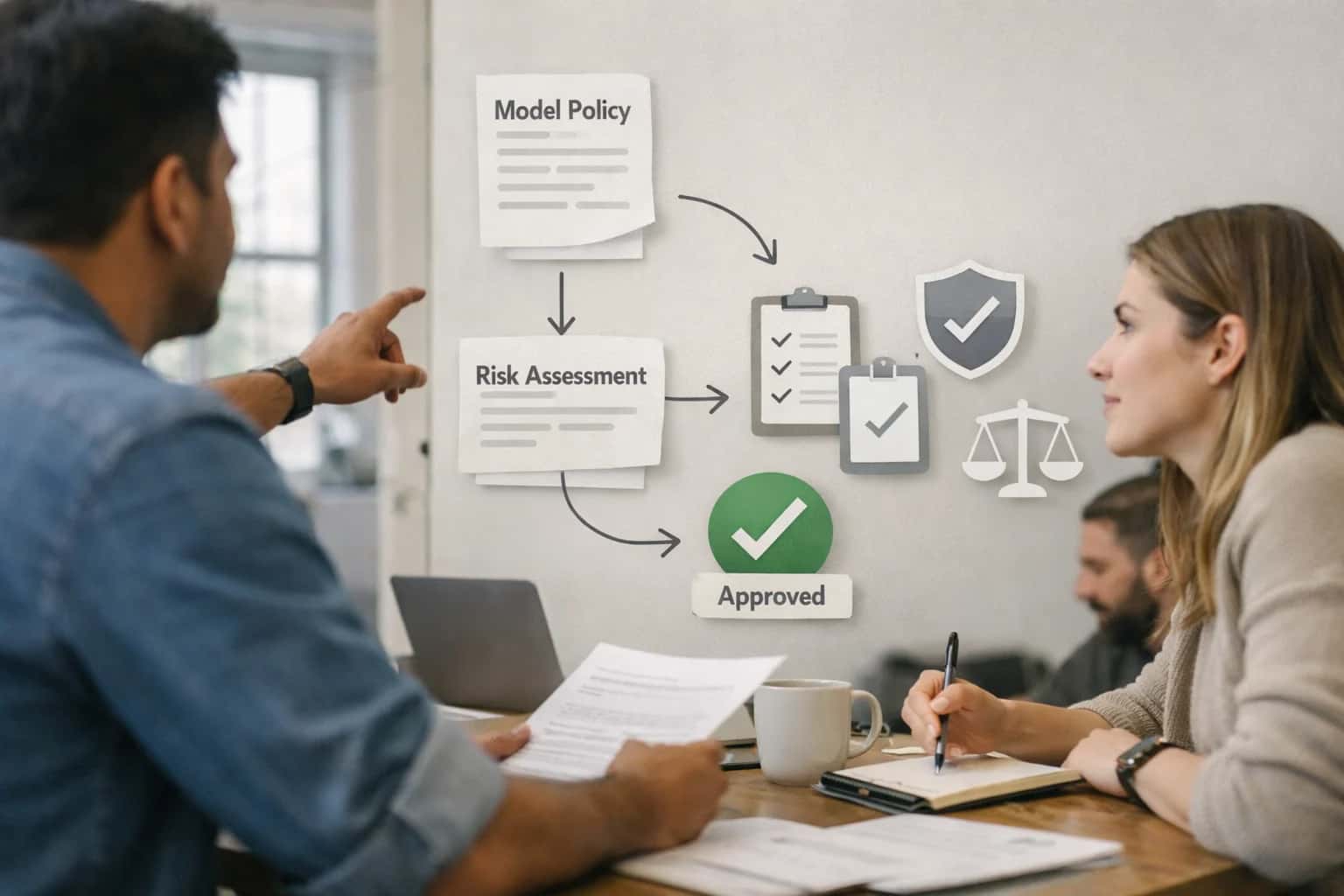
DATA MANAGEMENT
What is Synthetic Data Governance?
Synthetic data governance is the framework of policies, processes, and technical controls that ensure the responsible, secure, and compliant management of artificially generated datasets throughout their lifecycle.
Effective governance directly addresses risks unique to synthetic data, such as privacy leakage from overfitting, statistical drift in generative models, and bias propagation. It implements automated validation pipelines to measure synthetic data utility and fidelity, while access management protocols control who can generate or use specific datasets. This structured oversight is critical for scaling synthetic data use in regulated industries, enabling trust and reproducibility in machine learning workflows that depend on generated data for training, testing, and model debugging.
SYNTHETIC DATA GOVERNANCE
Core Components of a Governance Framework
A robust governance framework for synthetic data establishes the policies, technical controls, and lifecycle management processes required to ensure generated datasets are trustworthy, compliant, and fit for their intended analytical purpose.
01
Provenance & Lineage Tracking
Provenance and lineage tracking is the systematic recording of a synthetic dataset's complete origin and transformation history. This includes:
- Source Data Identification: Documenting the exact real-world datasets, versions, and subsets used as input for generation.
- Generator Metadata: Recording the model architecture (e.g., CTGAN, TVAE), hyperparameters, and software version used for synthesis.
- Transformation Logs: Tracking all preprocessing steps, feature engineering, and post-generation modifications applied to the data.
- Lineage Graphs: Creating auditable, immutable records (often using open standards like PROV or MLMD) that map the flow from source data to final synthetic product, enabling impact analysis and regulatory compliance.
02
Versioning & Artifact Management
Versioning and artifact management provides deterministic control over different iterations of synthetic datasets and their associated models. Key aspects are:
- Immutable Dataset Snapshots: Each generated dataset receives a unique, immutable identifier (e.g., a hash or version tag) upon creation, preventing accidental mutation.
- Model-Data Coupling: Storing the exact generative model checkpoint used to produce a specific dataset version, ensuring reproducibility.
- Metadata Registry: Maintaining a searchable catalog of all synthetic datasets, including their version, generation date, intended use case, and key statistical profiles.
- Rollback Capability: Allowing users to reliably retrieve and redeploy any prior version of a synthetic dataset, which is critical for debugging model performance regressions linked to data changes.
03
Privacy & Compliance Controls
Privacy and compliance controls are the technical and procedural safeguards that enforce regulatory adherence and protect sensitive information. This involves:
- Formal Privacy Guarantees: Implementing and validating techniques like differential privacy to provide mathematical proof that synthetic records cannot be linked to identifiable individuals in the source data.
- Bias & Fairness Audits: Conducting pre- and post-generation statistical tests to ensure synthetic data does not amplify historical biases present in the source data against protected attributes.
- Regulatory Alignment: Embedding controls to ensure synthetic data generation and usage comply with frameworks like GDPR, HIPAA, or the EU AI Act, particularly regarding provisions for fully artificial data.
- Residual Risk Assessment: Continuously evaluating the potential for membership inference or attribute inference attacks against the generative model and the synthetic data it produces.
04
Access Control & Entitlement
Access control and entitlement governs who can generate, modify, view, and use synthetic datasets based on their role and the dataset's sensitivity. Core mechanisms include:
- Role-Based Access Control (RBAC): Defining clear roles (e.g., Data Synthesizer, Validator, Consumer) with scoped permissions for dataset creation, approval, and consumption.
- Purpose-Based Restrictions: Tagging synthetic datasets with approved use cases (e.g., "model training only," "internal testing") and enforcing these restrictions at the point of access.
- Audit Logging: Recording all access events, queries run against synthetic data, and downstream usage to maintain a security trail for compliance audits.
- Dynamic Data Masking: Applying runtime masking or filtering to synthetic datasets based on user entitlements, ensuring users only see columns or rows relevant to their authorized tasks.
05
Quality & Fidelity Validation
Quality and fidelity validation is the continuous, automated assessment of synthetic data against objective metrics to ensure it meets utility standards. This process relies on:
- Statistical Similarity Metrics: Programmatically comparing the joint distributions, marginal distributions, and correlation structures of synthetic and real data using metrics like Wasserstein Distance, Kolmogorov-Smirnov tests, and correlation difference scores.
- Downstream Utility Testing: Implementing the Train on Synthetic, Test on Real (TSTR) evaluation protocol, where a model trained on synthetic data is validated on a held-out real dataset to measure performance parity.
- Constraint Validation: Checking that synthetic data respects inherent business rules and logical constraints from the source domain (e.g., age cannot be negative, admission date must be before discharge date).
- Anomaly Detection: Monitoring generated datasets for statistical outliers or implausible record combinations that may indicate model failure or data drift in the source system.
06
Lifecycle & Deprecation Policy
A lifecycle and deprecation policy defines the end-to-end management of synthetic datasets from creation to archival, ensuring operational hygiene. It encompasses:
- Retention Scheduling: Establishing rules for how long different classes of synthetic data are kept active based on their purpose, privacy profile, and storage costs.
- Refresh Triggers: Defining conditions that mandate the regeneration of a dataset, such as significant drift in the source data distribution, updates to the generative model, or expiration of a privacy budget in differentially private synthesis.
- Deprecation Workflows: Implementing automated notifications and access revocation for datasets that are scheduled for retirement, followed by secure deletion or movement to archival storage.
- Impact Analysis: Assessing which downstream models, reports, or applications depend on a synthetic dataset before authorizing its modification or deletion to prevent system-wide failures.
SYNTHETIC DATA GOVERNANCE
Implementation and Operational Workflow
The operational workflow for synthetic data governance translates high-level policies into executable technical controls and repeatable processes across the data lifecycle.
Synthetic data governance implementation is the systematic application of policies, controls, and technical processes to manage the lifecycle of artificially generated datasets. This operational workflow ensures generated data is versioned, lineage-tracked, and access-controlled to meet compliance standards like GDPR or HIPAA. It establishes clear provenance from the source data and generation parameters to the final synthetic dataset, creating an auditable trail for regulators and internal auditors.
The core operational components include a centralized metadata catalog for dataset discovery, automated validation pipelines that check for statistical fidelity and privacy leaks, and integrated access management tying dataset usage to role-based permissions. This technical infrastructure enables reproducible generation runs, facilitates rollback via version control, and provides the observability needed to monitor synthetic data consumption and its impact on downstream model performance in production.
SYNTHETIC DATA LIFECYCLE
Key Governance Challenges and Technical Solutions
A comparison of common governance risks in synthetic data pipelines and the technical controls used to mitigate them.
| Governance Challenge | Technical Control | Implementation Example | Primary Benefit |
|---|---|---|---|
Data Provenance & Lineage Tracking | Cryptographic hashing (e.g., DVC, MLflow) & metadata graphs | Auditable trail from synthetic record back to source data and generation parameters | |
Version Control for Generators & Datasets | Git-like versioning for model weights, code, and output datasets | Reproducibility and rollback capability for compliance audits | |
Access Control & Entitlement Management | Role-Based Access Control (RBAC) integrated with enterprise IAM | Ensures synthetic data is only accessible to authorized users/processes | |
Privacy Guarantee Verification | Automated differential privacy (ε, δ) audits & membership inference tests | Quantifiable proof that synthetic data protects individual privacy | |
Statistical Fidelity & Utility Degradation | Continuous monitoring of distributional metrics (e.g., Wasserstein distance, KS test) | Early detection of model drift or utility loss in synthetic outputs | |
Bias Propagation & Amplification | Fairness metrics (e.g., demographic parity, equalized odds) computed on synthetic vs. real data | Prevents encoding or exacerbating historical biases from source data | |
Regulatory Compliance (e.g., GDPR, AI Act) | Automated policy engines that tag synthetic data with compliance metadata | Demonstrates adherence to data sovereignty and algorithmic transparency mandates | |
Model Inversion & Re-identification Attacks | Adversarial robustness testing & k-anonymity checks on synthetic clusters | Mitigates risk of reconstructing original records from synthetic data |
SYNTHETIC DATA GOVERNANCE
Frequently Asked Questions
Essential questions and answers on the policies, processes, and technical controls for managing the lifecycle of artificially generated structured datasets.
Synthetic data governance is the comprehensive framework of policies, technical controls, and operational processes designed to manage the entire lifecycle of artificially generated datasets, ensuring they are fit for purpose, traceable, secure, and compliant. It is critical because synthetic data, while not containing real personal information, still carries significant risks related to model bias propagation, intellectual property protection, regulatory compliance (e.g., with the EU AI Act's provisions on high-risk AI systems), and downstream model performance. Without governance, organizations cannot trust that synthetic data used for training, testing, or analytics accurately represents real-world phenomena without introducing harmful artifacts or violating internal data policies.
Enabling Efficiency, Speed & Accuracy
Intelligent Analysis, Decision & Execution
We build AI systems for teams that need search across company data, workflow automation across tools, or AI features inside products and internal software.
Talk to Us
Search across company data
Give teams answers from docs, tickets, runbooks, and product data with sources and permissions.
Useful when people spend too long searching or get different answers from different systems.
Enterprise searchRAGPermissions
Read more
Automate internal workflows
Use AI to route work, draft outputs, trigger actions, and keep approvals and logs in place.
Useful when repetitive work moves across multiple tools and teams.
AI agentsWorkflow automationGovernance
Read more
Add AI to products and internal tools
Build assistants, guided actions, or decision support into the software your team or customers already use.
Useful when AI needs to be part of the product, not a separate tool.
AI integrationDecision supportModel routing
Read more
About the author
Prasad Kumkar
CEO & MD, Inference Systems
Prasad Kumkar is the CEO & MD of Inference Systems and writes about AI systems architecture, LLM infrastructure, model serving, evaluation, and production deployment. Over 5+ years, he has worked across computer vision models, L5 autonomous vehicle systems, and LLM research, with a focus on taking complex AI ideas into real-world engineering systems.
His work and writing cover AI systems, large language models, AI agents, multimodal systems, autonomous systems, inference optimization, RAG, evaluation, and production AI engineering.
LinkedIn
Limited slotsGet a Free AI Consultation
Partnered with leading AI, data, and software stack.





How We Work
Custom AI workflows for your Business
One-fit-all AI don't work for modern businesses. At Inferensys, we aim to understand your business & custom requirements; which we use to define most efficient agentic workflows, the data, and the tools for your business.
01
Review the use case
We understand the task, the users, and where AI can actually help.
Read more02
Pick the right approach
We define what needs search, automation, or product integration.
Read more03
Build the first useful version
We implement the part that proves the value first.
Read more04
Improve from there
We add the checks and visibility needed to keep it useful.
Read moreThe first call is a practical review of your use case and the right next step.
Talk to Us