
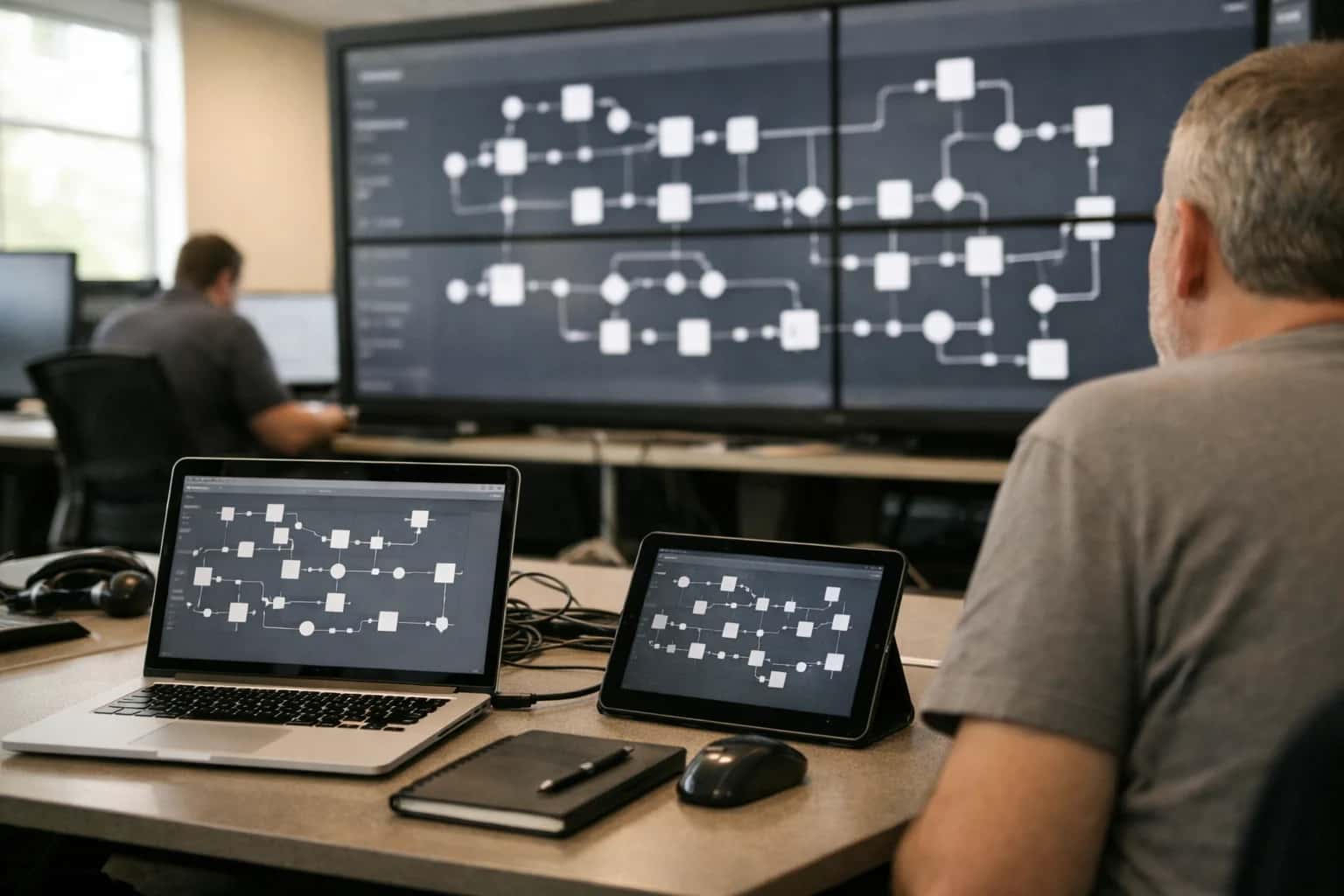
A digital twin is a dynamic, data-driven virtual model of a physical entity or system, synchronized via real-time sensor data and governed by physics-based simulation. It enables predictive analytics, what-if scenario testing, and remote monitoring without interacting with the physical asset. In machine learning, it functions as a synthetic environment for training reinforcement learning (RL) agents, providing a safe, scalable, and controllable sandbox to learn complex policies.
DIGITAL TWIN
Primary Use Cases & Applications
A digital twin is a high-fidelity virtual replica of a physical system, process, or environment, used for simulation, analysis, and control. Its applications span from predictive maintenance to serving as synthetic training grounds for AI agents.
01
Predictive Maintenance & Asset Management
Digital twins enable condition-based monitoring by continuously ingesting sensor data (IoT) from physical assets like jet engines, wind turbines, or factory machinery. The virtual model runs simulations to predict failure modes and remaining useful life (RUL), allowing for maintenance to be scheduled proactively, minimizing downtime and operational costs. This is a core application in Industry 4.0 and smart manufacturing.
~40%
Reduction in Maintenance Costs
>70%
Fewer Unplanned Downtime Events
02
Product Design & Virtual Prototyping
Engineers use digital twins as virtual prototypes to test and iterate designs under countless simulated conditions before physical manufacturing. This allows for:
- Performance optimization under stress, heat, or fatigue.
- Virtual stress testing and failure analysis.
- Rapid A/B testing of design variants. This drastically reduces development cycles, material waste, and costs, particularly in aerospace, automotive, and consumer electronics.
03
Synthetic Training for Reinforcement Learning
A high-fidelity digital twin serves as a risk-free, infinitely scalable synthetic environment for training reinforcement learning (RL) agents. This is critical for domains where real-world training is dangerous, expensive, or slow, such as:
- Autonomous vehicles navigating complex urban simulations.
- Robotic manipulation in simulated factories.
- Smart grid management agents. The twin provides the state space, action space, and physics-based transition dynamics required for RL, enabling sim-to-real transfer.
04
Urban Planning & Smart Cities
City-scale digital twins integrate geospatial data, building information models (BIM), traffic flows, and utility networks into a unified simulation. Planners and officials use this to:
- Model traffic congestion and test new road layouts.
- Simulate emergency response scenarios (e.g., evacuations).
- Optimize energy distribution across the grid.
- Plan for population growth and its impact on infrastructure. Examples include the digital twins of Singapore and Helsinki.
05
Healthcare & Personalized Medicine
In healthcare, digital twins model biological systems at various scales:
- Organ-level twins (e.g., a heart twin) simulate blood flow to plan surgeries.
- Process twins optimize hospital logistics and patient flow.
- Personalized patient twins use individual genomics, biomarkers, and lifestyle data to predict disease progression and simulate responses to different treatment plans, advancing precision medicine. This application requires integration with clinical workflow automation and healthcare federated learning for data privacy.
06
Supply Chain & Logistics Optimization
Digital twins create a live, virtual mirror of the entire supply chain network, from raw material sourcing to last-mile delivery. The model ingests real-time data on inventory, shipping locations, weather, and demand forecasts. It is used for:
- Stress-testing the network against disruptions (e.g., port closures).
- Running "what-if" simulations to optimize inventory placement and routing.
- Enabling autonomous decision-making by multi-agent systems to re-route shipments dynamically. This falls under autonomous supply chain intelligence.









