Lateral movement prevention is a cybersecurity discipline focused on impeding an adversary's progression through a network after an initial foothold is established. It operates on the principle that perimeter defenses will eventually be breached, shifting the emphasis to internal containment. By enforcing strict micro-segmentation, least privilege access, and continuous east-west traffic inspection, these controls ensure that a compromised workload or user account cannot be used as a launchpad to access high-value data stores, model weights, or inference endpoints.

Glossary
Lateral Movement Prevention
Security controls designed to stop an attacker from pivoting from a compromised host to other systems within the same network segment after gaining an initial foothold.
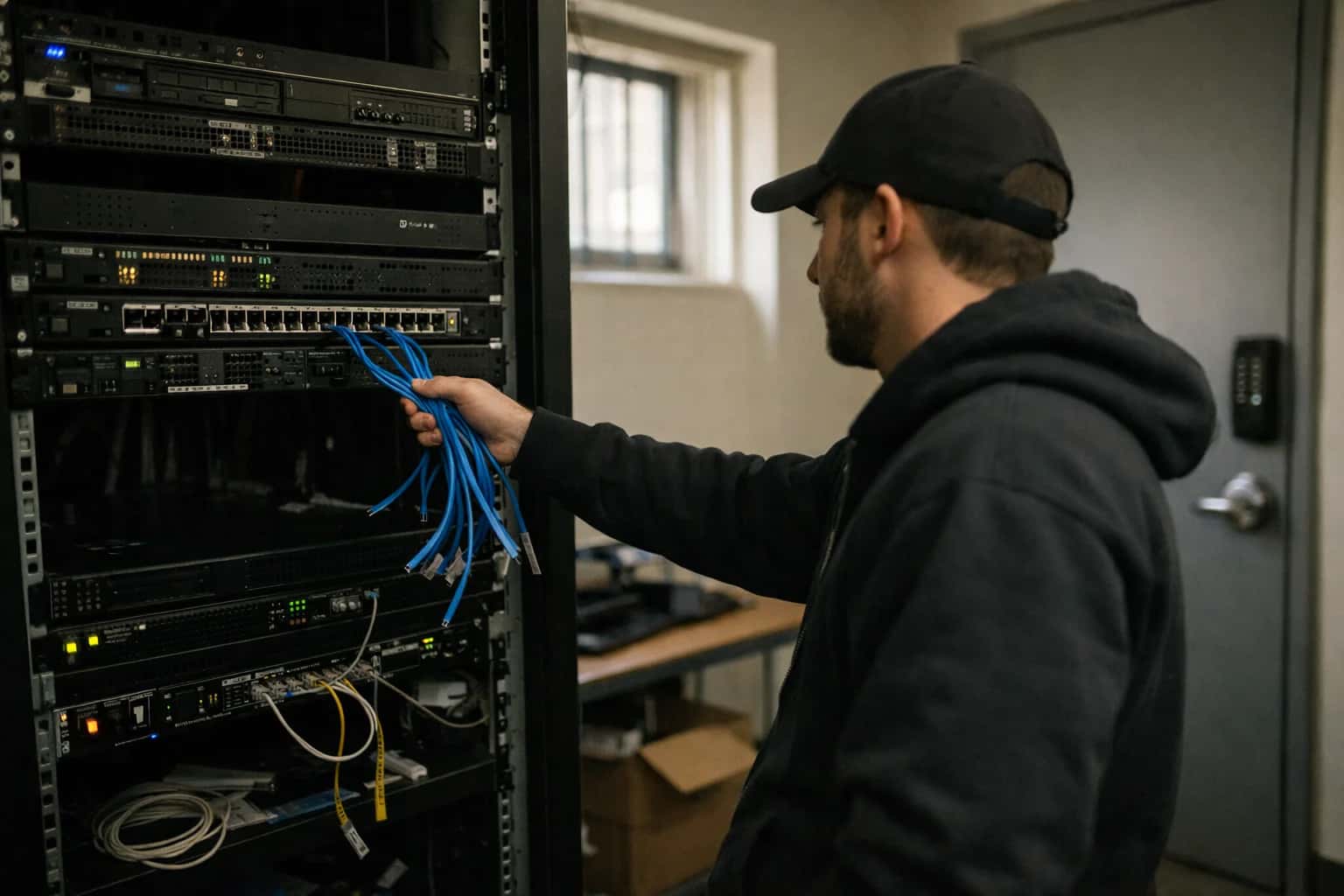
ADVERSARY CONTAINMENT
What is Lateral Movement Prevention?
Lateral movement prevention encompasses the security controls and architectural strategies designed to detect and block an attacker's ability to pivot from an initially compromised host to other systems within the same network segment.
In zero-trust AI networking, lateral movement prevention relies on cryptographic workload identity via protocols like SPIFFE and mTLS, rather than trust based on network location. A Policy Enforcement Point (PEP) evaluates every service-to-service request against a Policy Decision Point (PDP) in real-time, applying Attribute-Based Access Control (ABAC). This architecture logically isolates training clusters from inference APIs, ensuring that even if an attacker compromises a front-end container, they cannot pivot laterally to exfiltrate proprietary model artifacts or poison training data.
CONTAINING THE BREACH
Key Features of Lateral Movement Prevention
Lateral movement prevention transforms a flat, implicitly trusted network into a hardened environment where every east-west connection is authenticated, authorized, and encrypted. These controls ensure that an initial foothold does not cascade into a full-scale compromise.
01
Micro-Segmentation
The foundational control that divides the network into isolated logical segments down to the individual workload or container level. Unlike traditional perimeter firewalls, micro-segmentation enforces Layer 7 policy on east-west traffic between servers.
- Replaces broad VLAN-based segmentation with granular, identity-based boundaries
- Prevents a compromised web server from reaching the database tier on any port other than the explicitly allowed SQL connection
- Implemented via sidecar proxies in a service mesh or kernel-level eBPF programs
02
Workload Identity and mTLS
Assigns a cryptographically verifiable identity to every process, pod, or virtual machine using standards like SPIFFE. This identity forms the basis for mutual TLS (mTLS) authentication between services.
- Eliminates reliance on ephemeral IP addresses or network location for access decisions
- An attacker pivoting from a compromised host cannot present a valid X.509 certificate for the target service
- Enforces bidirectional authentication: the client verifies the server, and the server verifies the client before any data exchange
LATERAL MOVEMENT PREVENTION
Frequently Asked Questions
Explore the critical security controls and architectural patterns designed to contain breaches and prevent attackers from pivoting across your AI infrastructure after an initial compromise.
Lateral movement is the technique an attacker uses to progressively pivot from a compromised host to other systems within the same network segment after gaining an initial foothold. In sovereign AI infrastructure, preventing this is critical because a single compromised development node or model endpoint can become a beachhead for accessing high-value assets like proprietary training data, model weights, or the Policy Decision Point (PDP) itself. Unlike a simple data breach, lateral movement in an AI pipeline allows an adversary to perform data poisoning on training sets or model inversion attacks on inference endpoints. Effective prevention relies on micro-segmentation, which restricts east-west traffic between workloads, and continuous verification of every access request, ensuring that a stolen set of credentials cannot be used to traverse the network freely.
Enabling Efficiency, Speed & Accuracy
Intelligent Analysis, Decision & Execution
We build AI systems for teams that need search across company data, workflow automation across tools, or AI features inside products and internal software.
Talk to Us
Search across company data
Give teams answers from docs, tickets, runbooks, and product data with sources and permissions.
Useful when people spend too long searching or get different answers from different systems.
Enterprise searchRAGPermissions
Read more
Automate internal workflows
Use AI to route work, draft outputs, trigger actions, and keep approvals and logs in place.
Useful when repetitive work moves across multiple tools and teams.
AI agentsWorkflow automationGovernance
Read more
Add AI to products and internal tools
Build assistants, guided actions, or decision support into the software your team or customers already use.
Useful when AI needs to be part of the product, not a separate tool.
AI integrationDecision supportModel routing
Read more
About the author
Prasad Kumkar
CEO & MD, Inference Systems
Prasad Kumkar is the CEO & MD of Inference Systems and writes about AI systems architecture, LLM infrastructure, model serving, evaluation, and production deployment. Over 5+ years, he has worked across computer vision models, L5 autonomous vehicle systems, and LLM research, with a focus on taking complex AI ideas into real-world engineering systems.
His work and writing cover AI systems, large language models, AI agents, multimodal systems, autonomous systems, inference optimization, RAG, evaluation, and production AI engineering.
LinkedIn
Limited slotsGet a Free AI Consultation
Partnered with leading AI, data, and software stack.





How We Work
Custom AI workflows for your Business
One-fit-all AI don't work for modern businesses. At Inferensys, we aim to understand your business & custom requirements; which we use to define most efficient agentic workflows, the data, and the tools for your business.
01
Review the use case
We understand the task, the users, and where AI can actually help.
Read more02
Pick the right approach
We define what needs search, automation, or product integration.
Read more03
Build the first useful version
We implement the part that proves the value first.
Read more04
Improve from there
We add the checks and visibility needed to keep it useful.
Read moreThe first call is a practical review of your use case and the right next step.
Talk to Us