vLLM is a high-throughput, memory-efficient inference serving engine for large language models. It implements PagedAttention, a novel attention algorithm that manages the KV cache in non-contiguous memory blocks, virtually eliminating fragmentation and enabling near-zero waste in GPU memory.

Glossary
vLLM
An open-source, high-throughput inference serving engine that implements PagedAttention and continuous batching for efficient LLM deployment.
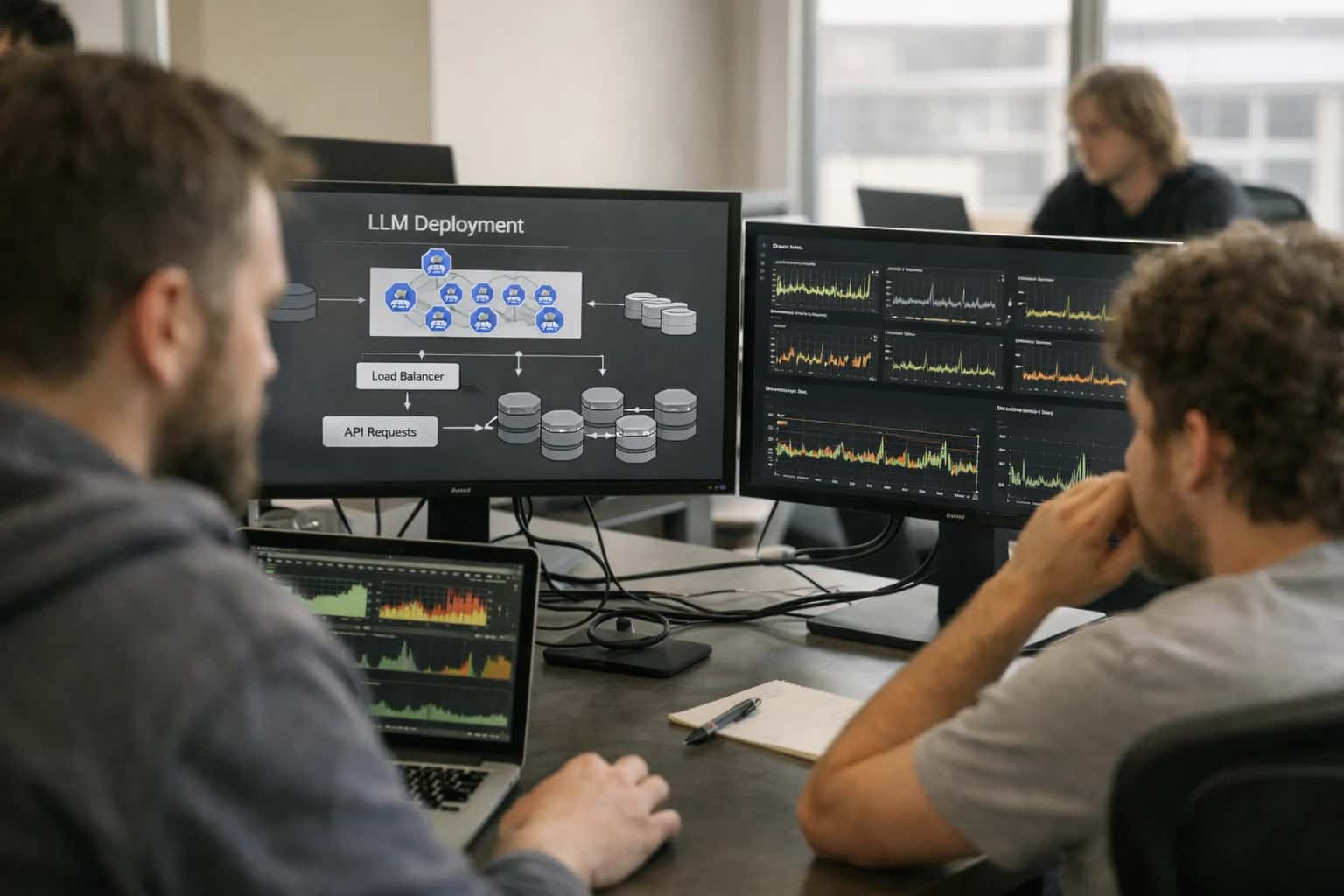
INFERENCE SERVING ENGINE
What is vLLM?
vLLM is an open-source library designed to serve large language models with high throughput and low memory footprint using PagedAttention and continuous batching.
The engine leverages continuous batching to dynamically append new requests to a running batch, maximizing GPU utilization and tokens per second (TPS). vLLM supports tensor parallelism for distributed inference and offers seamless integration with popular model weights, making it a foundational tool for self-hosted, sovereign AI infrastructure.
HIGH-THROUGHPUT LLM SERVING
Key Features of vLLM
vLLM is an open-source inference engine that achieves state-of-the-art serving throughput through innovative memory management and scheduling. These are the core architectural components that differentiate it from traditional serving solutions.
02
Continuous Batching
A dynamic scheduling technique that appends new requests to the running batch at each iteration rather than waiting for the entire batch to complete. This maximizes GPU utilization by preventing idle compute cycles.
- Traditional batching waits for the longest sequence to finish before accepting new work
- Continuous batching injects new sequences immediately as old ones complete
- Achieves 10x higher throughput compared to static batching under variable load
- Works in tandem with PagedAttention for seamless memory reclamation
03
Prefix Caching
An optimization that automatically detects and reuses the computed KV cache for shared prompt prefixes across multiple requests. When many users share a common system prompt, vLLM computes it once and reuses the result.
- Eliminates redundant computation for identical prompt beginnings
- Particularly effective for multi-turn conversations and few-shot examples
- Operates transparently without user configuration
- Reduces Time To First Token (TTFT) for cached prefixes to near-zero
04
Tensor Parallelism
A distributed inference strategy that splits individual weight matrices across multiple GPUs, enabling vLLM to serve models too large for a single accelerator. Unlike pipeline parallelism, tensor parallelism distributes each layer's computation.
- Supports megatron-style sharding across 2, 4, or 8 GPUs
- Communication uses NVIDIA NCCL for high-bandwidth GPU-to-GPU transfers
- Enables serving models like Llama 3 70B on commodity multi-GPU nodes
- Works with both eager mode and CUDA graph execution
05
Quantization Support
Native integration with multiple weight compression formats to reduce memory footprint and accelerate inference without significant accuracy loss. vLLM supports quantization methods that operate at the kernel level for maximum performance.
- AWQ and GPTQ for 4-bit weight-only quantization
- FP8 for native 8-bit floating point on H100 GPUs
- BitsAndBytes for on-the-fly quantization during loading
- Reduces model memory requirements by up to 75% while preserving output quality
06
OpenAI-Compatible API
A drop-in replacement server that implements the OpenAI completions and chat completions API protocols. Existing applications built for the OpenAI SDK can switch to a self-hosted vLLM endpoint by changing only the base URL.
- Supports
/v1/completionsand/v1/chat/completionsendpoints - Implements streaming responses via server-sent events
- Compatible with the official
openaiPython client library - Enables seamless migration from proprietary APIs to self-hosted infrastructure
VLLM DEEP DIVE
Frequently Asked Questions
Technical answers to the most common questions about deploying and optimizing the vLLM inference engine for production-grade large language model serving.
vLLM is an open-source, high-throughput inference serving engine that implements PagedAttention and continuous batching to efficiently serve large language models (LLMs). It works by managing the KV cache in non-contiguous memory blocks, analogous to virtual memory paging in operating systems, which eliminates fragmentation and allows memory sharing across sequences. When a request arrives, vLLM dynamically allocates GPU memory blocks for the prompt's key-value tensors. During autoregressive generation, it appends new blocks as needed. The scheduler continuously batches incoming requests—injecting new sequences into the running batch without waiting for existing generations to complete—maximizing GPU utilization. This architecture achieves up to 24x higher throughput than traditional static batching systems like Hugging Face Transformers, making it the de facto standard for production LLM serving at organizations ranging from startups to hyperscale cloud providers.
Enabling Efficiency, Speed & Accuracy
Intelligent Analysis, Decision & Execution
We build AI systems for teams that need search across company data, workflow automation across tools, or AI features inside products and internal software.
Talk to Us
Search across company data
Give teams answers from docs, tickets, runbooks, and product data with sources and permissions.
Useful when people spend too long searching or get different answers from different systems.
Enterprise searchRAGPermissions
Read more
Automate internal workflows
Use AI to route work, draft outputs, trigger actions, and keep approvals and logs in place.
Useful when repetitive work moves across multiple tools and teams.
AI agentsWorkflow automationGovernance
Read more
Add AI to products and internal tools
Build assistants, guided actions, or decision support into the software your team or customers already use.
Useful when AI needs to be part of the product, not a separate tool.
AI integrationDecision supportModel routing
Read more
About the author
Prasad Kumkar
CEO & MD, Inference Systems
Prasad Kumkar is the CEO & MD of Inference Systems and writes about AI systems architecture, LLM infrastructure, model serving, evaluation, and production deployment. Over 5+ years, he has worked across computer vision models, L5 autonomous vehicle systems, and LLM research, with a focus on taking complex AI ideas into real-world engineering systems.
His work and writing cover AI systems, large language models, AI agents, multimodal systems, autonomous systems, inference optimization, RAG, evaluation, and production AI engineering.
LinkedIn
Limited slotsGet a Free AI Consultation
Partnered with leading AI, data, and software stack.





How We Work
Custom AI workflows for your Business
One-fit-all AI don't work for modern businesses. At Inferensys, we aim to understand your business & custom requirements; which we use to define most efficient agentic workflows, the data, and the tools for your business.
01
Review the use case
We understand the task, the users, and where AI can actually help.
Read more02
Pick the right approach
We define what needs search, automation, or product integration.
Read more03
Build the first useful version
We implement the part that proves the value first.
Read more04
Improve from there
We add the checks and visibility needed to keep it useful.
Read moreThe first call is a practical review of your use case and the right next step.
Talk to Us