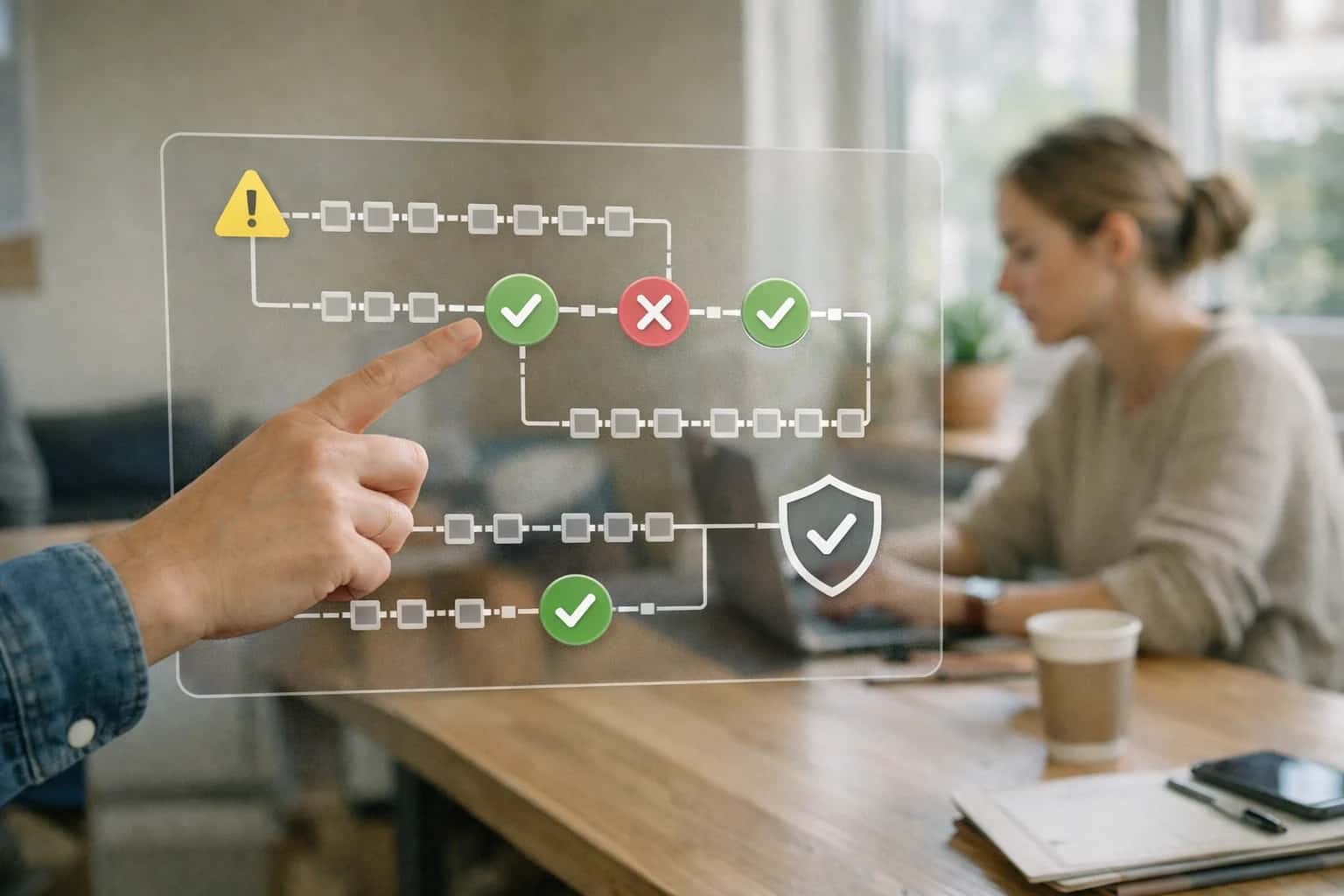
Data lineage is the systematic tracking of data's complete lifecycle, documenting its origin, transformations, and destinations. It creates a directed acyclic graph (DAG) that maps how raw source data flows through ETL pipelines, feature engineering steps, and model training runs, providing a granular, column-level audit trail for compliance with frameworks like GDPR and the EU AI Act.

Glossary
Data Lineage
A metadata map that tracks the complete lifecycle of data from its origin through every transformation and movement, providing a detailed audit trail for compliance and debugging.
METADATA GOVERNANCE
What is Data Lineage?
Data lineage provides a complete, end-to-end metadata map of a data record's journey from its origin through every transformation, movement, and aggregation point, creating a detailed audit trail essential for regulatory compliance and debugging.
In geofenced data pipelines, lineage metadata captures jurisdictional provenance by tagging each transformation with its execution location, ensuring no processing step violates data residency constraints. This allows regulatory compliance architects to instantly trace any model output back to its sovereign source, verifying that cross-border data transfer rules were never breached during the pipeline's execution.
UNDERSTANDING THE AUDIT TRAIL
Key Features of Data Lineage
Data lineage provides a complete, end-to-end metadata map of your data's journey, from origin to consumption. It is the foundational tool for debugging, compliance, and trust in modern data pipelines.
01
Backwards & Forwards Tracing
Lineage tools must support bidirectional tracing to answer two critical questions. Backwards lineage traces a data element in a report back to its raw source systems, which is essential for root-cause analysis. Forwards lineage identifies all downstream consumers and assets impacted by a change at the source, enabling accurate impact assessments before a schema migration or pipeline update. This is often visualized as a Directed Acyclic Graph (DAG).
02
Granular Column-Level Lineage
Modern data platforms parse SQL query logs and execution plans to achieve column-level lineage, not just table-level. This means the system can show that the revenue column in a dashboard is derived from a specific SUM() aggregation on the transaction_amount column of a source table. This granularity is critical for:
- PII Tracking: Identifying every column that contains a derivative of a raw Social Security Number.
- Deprecation: Safely removing a source column by verifying no downstream column depends on it.
03
Automated Parsing & Stitching
Manual lineage documentation is brittle and instantly obsolete. Robust systems automatically parse execution logs from ETL tools (e.g., dbt, Apache Spark), data warehouses (e.g., Snowflake, BigQuery), and BI tools. They stitch these fragments into a unified, cross-system graph. This requires deep integrations that understand the dialect-specific SQL and transformation logic of each platform to map how data flows across heterogeneous tools.
04
Impact Analysis & Root Cause
Lineage powers two key operational workflows. Impact Analysis predicts the blast radius of a change: 'If I deprecate this API field, which 50 dashboards will break?' Root Cause Analysis accelerates debugging: 'Why is the CFO's report wrong?' By clicking the erroneous number, an engineer can visually traverse backwards through the transformation layers to find the exact failed job or corrupted source record, reducing time-to-resolution from hours to minutes.
05
Static vs. Operational Lineage
It's crucial to distinguish between two types of lineage. Static lineage maps the intended data flow based on code analysis and parsing SQL definitions. Operational lineage captures the actual data flow at runtime, including specific job execution IDs, timestamps, and record counts processed. Operational lineage is essential for auditing a specific run and verifying that the data actually moved as designed, closing the gap between theory and practice.
06
Open Standards & Interoperability
To avoid vendor lock-in, lineage metadata should be portable. The OpenLineage standard defines a vendor-neutral specification for collecting and publishing lineage events. A job emits standardized JSON events describing its inputs, outputs, and run facets. A central lineage backend can then consume these events from various tools (Airflow, Spark, Fivetran) to build a complete, technology-agnostic graph, ensuring your lineage map survives changes in your toolchain.
Enabling Efficiency, Speed & Accuracy
Intelligent Analysis, Decision & Execution
We build AI systems for teams that need search across company data, workflow automation across tools, or AI features inside products and internal software.
Talk to Us
Search across company data
Give teams answers from docs, tickets, runbooks, and product data with sources and permissions.
Useful when people spend too long searching or get different answers from different systems.
Enterprise searchRAGPermissions
Read more
Automate internal workflows
Use AI to route work, draft outputs, trigger actions, and keep approvals and logs in place.
Useful when repetitive work moves across multiple tools and teams.
AI agentsWorkflow automationGovernance
Read more
Add AI to products and internal tools
Build assistants, guided actions, or decision support into the software your team or customers already use.
Useful when AI needs to be part of the product, not a separate tool.
AI integrationDecision supportModel routing
Read moreDATA LINEAGE
Frequently Asked Questions
Data lineage provides a complete metadata map of your data's journey from origin to consumption, enabling precise impact analysis, regulatory compliance, and debugging of complex pipelines.
Data lineage is a metadata map that tracks the complete lifecycle of data from its origin through every transformation and movement, providing a detailed audit trail for compliance and debugging. It works by instrumenting data pipelines to capture and persist metadata about each operation performed on a dataset. This includes recording the source system, the specific transformation logic applied (e.g., a SQL query or a Python function), the schema changes, and the destination target. The lineage graph is constructed by parsing execution logs, query histories, and ETL job metadata, then linking these operations into a directed acyclic graph (DAG). This graph visually and programmatically represents how data flows, enabling engineers to trace a report field back to its raw source table or forward to assess the blast radius of a schema change.

About the author
Prasad Kumkar
CEO & MD, Inference Systems
Prasad Kumkar is the CEO & MD of Inference Systems and writes about AI systems architecture, LLM infrastructure, model serving, evaluation, and production deployment. Over 5+ years, he has worked across computer vision models, L5 autonomous vehicle systems, and LLM research, with a focus on taking complex AI ideas into real-world engineering systems.
His work and writing cover AI systems, large language models, AI agents, multimodal systems, autonomous systems, inference optimization, RAG, evaluation, and production AI engineering.
LinkedIn
Limited slotsGet a Free AI Consultation
Partnered with leading AI, data, and software stack.





How We Work
Custom AI workflows for your Business
One-fit-all AI don't work for modern businesses. At Inferensys, we aim to understand your business & custom requirements; which we use to define most efficient agentic workflows, the data, and the tools for your business.
01
Review the use case
We understand the task, the users, and where AI can actually help.
Read more02
Pick the right approach
We define what needs search, automation, or product integration.
Read more03
Build the first useful version
We implement the part that proves the value first.
Read more04
Improve from there
We add the checks and visibility needed to keep it useful.
Read moreThe first call is a practical review of your use case and the right next step.
Talk to Us