Air-gapped processing is a security measure where a computing environment is physically isolated from unsecured networks, including the public internet, to process highly sensitive data without risk of remote exfiltration. This architecture creates an impassable 'air gap' that prevents any wireless or wired network connection, ensuring data can only be transferred via strictly controlled physical media or one-way data diodes.

Glossary
Air-Gapped Processing
A security measure where a computing environment is physically isolated from unsecured networks, including the public internet, to process highly sensitive data without risk of remote exfiltration.
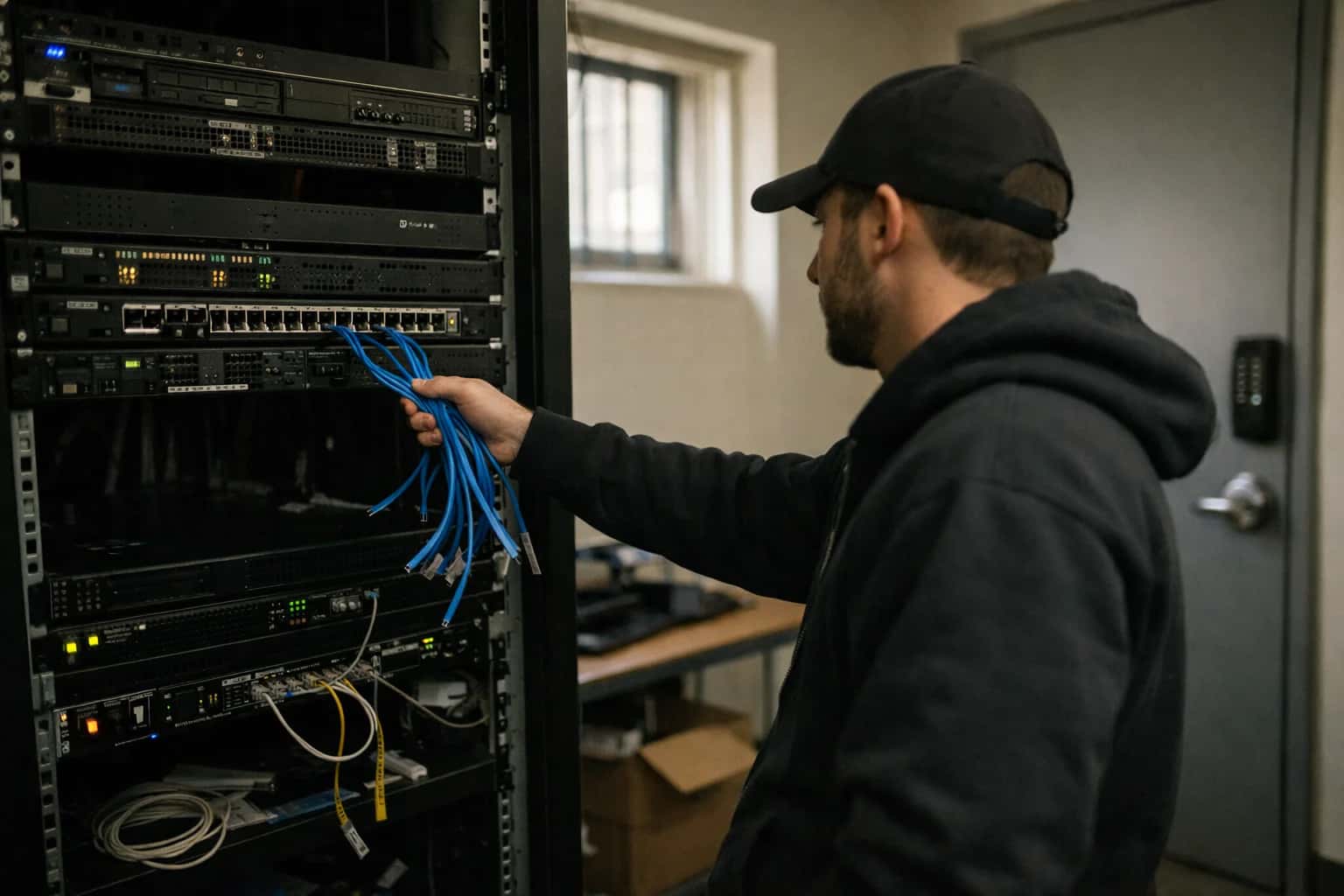
PHYSICAL NETWORK ISOLATION
What is Air-Gapped Processing?
A definitive security architecture for processing highly sensitive data in an environment physically disconnected from unsecured networks.
This paradigm is mandatory for sovereign AI infrastructure handling classified intelligence, critical national infrastructure controls, or proprietary model weights. By eliminating the attack surface of remote network exploitation, air-gapped processing guarantees that even a compromised host operating system cannot establish a covert command-and-control channel, enforcing absolute data sovereignty through physical impossibility rather than software policy.
PHYSICAL ISOLATION ARCHITECTURE
Key Characteristics of Air-Gapped Environments
Air-gapped processing is defined by a strict set of physical and logical controls that eliminate any electronic communication pathway to unsecured networks. These characteristics form a layered defense-in-depth strategy for the most sensitive data.
01
Physical Network Disconnection
The foundational characteristic is the absolute absence of a physical or wireless network interface connecting the secure environment to the public internet or any unclassified network. This is not a firewall rule but a physical air gap—a literal break in the electrical signal path. Data ingress and egress occur exclusively through sneakernet procedures, using controlled, human-mediated transfers on approved removable media.
0
External Network Interfaces
02
Strict Electromagnetic Emission Control (EMSEC)
Also known as TEMPEST countermeasures, this characteristic involves shielding the facility and its computing equipment to prevent data exfiltration through unintended electromagnetic emanations. This includes:
- Faraday cages or shielded enclosures to block radio frequency signals.
- Strict physical distance (red/black separation) between secure and unsecure equipment.
- Use of fiber optic cables instead of copper to eliminate radiated signals.
03
Unidirectional Data Diodes
When a one-way data flow is absolutely necessary (e.g., sending system logs to an external monitoring tool), a data diode is used. This is a hardware device that physically enforces unidirectional communication at the physical layer, often using an optical transmitter on the sending side and a receiver with no return path on the other. This makes it physically impossible for an attacker to exfiltrate data back through the same channel.
04
Rigorous Human-Mediated Transfer Protocols
All data movement relies on a formal sneakernet process with strict procedural controls. This includes:
- Two-person integrity: No single individual can move media alone.
- Mandatory malware scanning on a dedicated sheep-dip station before media enters the air-gapped zone.
- Cryptographic hashing and logging of all files transferred, creating an immutable chain of custody.
05
Hardened Endpoint and Peripheral Control
Endpoints within the air-gapped environment are locked down to prevent covert channels. This involves:
- Physically disabling or removing all unnecessary I/O ports (USB, Bluetooth, Wi-Fi cards).
- Using port locks or epoxy to seal unused network jacks.
- Strict application whitelisting to prevent execution of unauthorized code that might attempt to exploit a hidden or intermittent connection.
06
Self-Contained Infrastructure Stack
The environment must operate with full autonomy, hosting a complete replica of required services internally. This includes a local Private Container Registry, an internal DNS and certificate authority (CA), a disconnected Kubernetes control plane, and a local package mirror. This ensures no runtime dependency on external resources, which would violate the air gap.
AIR-GAPPED PROCESSING
Frequently Asked Questions
Clear answers to the most common technical and architectural questions about physically isolating compute environments for maximum data security.
Air-gapped processing is a security architecture where a computing environment is physically isolated from all unsecured networks, including the public internet, to process highly sensitive data without any risk of remote exfiltration. The system operates on a standalone network segment with no wireless, Bluetooth, or removable media interfaces active unless strictly controlled. Data ingress typically occurs through strict, audited procedures—often involving data diodes (unidirectional hardware that permits data to flow in but never out) or manual transfer via verified, sanitized media. Once inside the air-gapped enclave, models train or perform inference with zero external connectivity, ensuring that even if the workload is compromised, the attacker has no command-and-control channel to extract data.
Enabling Efficiency, Speed & Accuracy
Intelligent Analysis, Decision & Execution
We build AI systems for teams that need search across company data, workflow automation across tools, or AI features inside products and internal software.
Talk to Us
Search across company data
Give teams answers from docs, tickets, runbooks, and product data with sources and permissions.
Useful when people spend too long searching or get different answers from different systems.
Enterprise searchRAGPermissions
Read more
Automate internal workflows
Use AI to route work, draft outputs, trigger actions, and keep approvals and logs in place.
Useful when repetitive work moves across multiple tools and teams.
AI agentsWorkflow automationGovernance
Read more
Add AI to products and internal tools
Build assistants, guided actions, or decision support into the software your team or customers already use.
Useful when AI needs to be part of the product, not a separate tool.
AI integrationDecision supportModel routing
Read moreDEPLOYMENT SCENARIOS
Real-World Use Cases for Air-Gapped Processing
Air-gapped processing is not a theoretical construct; it is an operational necessity for environments where a data breach carries existential consequences. These scenarios demonstrate the physical isolation of compute from public networks to guarantee unilateral data control.
01
National Defense & Intelligence
Classified intelligence analysis and nuclear command-and-control systems operate on physically disconnected networks (SIPRNet, JWICS). Air-gapping prevents remote exfiltration of state secrets by foreign adversaries. Cross-domain solutions (CDS) are the only sanctioned mechanism for data transfer, often requiring human review or optical character recognition of printed documents to bridge the gap.
Zero Trust + Physical
Security Posture
02
Critical Infrastructure Control
Industrial Control Systems (ICS) and SCADA environments managing power grids, water treatment, and nuclear facilities are air-gapped to prevent catastrophic kinetic damage. The Stuxnet attack demonstrated that even air-gapped systems are vulnerable to sneakernet propagation via removable media, necessitating strict USB device policies and media sanitization stations at the perimeter.
03
Cryptocurrency Key Management
Institutional custodians and exchanges use air-gapped Hardware Security Modules (HSMs) to generate and store private keys. Transaction signing occurs on the offline device, and the signed payload is transferred via QR code or SD card to an internet-connected system for broadcasting. This ensures that private keys are never exposed to a networked memory space.
Cold Storage
Architecture Model
04
High-Value IP & Drug Formulation
Pharmaceutical companies and semiconductor fabs process proprietary molecular formulas and chip designs (GDSII files) in air-gapped sensitive compartmented information facilities (SCIFs). This prevents industrial espionage and protects trade secrets worth billions. Workstations are often stripped of wireless cards and USB ports are epoxy-filled to prevent physical bridging.
05
Election & Voting Infrastructure
Ballot tabulation systems are mandated by law in many jurisdictions to be air-gapped from the internet during active voting periods. The voting machine generates results that are exported to removable media and physically transported to a central reporting system, creating an air-gap verification step that prevents remote manipulation of vote counts.
06
AI Model Training on Classified Data
Intelligence agencies train large language models on classified document corpora within air-gapped GPU clusters. This allows leveraging modern transformer architectures without risking leakage of training data. Model updates and inference APIs are exposed only to users on the secure enclave, creating a sovereign AI instance that is completely invisible to the outside world.

About the author
Prasad Kumkar
CEO & MD, Inference Systems
Prasad Kumkar is the CEO & MD of Inference Systems and writes about AI systems architecture, LLM infrastructure, model serving, evaluation, and production deployment. Over 5+ years, he has worked across computer vision models, L5 autonomous vehicle systems, and LLM research, with a focus on taking complex AI ideas into real-world engineering systems.
His work and writing cover AI systems, large language models, AI agents, multimodal systems, autonomous systems, inference optimization, RAG, evaluation, and production AI engineering.
LinkedIn
Limited slotsGet a Free AI Consultation
Partnered with leading AI, data, and software stack.





How We Work
Custom AI workflows for your Business
One-fit-all AI don't work for modern businesses. At Inferensys, we aim to understand your business & custom requirements; which we use to define most efficient agentic workflows, the data, and the tools for your business.
01
Review the use case
We understand the task, the users, and where AI can actually help.
Read more02
Pick the right approach
We define what needs search, automation, or product integration.
Read more03
Build the first useful version
We implement the part that proves the value first.
Read more04
Improve from there
We add the checks and visibility needed to keep it useful.
Read moreThe first call is a practical review of your use case and the right next step.
Talk to Us