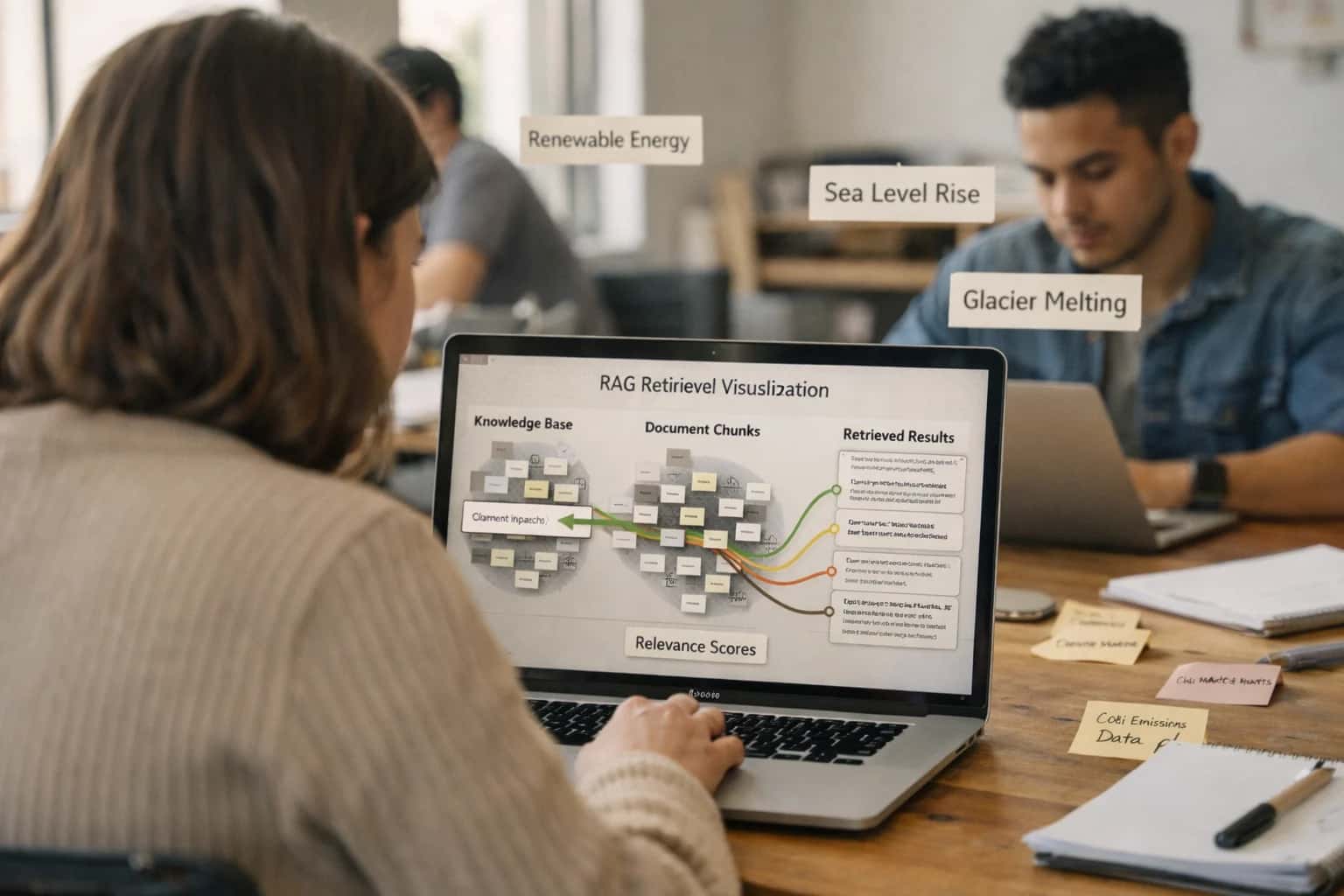
Retrieval-Augmented Generation (RAG) is an architectural framework that enhances a foundation model's reliability by first querying an external, authoritative knowledge source—such as a vector database of equipment manuals—and injecting the retrieved context directly into the model's prompt before text generation. This mechanism anchors the model's output in factual data, effectively mitigating hallucination in industrial applications where operational precision is non-negotiable.

Glossary
Retrieval-Augmented Generation (RAG)
An architectural pattern that grounds a foundation model's outputs by first retrieving relevant, authoritative information from an external knowledge base, such as a vector database of equipment manuals, before generating a response.
ARCHITECTURAL PATTERN
What is Retrieval-Augmented Generation (RAG)?
An architectural pattern that grounds a foundation model's outputs by first retrieving relevant, authoritative information from an external knowledge base before generating a response.
The process begins by converting a user query into a high-dimensional vector embedding for semantic search against a pre-indexed corpus. The most relevant documents are retrieved and prepended to the original prompt, providing the model with explicit, verifiable grounding context. This decouples the model's parametric knowledge from dynamic, proprietary data sources, enabling accurate responses about real-time machine states or specific maintenance procedures without costly model retraining.
ARCHITECTURAL PRINCIPLES
Core Characteristics of RAG
Retrieval-Augmented Generation is not a single technique but a composite architecture defined by several interlocking characteristics that distinguish it from standard language model inference.
01
Retrieval-First Query Processing
Unlike a standard language model that relies solely on its internal weights, a RAG system prepends a retrieval step before generation. The user's query is first encoded into a dense vector embedding and used to perform a semantic similarity search against an external knowledge corpus. Only the most relevant documents, chunks, or data objects are retrieved and injected into the model's context window. This transforms the generation task from an open-ended prediction into a grounded summarization or extraction task constrained by the retrieved evidence.
< 100ms
Typical Retrieval Latency
02
Parametric and Non-Parametric Memory Fusion
RAG architectures combine two distinct forms of memory:
- Parametric Memory: The static, implicit knowledge encoded in the model's trained weights, representing general language understanding and broad world knowledge frozen at the training cutoff date.
- Non-Parametric Memory: The dynamic, explicit knowledge stored in an external retrieval corpus, such as a vector database of equipment manuals or a real-time sensor feed. The generator fuses these two sources, using the retrieved non-parametric data as the authoritative ground truth to override or supplement its parametric knowledge, effectively decoupling knowledge storage from reasoning capability.
03
Factual Grounding and Source Attribution
A defining characteristic of RAG is its inherent ability to provide verifiable provenance for its outputs. Because the generated response is conditioned on specific retrieved documents, the system can cite the exact source passage, document ID, or data record that supports each claim. This transforms the model from an opaque oracle into an auditable reasoning engine. In industrial contexts, this allows a maintenance technician to trace a diagnostic recommendation directly back to the specific page of a machine's service manual, enabling trust and verification.
04
Knowledge Freshness Without Retraining
Standard foundation models suffer from knowledge cutoff—their understanding of the world is frozen at the moment training completes. RAG decouples knowledge currency from model weights. Updating the system's knowledge base is as simple as upserting new documents into the vector index or knowledge graph. The model can immediately retrieve and reason over this new information without any gradient updates or fine-tuning. This enables use cases like querying real-time production metrics or referencing the latest revision of a safety protocol without any model retraining cycle.
05
Hallucination Mitigation by Design
While no architecture eliminates hallucination entirely, RAG fundamentally alters its nature. Instead of the model confabulating from its parametric memory, errors in a RAG system typically manifest as faithfulness violations—cases where the generated text contradicts or extrapolates beyond the provided retrieved context. This is a more tractable problem than open-ended hallucination. Mitigation strategies include:
- Strict prompting: Instructing the model to answer only from the provided documents and to state 'I don't know' if the information is absent.
- Retrieval quality thresholds: Rejecting queries if the similarity score of the top retrieved chunk falls below a defined confidence level.
06
Modular and Swappable Component Architecture
RAG is not a monolithic model but a pipeline of discrete, independently optimizable components:
- The Embedding Model: Encodes queries and documents into vectors. Can be swapped for domain-specific models fine-tuned on industrial terminology.
- The Retriever: The search algorithm, ranging from sparse lexical retrieval (BM25) to dense semantic search to hybrid approaches.
- The Vector Store: The indexing infrastructure, which can be optimized for latency, recall, or scale.
- The Generator: The foundation model producing the final text, which can be a massive cloud model or a small, fine-tuned edge model. This modularity allows engineering teams to benchmark and upgrade each component independently to meet specific precision and latency requirements.
RETRIEVAL-AUGMENTED GENERATION
Frequently Asked Questions
Clear, technically precise answers to the most common questions about grounding foundation model outputs with authoritative manufacturing data.
Retrieval-Augmented Generation (RAG) is an architectural pattern that grounds a foundation model's outputs by first retrieving relevant, authoritative information from an external knowledge base before generating a response. The process operates in two distinct phases: retrieval and generation. During retrieval, a user query is converted into a vector embedding and used to perform a semantic search against a vector database containing indexed documents such as equipment manuals, standard operating procedures, or real-time sensor logs. The most semantically similar chunks of text are fetched. During generation, these retrieved chunks are injected into the model's context window alongside the original query as grounding evidence. The model is then instructed to synthesize an answer strictly from the provided context, effectively constraining its output to factual, verifiable sources. This architecture decouples the model's parametric knowledge from the organization's dynamic, proprietary data, enabling real-time knowledge updates without retraining the model itself.
Enabling Efficiency, Speed & Accuracy
Intelligent Analysis, Decision & Execution
We build AI systems for teams that need search across company data, workflow automation across tools, or AI features inside products and internal software.
Talk to Us
Search across company data
Give teams answers from docs, tickets, runbooks, and product data with sources and permissions.
Useful when people spend too long searching or get different answers from different systems.
Enterprise searchRAGPermissions
Read more
Automate internal workflows
Use AI to route work, draft outputs, trigger actions, and keep approvals and logs in place.
Useful when repetitive work moves across multiple tools and teams.
AI agentsWorkflow automationGovernance
Read more
Add AI to products and internal tools
Build assistants, guided actions, or decision support into the software your team or customers already use.
Useful when AI needs to be part of the product, not a separate tool.
AI integrationDecision supportModel routing
Read more
About the author
Prasad Kumkar
CEO & MD, Inference Systems
Prasad Kumkar is the CEO & MD of Inference Systems and writes about AI systems architecture, LLM infrastructure, model serving, evaluation, and production deployment. Over 5+ years, he has worked across computer vision models, L5 autonomous vehicle systems, and LLM research, with a focus on taking complex AI ideas into real-world engineering systems.
His work and writing cover AI systems, large language models, AI agents, multimodal systems, autonomous systems, inference optimization, RAG, evaluation, and production AI engineering.
LinkedIn
Limited slotsGet a Free AI Consultation
Partnered with leading AI, data, and software stack.





How We Work
Custom AI workflows for your Business
One-fit-all AI don't work for modern businesses. At Inferensys, we aim to understand your business & custom requirements; which we use to define most efficient agentic workflows, the data, and the tools for your business.
01
Review the use case
We understand the task, the users, and where AI can actually help.
Read more02
Pick the right approach
We define what needs search, automation, or product integration.
Read more03
Build the first useful version
We implement the part that proves the value first.
Read more04
Improve from there
We add the checks and visibility needed to keep it useful.
Read moreThe first call is a practical review of your use case and the right next step.
Talk to Us