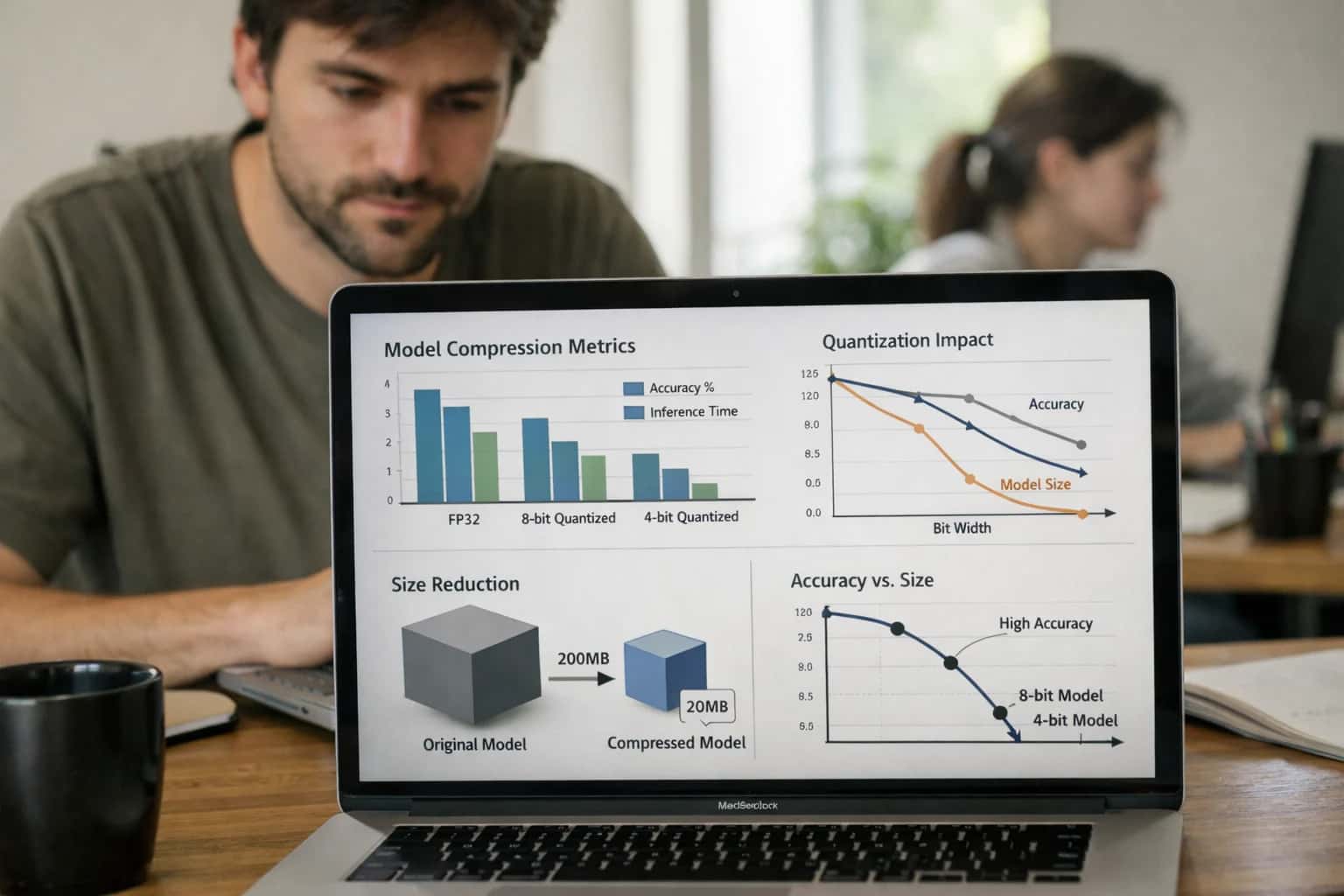
Quantization is the process of mapping continuous, high-precision numerical values (typically 32-bit floating-point) to a smaller set of discrete, lower-precision representations (such as 8-bit integers). This transformation drastically reduces the memory footprint and computational cost of a neural network, enabling large industrial foundation models to execute inference directly on edge devices with minimal latency and power consumption.

Glossary
Quantization
A model compression technique that reduces the numerical precision of a neural network's weights and activations, enabling large foundation models to run efficiently on resource-constrained factory-floor hardware.
MODEL COMPRESSION
What is Quantization?
Quantization is a model compression technique that reduces the numerical precision of a neural network's weights and activations, enabling large foundation models to run efficiently on resource-constrained factory-floor hardware.
The technique leverages the empirical observation that deep neural networks are often robust to reduced numerical precision. Post-training quantization (PTQ) converts a pre-trained model without retraining, while quantization-aware training (QAT) simulates low-precision effects during fine-tuning to recover accuracy. For manufacturing, this allows complex models for anomaly detection or natural language interfaces to be deployed on programmable logic controllers (PLCs) and industrial PCs without cloud dependency.
PRECISION REDUCTION
Key Quantization Techniques
Quantization maps high-precision weights and activations to lower-bit representations, dramatically reducing model size and inference latency for resource-constrained factory-floor hardware.
01
Post-Training Quantization (PTQ)
A one-shot compression technique applied after a model is fully trained. PTQ converts 32-bit floating-point weights (FP32) to 8-bit integers (INT8) without retraining. The process uses a calibration dataset—a small, representative sample of manufacturing data—to determine optimal clipping ranges and scaling factors. PTQ is the most common entry point for industrial deployment because it requires no access to the original training pipeline. However, accuracy degradation can occur with aggressive bit-width reduction, particularly for models handling rare defect types or subtle sensor anomalies.
4x
Typical Model Size Reduction
< 1 hour
Calibration Time
02
Quantization-Aware Training (QAT)
A technique that simulates quantization noise during the training process itself. The forward pass uses fake quantization nodes that round values to lower precision, while the backward pass uses full-precision gradients to update weights. This allows the model to learn representations that are inherently robust to quantization error. QAT consistently outperforms PTQ in accuracy preservation, especially at ultra-low bit-widths like 4-bit (INT4). For manufacturing defect classification where false negatives carry high cost, QAT is the gold standard despite requiring full retraining access.
< 0.5%
Accuracy Loss at INT8
INT4
Minimum Viable Bit-Width
03
Dynamic vs. Static Quantization
Two fundamental strategies for when scaling factors are computed:
-
Dynamic Quantization: Weights are quantized ahead of time, but activations are quantized on-the-fly during inference. Each activation tensor gets its own scaling factor computed from its observed range. This adds minimal latency overhead and works well for models dominated by memory-bandwidth constraints, such as transformer-based natural language interfaces.
-
Static Quantization: Both weights and activations are quantized offline using pre-computed scaling factors derived from the calibration dataset. This eliminates runtime computation of ranges, yielding the lowest possible inference latency—critical for real-time control loops in adaptive process control systems.
04
Granularity: Per-Tensor vs. Per-Channel
Quantization granularity defines the scope of the scaling factor:
-
Per-Tensor Quantization: A single scale and zero-point for an entire weight tensor. Fastest to compute but can cause significant accuracy loss if weight distributions vary widely across channels.
-
Per-Channel Quantization: A separate scale for each output channel in a convolutional or linear layer. This preserves fine-grained weight distributions and is essential for models deployed on Neural Processing Units (NPUs) that support channel-wise integer operations. Per-channel is the default recommendation for vision-based quality inspection models where spatial feature maps have heterogeneous value ranges.
05
GPTQ and LLM-Specific Quantization
Specialized algorithms designed for the extreme scale of Large Language Models and industrial foundation models with billions of parameters. GPTQ (GPT Post-Training Quantization) uses an approximate second-order method based on the Hessian matrix to quantize weights layer-by-layer while compensating for the quantization error in subsequent layers. This allows 4-bit quantization of 175B-parameter models on a single GPU. For factory-floor deployment of natural language shop-floor interfaces, GPTQ enables running powerful instruction-following models on edge hardware with limited VRAM.
4-bit
Achievable Precision
~4 GB
Memory for 7B Model
06
Integer-Only Inference
The end-goal of quantization: executing the entire model computation using only integer arithmetic. This requires:
- Quantized weights stored as INT8 or INT4
- Quantized activations produced by each layer
- Integer-arithmetic-only kernels that perform matrix multiplication and convolution without any floating-point operations
Integer-only inference unlocks deployment on microcontrollers and embedded systems that lack floating-point units entirely. For TinyML applications on factory-floor vibration sensors, this enables always-on anomaly detection at microwatt power budgets. Frameworks like TensorFlow Lite Micro and CMSIS-NN provide the optimized kernel libraries for these extreme edge scenarios.
QUANTIZATION EXPLAINED
Frequently Asked Questions
Clear, technically precise answers to the most common questions about model quantization, its mechanisms, and its critical role in deploying industrial foundation models on resource-constrained factory-floor hardware.
Quantization is a model compression technique that reduces the numerical precision of a neural network's weights and activations, typically converting 32-bit floating-point numbers (FP32) to lower-bit representations like 8-bit integers (INT8) or 4-bit integers (INT4). This process significantly decreases the model's memory footprint and accelerates inference speed by leveraging faster integer arithmetic on modern hardware, with a minimal, controlled trade-off in predictive accuracy. The core mechanism involves mapping continuous high-precision values to a discrete set of quantization levels defined by a scale factor and a zero-point. For industrial foundation models, this enables deployment directly on edge devices like smart cameras or programmable logic controllers without requiring expensive GPU servers.
Enabling Efficiency, Speed & Accuracy
Intelligent Analysis, Decision & Execution
We build AI systems for teams that need search across company data, workflow automation across tools, or AI features inside products and internal software.
Talk to Us
Search across company data
Give teams answers from docs, tickets, runbooks, and product data with sources and permissions.
Useful when people spend too long searching or get different answers from different systems.
Enterprise searchRAGPermissions
Read more
Automate internal workflows
Use AI to route work, draft outputs, trigger actions, and keep approvals and logs in place.
Useful when repetitive work moves across multiple tools and teams.
AI agentsWorkflow automationGovernance
Read more
Add AI to products and internal tools
Build assistants, guided actions, or decision support into the software your team or customers already use.
Useful when AI needs to be part of the product, not a separate tool.
AI integrationDecision supportModel routing
Read moreQUANTIZATION IN MANUFACTURING
Industrial Applications
Quantization compresses neural network precision to deploy large foundation models directly on resource-constrained factory-floor hardware, enabling real-time inference without cloud dependency.
01
Edge Inference on PLCs
Post-training quantization reduces model weights from 32-bit floating point to 8-bit integers, allowing a transformer-based anomaly detector to run directly on a programmable logic controller. This eliminates the latency and connectivity risks of cloud round-trips for real-time defect classification on high-speed production lines.
< 5ms
Inference Latency
4x
Model Size Reduction
02
Quantization-Aware Training
Unlike post-training methods, quantization-aware training (QAT) simulates low-precision arithmetic during the forward and backward passes. This allows the model to learn to compensate for quantization error, preserving accuracy for sensitive tasks like predictive maintenance vibration analysis where subtle signal patterns must not be lost.
03
Integer-Only Arithmetic
Modern quantization schemes target integer-only inference, where all matrix multiplications and activations use INT8 or INT4 operations. This is critical for deployment on neural processing units (NPUs) and microcontrollers that lack floating-point units, enabling foundation model capabilities on sub-watt hardware for remote sensor nodes.
04
Mixed-Precision Deployment
Not all layers are equally sensitive to precision loss. Mixed-precision quantization assigns higher bit-widths to attention mechanisms and lower bit-widths to feed-forward layers. This strategy preserves the model's ability to reason over complex sensor fusion inputs while maximizing compression for deployment on industrial gateways.
05
Calibration for Factory Data
Effective quantization requires a representative calibration dataset to determine optimal scaling factors. For manufacturing, this means sampling real production telemetry across shift changes, ambient temperature variations, and equipment wear states to ensure the quantized model generalizes under actual operating conditions.
06
Weight Clustering and Sharing
Aggressive compression techniques like weight clustering group similar weight values and store only cluster centroids and indices. Combined with quantization, this can reduce a vision inspection model's footprint by over 10x, enabling deployment on smart cameras with limited onboard memory for in-situ quality checks.

About the author
Prasad Kumkar
CEO & MD, Inference Systems
Prasad Kumkar is the CEO & MD of Inference Systems and writes about AI systems architecture, LLM infrastructure, model serving, evaluation, and production deployment. Over 5+ years, he has worked across computer vision models, L5 autonomous vehicle systems, and LLM research, with a focus on taking complex AI ideas into real-world engineering systems.
His work and writing cover AI systems, large language models, AI agents, multimodal systems, autonomous systems, inference optimization, RAG, evaluation, and production AI engineering.
LinkedIn
Limited slotsGet a Free AI Consultation
Partnered with leading AI, data, and software stack.





How We Work
Custom AI workflows for your Business
One-fit-all AI don't work for modern businesses. At Inferensys, we aim to understand your business & custom requirements; which we use to define most efficient agentic workflows, the data, and the tools for your business.
01
Review the use case
We understand the task, the users, and where AI can actually help.
Read more02
Pick the right approach
We define what needs search, automation, or product integration.
Read more03
Build the first useful version
We implement the part that proves the value first.
Read more04
Improve from there
We add the checks and visibility needed to keep it useful.
Read moreThe first call is a practical review of your use case and the right next step.
Talk to Us