Stream processing is a data management architecture that processes data records in motion, rather than waiting for static batches to accumulate. Unlike traditional batch processing, which operates on bounded datasets at rest, a stream processing engine computes results incrementally on infinite, continuously flowing data. This paradigm is fundamental to Industrial DataOps pipelines, where high-velocity sensor telemetry from the factory floor must be filtered, enriched, and analyzed within milliseconds to enable closed-loop control and immediate anomaly detection.

Glossary
Stream Processing
A computational paradigm that continuously analyzes and acts on data records as they arrive, rather than processing static batches, enabling real-time industrial analytics.
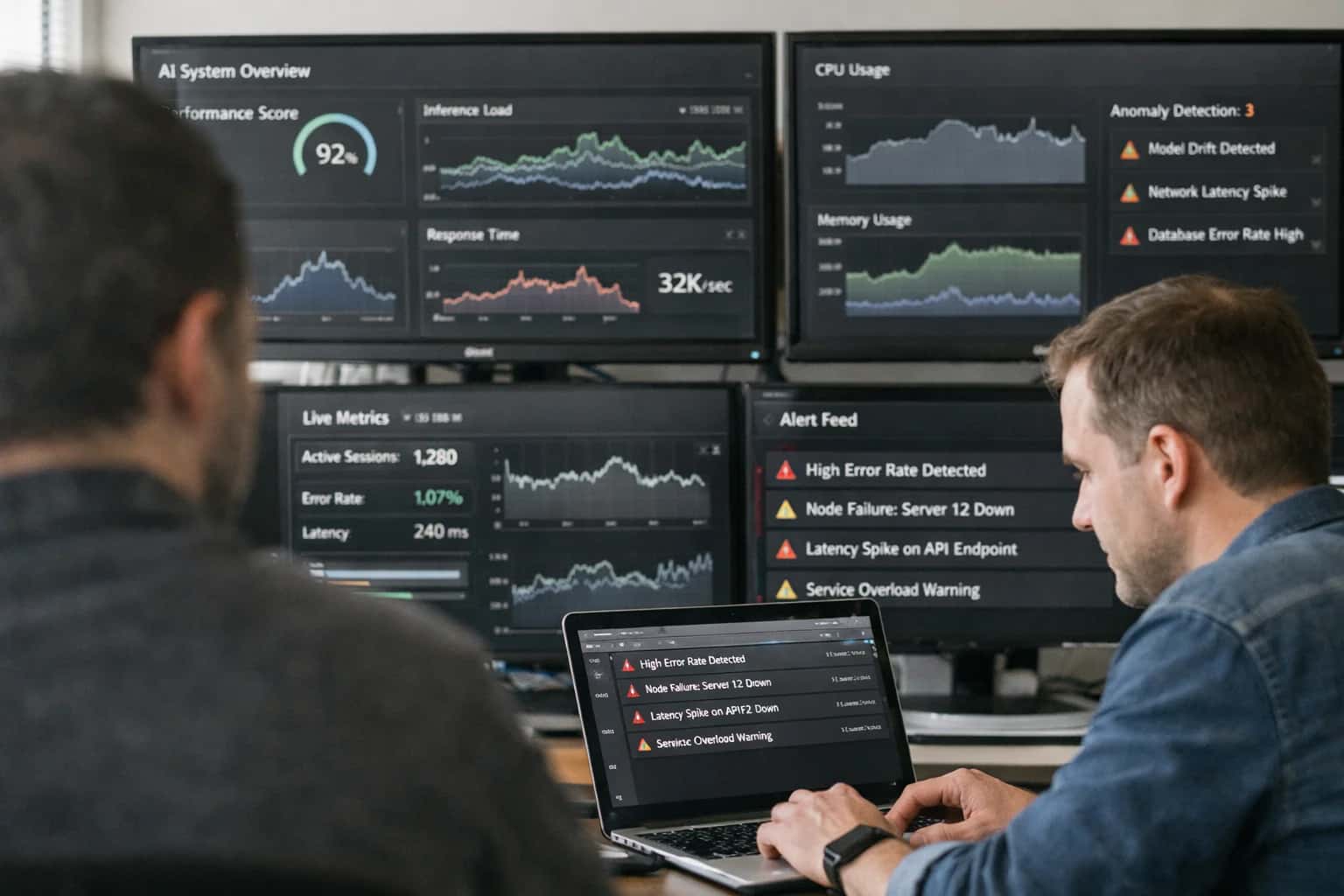
REAL-TIME DATA COMPUTATION
What is Stream Processing?
Stream processing is a computational paradigm that continuously ingests, analyzes, and acts upon unbounded sequences of data records as they arrive, enabling real-time industrial analytics and decision-making.
Modern stream processing frameworks, such as Apache Kafka Streams and Apache Flink, provide exactly-once semantics and stateful processing guarantees essential for mission-critical manufacturing. They consume events from a distributed log, perform transformations like windowed aggregations or joins against reference data, and emit results to downstream sinks. This architecture directly supports the Unified Namespace (UNS) pattern, where a stream processor can subscribe to raw OPC UA PubSub messages, contextualize them against the ISA-95 asset hierarchy, and publish enriched, structured data products for consumption by predictive maintenance algorithms and digital twin simulations.
ARCHITECTURAL FOUNDATIONS
Core Characteristics of Stream Processing Engines
Stream processing engines are the computational backbone of real-time industrial analytics. Unlike batch processors that operate on static datasets, these engines continuously ingest, analyze, and act upon unbounded sequences of sensor telemetry and events as they arrive.
01
Unbounded Data Handling
Stream processing engines treat data as an infinite, continuously flowing sequence rather than a finite dataset. This fundamental shift enables immediate processing of factory-floor telemetry without artificial boundaries.
- Event-by-event processing: Each sensor reading is processed individually upon arrival
- No fixed end: The engine assumes data will flow indefinitely, eliminating batch window constraints
- Windowing for aggregation: Time-based or count-based windows (tumbling, sliding, session) impose temporary boundaries for calculations like 5-minute rolling averages of vibration data
- Watermarks: Track event-time progress to handle out-of-order data common in industrial environments with network latency
02
Stateful Processing
Maintaining fault-tolerant, distributed state is essential for computations that span multiple events, such as tracking equipment runtime or detecting anomaly patterns over time.
- Local state stores: Embedded key-value stores (e.g., RocksDB) hold intermediate results within each processing node
- Changlog-backed recovery: State changes are persisted to a distributed log, enabling full restoration after node failure
- Exactly-once semantics: Coordinated checkpointing and idempotent writes ensure each event is processed precisely once, critical for industrial transactions like quality pass/fail counts
- State TTL: Automatic expiration of stale state prevents unbounded memory growth for transient entities like work-in-progress items
03
Event-Time Processing
Distinguishing between event time (when data was generated on the factory floor) and processing time (when the engine received it) is critical for accurate industrial analytics.
- Event-time semantics: Timestamps embedded in sensor payloads drive window calculations, not server arrival time
- Out-of-order handling: Watermarks define how long the engine waits for late-arriving data before finalizing window results
- Side outputs: Late events that miss the watermark can be routed to separate streams for reconciliation or audit logging
- Temporal joins: Correlating streams from different machines requires aligning events by their original timestamps, not ingestion order
04
Fault Tolerance and Elasticity
Production-grade stream processors must survive hardware failures and scale dynamically without data loss or duplication, ensuring continuous operation in mission-critical manufacturing environments.
- Distributed checkpointing: Periodic snapshots of operator state and stream positions are persisted to durable storage
- Lineage-based recovery: Failed nodes are restarted and replay only the necessary data from upstream sources using saved offsets
- Dynamic scaling: Adding or removing worker nodes triggers automatic state redistribution without pipeline shutdown
- Backpressure propagation: When downstream sinks slow down, the engine throttles upstream ingestion to prevent out-of-memory errors and buffer overflows
05
Streaming SQL and CEP
Modern engines expose declarative query interfaces that abstract away the complexity of distributed stream processing, enabling domain experts to define real-time logic without low-level programming.
- Streaming SQL: Continuous queries using familiar SQL syntax with extensions for windows, watermarks, and temporal joins
- Complex Event Processing (CEP): Pattern-matching languages (e.g., MATCH_RECOGNIZE) detect sequences like "temperature spike followed by pressure drop within 30 seconds"
- User-Defined Functions (UDFs): Custom logic in Python or Java for domain-specific transformations like vibration FFT analysis
- Materialized views: Continuously updated query results serve as real-time dashboards or triggers for downstream automation
06
Exactly-Once Semantics
The strongest consistency guarantee ensures each event is processed precisely one time, eliminating duplicates or gaps that could corrupt industrial metrics like production counts or quality scores.
- Idempotent sinks: Downstream systems accept writes with unique transaction IDs, deduplicating on replay
- Two-phase commits: Coordinated atomic writes across state stores and external sinks
- End-to-end exactly-once: Guarantees span from source ingestion through processing to sink output, not just within the engine
- Trade-off awareness: Exactly-once incurs latency overhead; at-least-once with idempotent consumers is a common pragmatic alternative for high-throughput telemetry
DATA PROCESSING PARADIGMS
Stream Processing vs. Batch Processing
A technical comparison of continuous, real-time data analysis versus periodic, high-volume data processing for industrial data pipelines.
| Feature | Stream Processing | Batch Processing |
|---|---|---|
Processing Model | Record-by-record or micro-batch as data arrives | Finite chunks of data processed at scheduled intervals |
Latency | Sub-second to milliseconds | Minutes to hours |
Data Scope | Rolling window or infinite dataset | Bounded, finite dataset |
State Management | Stateful; maintains context across events | Typically stateless between jobs |
Output Timing | Continuous, incremental results | Complete results after entire job finishes |
Use Case | Real-time anomaly detection, adaptive process control | End-of-shift reporting, model training, ETL |
Fault Tolerance | Checkpointing and exactly-once semantics | Job restart from last completed stage |
Resource Utilization | Always-on compute; optimized for steady throughput | Burst compute; optimized for throughput over latency |
STREAM PROCESSING
Frequently Asked Questions
Clear, technically precise answers to the most common questions about stream processing architectures, guarantees, and patterns in industrial data environments.
Stream processing is a computational paradigm that continuously ingests, analyzes, and acts upon unbounded sequences of data records as they arrive, typically with sub-second latency. Unlike batch processing, which collects data into finite chunks and processes them on a scheduled interval (e.g., hourly or nightly), stream processing operates on an event-by-event basis. The fundamental distinction lies in the unbounded dataset assumption: stream processors never assume data stops arriving. Architecturally, this requires stateful operators that maintain incremental aggregates in memory, event-time processing to handle out-of-order arrival, and windowing to group infinite streams into finite logical subsets. In industrial contexts, a batch job might calculate OEE daily from a data lake, while a stream processor detects a bearing temperature spike and triggers a shutdown within 50 milliseconds.
Enabling Efficiency, Speed & Accuracy
Intelligent Analysis, Decision & Execution
We build AI systems for teams that need search across company data, workflow automation across tools, or AI features inside products and internal software.
Talk to Us
Search across company data
Give teams answers from docs, tickets, runbooks, and product data with sources and permissions.
Useful when people spend too long searching or get different answers from different systems.
Enterprise searchRAGPermissions
Read more
Automate internal workflows
Use AI to route work, draft outputs, trigger actions, and keep approvals and logs in place.
Useful when repetitive work moves across multiple tools and teams.
AI agentsWorkflow automationGovernance
Read more
Add AI to products and internal tools
Build assistants, guided actions, or decision support into the software your team or customers already use.
Useful when AI needs to be part of the product, not a separate tool.
AI integrationDecision supportModel routing
Read more
About the author
Prasad Kumkar
CEO & MD, Inference Systems
Prasad Kumkar is the CEO & MD of Inference Systems and writes about AI systems architecture, LLM infrastructure, model serving, evaluation, and production deployment. Over 5+ years, he has worked across computer vision models, L5 autonomous vehicle systems, and LLM research, with a focus on taking complex AI ideas into real-world engineering systems.
His work and writing cover AI systems, large language models, AI agents, multimodal systems, autonomous systems, inference optimization, RAG, evaluation, and production AI engineering.
LinkedIn
Limited slotsGet a Free AI Consultation
Partnered with leading AI, data, and software stack.





How We Work
Custom AI workflows for your Business
One-fit-all AI don't work for modern businesses. At Inferensys, we aim to understand your business & custom requirements; which we use to define most efficient agentic workflows, the data, and the tools for your business.
01
Review the use case
We understand the task, the users, and where AI can actually help.
Read more02
Pick the right approach
We define what needs search, automation, or product integration.
Read more03
Build the first useful version
We implement the part that proves the value first.
Read more04
Improve from there
We add the checks and visibility needed to keep it useful.
Read moreThe first call is a practical review of your use case and the right next step.
Talk to Us