Workload consolidation is the architectural practice of hosting previously isolated industrial control, human-machine interface (HMI), and data analytics functions on a unified hyperconverged infrastructure (HCI) platform. By leveraging a real-time hypervisor, deterministic Programmable Logic Controller (PLC) execution can coexist with general-purpose operating systems on shared silicon, eliminating the need for dedicated physical controllers for each function.

Glossary
Workload Consolidation
The strategy of merging multiple discrete control, HMI, and analytics functions onto a single high-performance edge server to reduce hardware footprint, cabling, and energy consumption in industrial settings.
EDGE COMPUTING STRATEGY
What is Workload Consolidation?
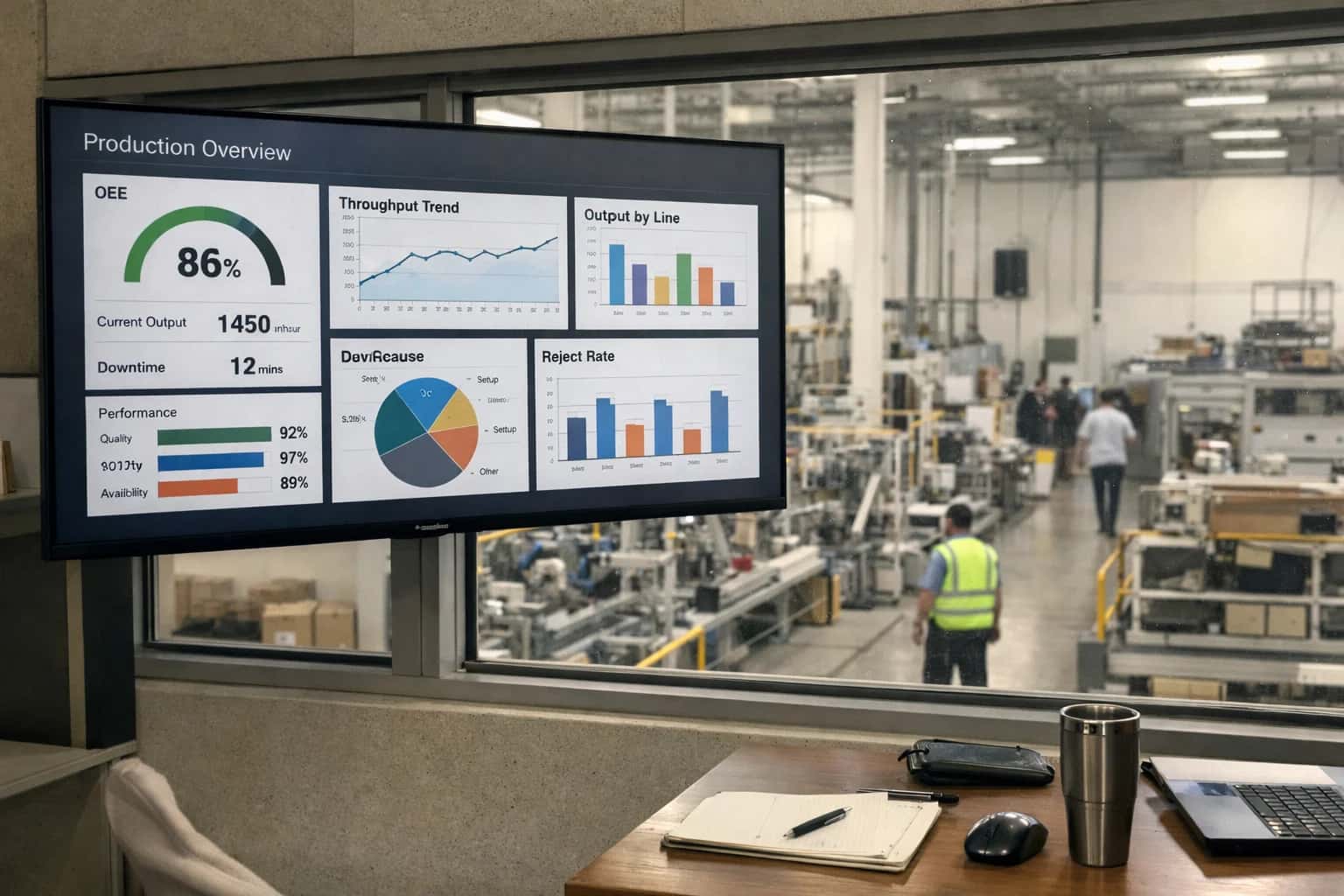
Workload consolidation is the strategic merging of multiple discrete industrial functions—such as real-time control, HMI, and analytics—onto a single high-performance edge server to reduce hardware footprint and system complexity.
This strategy directly reduces capital expenditure on hardware, cabling, and energy consumption while simplifying lifecycle management through Infrastructure as Code (IaC). The success of consolidation depends on strict temporal and spatial isolation enforced by technologies like CPU pinning and Single Root I/O Virtualization (SR-IOV) to prevent non-critical workloads from starving safety-critical control loops of compute resources.
ARCHITECTURAL PRINCIPLES
Key Characteristics of Workload Consolidation
Workload consolidation merges discrete control, HMI, and analytics functions onto a single high-performance edge server. The following characteristics define a robust, deterministic consolidation strategy.
02
Mixed-Criticality Coexistence
The ability to safely host functions with different safety integrity levels on a single platform. A Mixed-Criticality System enforces strict temporal and spatial separation.
- Temporal Isolation: A real-time hypervisor guarantees that a safety-certified control loop executes within its microsecond-level deadline regardless of the load on general-purpose operating systems.
- Spatial Isolation: Memory regions are strictly partitioned using hardware virtualization extensions to prevent a crash in a Linux-based analytics container from corrupting the memory space of a safety controller.
- Freedom from Interference: The architecture must demonstrably prove that non-critical functions cannot impact the performance or safety of critical functions, a key requirement for IEC 61508 certification.
03
Network Convergence via TSN
Collapses multiple physical fieldbus networks into a single converged Ethernet fabric. Time-Sensitive Networking (TSN) is the essential enabler for this consolidation.
- Traffic Scheduling: TSN uses a gatekeeper mechanism (IEEE 802.1Qbv) to create protected time slots for cyclic control data, ensuring it bypasses queues filled with best-effort video or analytics traffic.
- Precision Synchronization: The Precision Time Protocol (PTP) synchronizes clocks across all consolidated nodes to sub-microsecond accuracy, allowing coordinated motion control over the same wire that carries HMI traffic.
- OPC UA Pub/Sub: This protocol leverages TSN to deliver a scalable, connectionless data bus where a single publisher can multicast sensor data to multiple consolidated subscriber functions without a central broker.
04
Immutable Lifecycle Management
Treats the consolidated server as a single, version-controlled entity rather than a collection of individually managed components. This is the principle of Immutable Infrastructure.
- Golden Images: The entire software stack—hypervisor, real-time OS, soft PLC, and edge analytics—is pre-integrated and tested as a single bootable image.
- Atomic Updates: Patches are never applied in-place. Instead, the entire system is replaced with a new, validated image, eliminating configuration drift and ensuring every deployed unit is identical.
- Infrastructure as Code (IaC): The desired state of the consolidated workloads is defined in declarative configuration files, enabling automated, repeatable provisioning and disaster recovery.
05
High-Availability Orchestration
Maintains continuous operation of all consolidated functions through automated failover mechanisms that preserve state across all virtualized workloads.
- Fault Tolerance (FT): A secondary host runs a shadow instance of the control VM in lockstep execution. If the primary fails, the secondary takes over with zero state loss and no process interruption.
- Live Migration: The hypervisor can move a running control workload from a failing hardware node to a healthy one without stopping the process, enabling proactive maintenance.
- Unified Namespace (UNS): A centralized data hub ensures that upon failover, the new active instance immediately has access to the complete, current state of all data sources, preventing information gaps.
06
Hardware-Accelerated Data Processing
Offloads infrastructure services from the host CPU to specialized hardware, preserving compute cycles for core control and analytics functions.
- Data Processing Unit (DPU): A DPU handles the entire virtual switch, network security, and storage virtualization, freeing the CPU to focus exclusively on executing control logic and machine learning inference.
- Hyperconverged Infrastructure (HCI): Abstracts and pools direct-attached storage from the server into a virtual SAN, eliminating the need for external storage arrays and consolidating the entire data path within the edge node.
- GPU/NPU Partitioning: A single physical GPU can be virtualized into multiple instances, simultaneously accelerating a computer vision quality inspection model and rendering a 3D HMI, all on the same consolidated hardware.
WORKLOAD CONSOLIDATION
Frequently Asked Questions
Clear, technically precise answers to the most common questions about merging discrete industrial control, HMI, and analytics functions onto unified edge server infrastructure.
Workload consolidation is the architectural strategy of merging multiple discrete industrial control, human-machine interface (HMI), data acquisition, and analytics functions—traditionally running on separate physical controllers and PCs—onto a single, high-performance edge server or hyperconverged infrastructure (HCI) node. This approach leverages real-time hypervisors and containerization to partition hardware resources while guaranteeing strict temporal isolation between safety-critical and non-critical tasks. The primary objective is to reduce physical hardware footprint, cabling complexity, and energy consumption on the factory floor. By replacing racks of dedicated programmable logic controllers (PLCs) and operator stations with a unified compute platform, organizations achieve centralized management, simplified lifecycle operations, and the ability to dynamically reallocate resources as production demands shift. This is a foundational principle of software-defined manufacturing, decoupling control logic from proprietary hardware silos.
Enabling Efficiency, Speed & Accuracy
Intelligent Analysis, Decision & Execution
We build AI systems for teams that need search across company data, workflow automation across tools, or AI features inside products and internal software.
Talk to Us
Search across company data
Give teams answers from docs, tickets, runbooks, and product data with sources and permissions.
Useful when people spend too long searching or get different answers from different systems.
Enterprise searchRAGPermissions
Read more
Automate internal workflows
Use AI to route work, draft outputs, trigger actions, and keep approvals and logs in place.
Useful when repetitive work moves across multiple tools and teams.
AI agentsWorkflow automationGovernance
Read more
Add AI to products and internal tools
Build assistants, guided actions, or decision support into the software your team or customers already use.
Useful when AI needs to be part of the product, not a separate tool.
AI integrationDecision supportModel routing
Read more
About the author
Prasad Kumkar
CEO & MD, Inference Systems
Prasad Kumkar is the CEO & MD of Inference Systems and writes about AI systems architecture, LLM infrastructure, model serving, evaluation, and production deployment. Over 5+ years, he has worked across computer vision models, L5 autonomous vehicle systems, and LLM research, with a focus on taking complex AI ideas into real-world engineering systems.
His work and writing cover AI systems, large language models, AI agents, multimodal systems, autonomous systems, inference optimization, RAG, evaluation, and production AI engineering.
LinkedIn
Limited slotsGet a Free AI Consultation
Partnered with leading AI, data, and software stack.





How We Work
Custom AI workflows for your Business
One-fit-all AI don't work for modern businesses. At Inferensys, we aim to understand your business & custom requirements; which we use to define most efficient agentic workflows, the data, and the tools for your business.
01
Review the use case
We understand the task, the users, and where AI can actually help.
Read more02
Pick the right approach
We define what needs search, automation, or product integration.
Read more03
Build the first useful version
We implement the part that proves the value first.
Read more04
Improve from there
We add the checks and visibility needed to keep it useful.
Read moreThe first call is a practical review of your use case and the right next step.
Talk to Us