IEC 61499 is an international standard for distributed industrial automation that defines a component-based function block architecture enabling event-driven control logic decoupled from specific hardware topologies. It extends the cyclical execution model of IEC 61131-3 by introducing an event-triggered execution paradigm, where function blocks communicate via event and data flows across networked devices without a centralized scan cycle.

Glossary
IEC 61499
An international standard for distributed industrial automation that defines a component-based function block architecture enabling event-driven control logic decoupled from specific hardware topologies.
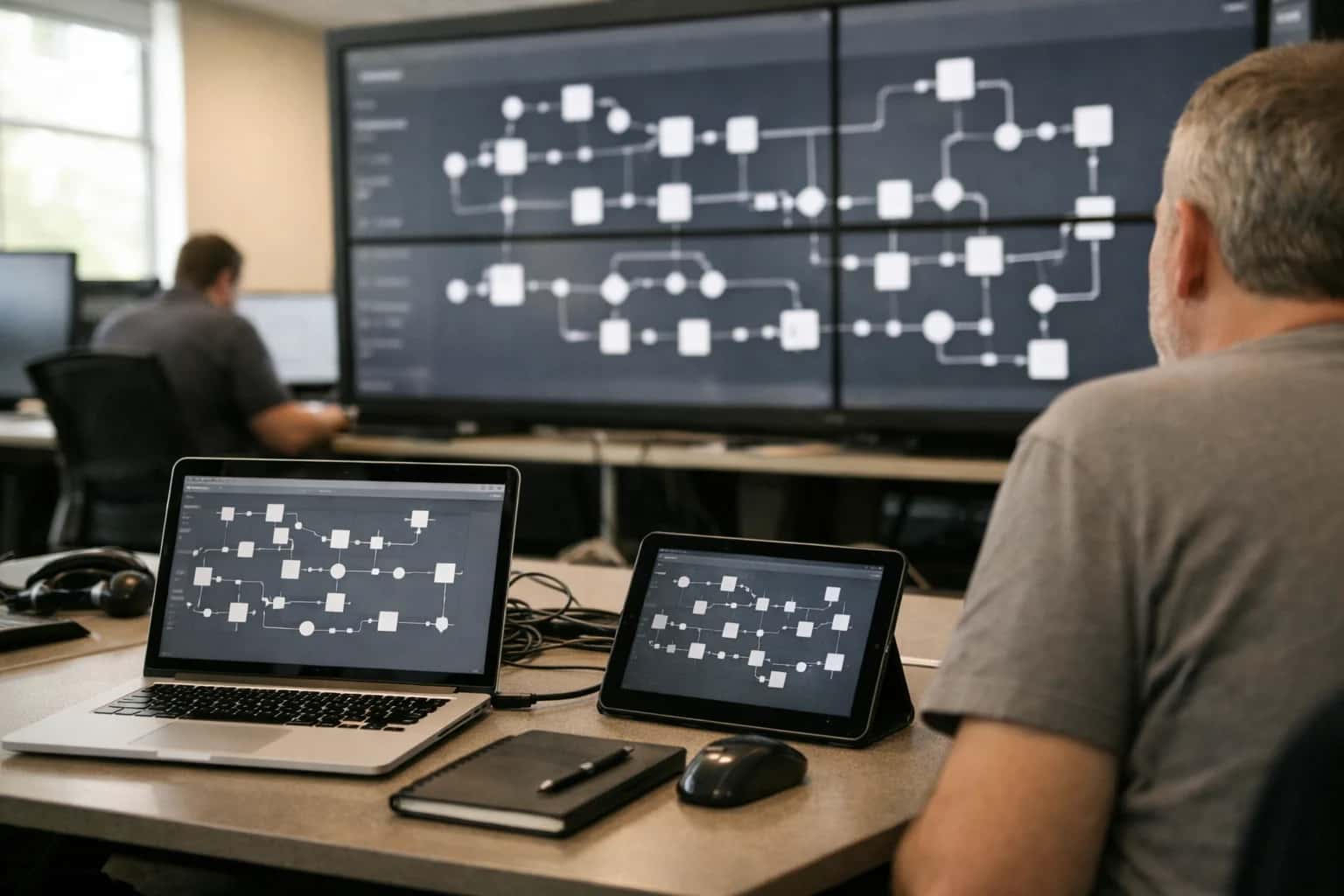
Distributed Automation Standard
What is IEC 61499?
IEC 61499 is an international standard defining a component-based architecture for distributed industrial automation systems using event-driven function blocks.
The standard's core abstraction is the function block—a self-contained software unit encapsulating algorithms and internal state—which can be distributed across multiple physical controllers. Unlike traditional PLC architectures that bind logic to a single processor, IEC 61499 enables hardware-agnostic application design, allowing control engineers to model entire production systems as networks of interoperable, reconfigurable components that execute deterministically across heterogeneous edge devices.
ARCHITECTURAL PRINCIPLES
Key Features of IEC 61499
The IEC 61499 standard fundamentally rearchitects industrial automation by decoupling software from hardware, enabling portable, event-driven, and distributed control systems.
01
Event-Driven Function Blocks
The core building block is the function block, which encapsulates both algorithms and a state machine. Unlike IEC 61131-3's cyclical scan, execution is triggered by event inputs. An Execution Control Chart (ECC) inside each block defines a finite state machine, dictating which algorithm executes in response to specific event combinations. This enables truly asynchronous, reactive behavior where blocks process data only when relevant events occur, dramatically reducing idle computation.
02
Hardware-Independent System Model
IEC 61499 enforces a strict separation between the application model and the device model. Control logic is designed as a network of function blocks independent of any specific hardware topology. The system model then maps these logical blocks to physical devices and their resources. This allows the same application to be deployed across heterogeneous hardware—from embedded ARM controllers to x86 edge servers—without code modification, enabling true software-defined automation.
03
Distributed Control Architecture
The standard natively supports distributed intelligence. A system is composed of multiple devices, each containing resources (logical execution units) that host function blocks. Communication between blocks on different devices is handled by service interface function blocks (SIFBs) that abstract the underlying network protocol. This eliminates the need for a central controller, allowing peer-to-peer coordination and fault isolation across a plant-wide distributed system.
04
Service Interface & Communication Abstraction
Interaction with the physical world and external protocols is encapsulated in Service Interface Function Blocks (SIFBs). These special blocks provide a standardized interface for:
- Publish/Subscribe: For one-to-many data distribution, often mapped to OPC UA Pub/Sub or DDS.
- Client/Server: For request-response interactions with databases or MES systems. This abstraction layer makes the application logic agnostic to the underlying communication middleware, allowing protocol swaps without logic changes.
05
Subapplication & Composite Types
Complex logic is managed through subapplications, which are composite function block networks treated as a single reusable component. A subapplication has a defined interface of external events and data, enabling hierarchical design. Crucially, subapplications can be marked as distributed, allowing their internal blocks to be split across multiple devices during the mapping process. This supports modular, vendor-agnostic packaging of intellectual property.
06
Dynamic Reconfiguration
IEC 61499 provides management commands for online reconfiguration without stopping the entire system. New function blocks, connections, or even entire subapplications can be added, removed, or modified during runtime. This is critical for high-availability processes that cannot tolerate a full shutdown for logic updates, enabling continuous improvement and adaptive manufacturing directly on the live system.
ARCHITECTURAL COMPARISON
IEC 61499 vs. IEC 61131-3
Fundamental differences between the event-driven function block standard and the cyclical scan-based programming standard for industrial automation.
| Feature | IEC 61499 | IEC 61131-3 |
|---|---|---|
Execution Model | Event-driven, asynchronous | Cyclical scan, synchronous |
System Architecture | Distributed, network-centric | Centralized, controller-centric |
Functional Unit | Function Block with event/data interfaces | Program Organization Unit (POU) |
Hardware Coupling | Hardware-independent, late binding | Tightly coupled to specific PLC hardware |
Communication Model | Native publish-subscribe, implicit data flow | Explicit, programmer-managed I/O mapping |
Reusability | Self-contained, composable blocks | Vendor-specific libraries, limited portability |
Concurrency | Inherently parallel execution | Sequential task scheduling |
Dynamic Reconfiguration |
IEC 61499 EXPLAINED
Frequently Asked Questions
Clear, technically precise answers to the most common questions about the IEC 61499 standard for distributed industrial automation and its role in software-defined manufacturing.
IEC 61499 is an international standard for distributed industrial automation that defines a component-based function block architecture enabling event-driven control logic decoupled from specific hardware topologies. Unlike the cyclical scan model of IEC 61131-3, IEC 61499 operates on an event-triggered execution model where function blocks process data only when an input event arrives. Each function block encapsulates both algorithms and an internal state machine, communicating through event flows and data flows that are explicitly separated. The standard's core architectural element is the Application Model, which defines a network of interconnected function blocks that can be transparently mapped to any physical device in a distributed system. This hardware-agnostic design means the same control application can be deployed across a single PLC, a cluster of edge nodes, or a cloud instance without rewriting logic, making it foundational for software-defined manufacturing automation.
Enabling Efficiency, Speed & Accuracy
Intelligent Analysis, Decision & Execution
We build AI systems for teams that need search across company data, workflow automation across tools, or AI features inside products and internal software.
Talk to Us
Search across company data
Give teams answers from docs, tickets, runbooks, and product data with sources and permissions.
Useful when people spend too long searching or get different answers from different systems.
Enterprise searchRAGPermissions
Read more
Automate internal workflows
Use AI to route work, draft outputs, trigger actions, and keep approvals and logs in place.
Useful when repetitive work moves across multiple tools and teams.
AI agentsWorkflow automationGovernance
Read more
Add AI to products and internal tools
Build assistants, guided actions, or decision support into the software your team or customers already use.
Useful when AI needs to be part of the product, not a separate tool.
AI integrationDecision supportModel routing
Read more
About the author
Prasad Kumkar
CEO & MD, Inference Systems
Prasad Kumkar is the CEO & MD of Inference Systems and writes about AI systems architecture, LLM infrastructure, model serving, evaluation, and production deployment. Over 5+ years, he has worked across computer vision models, L5 autonomous vehicle systems, and LLM research, with a focus on taking complex AI ideas into real-world engineering systems.
His work and writing cover AI systems, large language models, AI agents, multimodal systems, autonomous systems, inference optimization, RAG, evaluation, and production AI engineering.
LinkedIn
Limited slotsGet a Free AI Consultation
Partnered with leading AI, data, and software stack.





How We Work
Custom AI workflows for your Business
One-fit-all AI don't work for modern businesses. At Inferensys, we aim to understand your business & custom requirements; which we use to define most efficient agentic workflows, the data, and the tools for your business.
01
Review the use case
We understand the task, the users, and where AI can actually help.
Read more02
Pick the right approach
We define what needs search, automation, or product integration.
Read more03
Build the first useful version
We implement the part that proves the value first.
Read more04
Improve from there
We add the checks and visibility needed to keep it useful.
Read moreThe first call is a practical review of your use case and the right next step.
Talk to Us