An Edge Runtime is a deterministic execution environment situated physically close to industrial machinery, designed to host containerized workloads such as Soft PLCs, protocol translators, and local inference engines. It abstracts the underlying hardware—typically an industrial PC or edge server—to provide a consistent, managed layer for deploying and orchestrating real-time control applications without dependency on a remote data center.

Glossary
Edge Runtime
A lightweight software environment deployed on factory-floor hardware that executes containerized control logic, protocol translation, and local analytics independently of cloud connectivity.
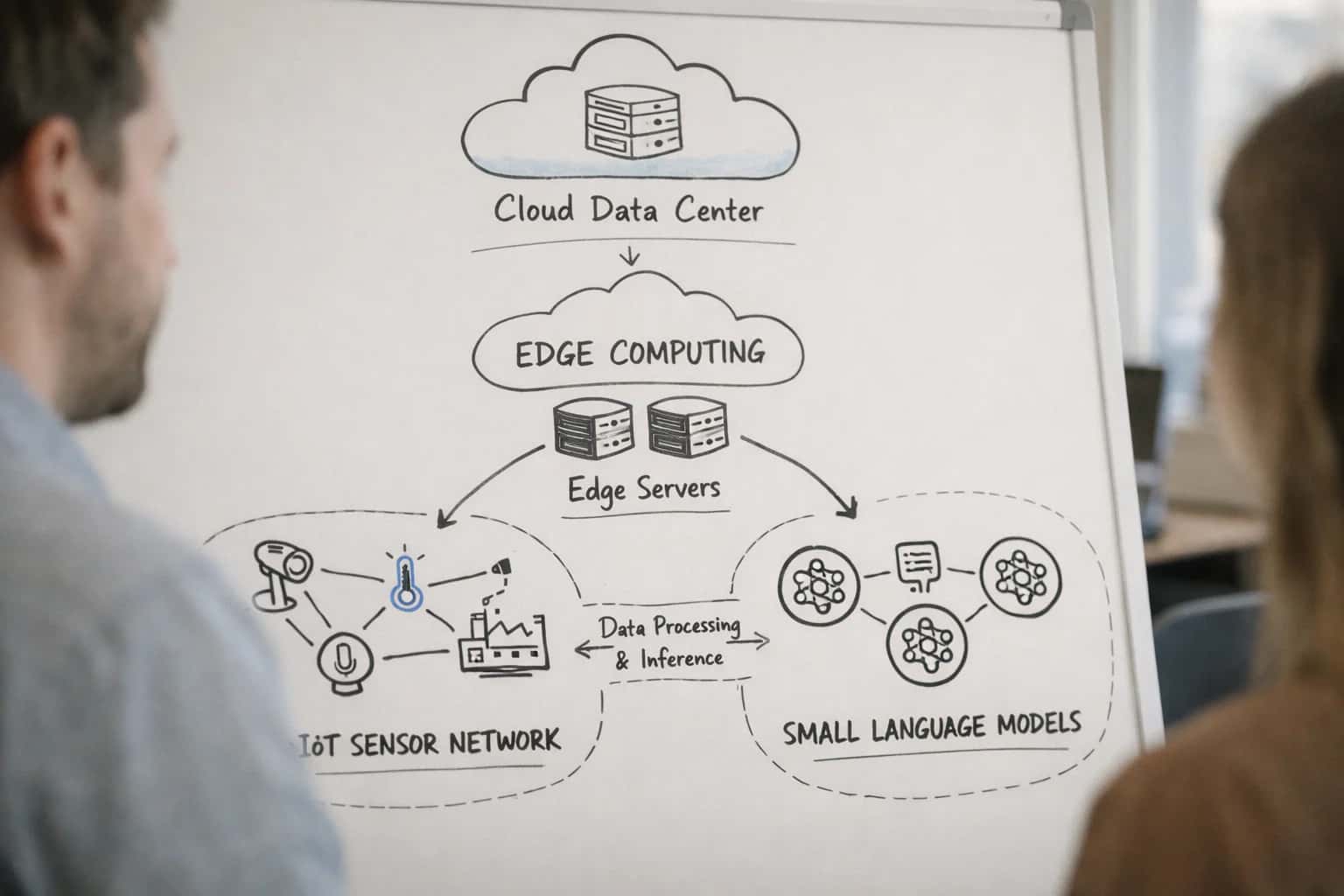
FACTORY-FLOOR EXECUTION ENVIRONMENT
What is Edge Runtime?
An Edge Runtime is a lightweight, containerized software environment deployed on factory-floor hardware that executes control logic, protocol translation, and local analytics independently of cloud connectivity.
Unlike cloud-native runtimes, an Edge Runtime must guarantee low-latency determinism and operational continuity during network interruptions. It often leverages a real-time hypervisor or PREEMPT_RT kernel to isolate critical control functions from analytics containers, enabling workload consolidation on a single piece of hardware while maintaining the strict timing requirements of IEC 61131-3 execution and Time-Sensitive Networking (TSN) integration.
ARCHITECTURAL PREREQUISITES
Core Characteristics of an Industrial Edge Runtime
An industrial edge runtime must deliver deterministic execution, hardware abstraction, and autonomous operation on resource-constrained factory-floor hardware. These six characteristics define a production-grade environment for virtualized control and local analytics.
01
Deterministic Real-Time Execution
Guarantees that control logic completes within a defined time budget, measured in microseconds, not milliseconds. This is non-negotiable for closed-loop motion and safety.
- PREEMPT_RT Kernel: Applies kernel patches to Linux, making it fully preemptible for hard real-time scheduling.
- CPU Pinning: Dedicate specific physical cores exclusively to the runtime, eliminating cache misses and scheduler jitter.
- Time-Sensitive Networking (TSN): Leverages IEEE 802.1 standards for deterministic, low-latency data delivery over converged Ethernet networks.
- Precision Time Protocol (PTP): Synchronizes distributed clocks to sub-microsecond accuracy via IEEE 1588, essential for coordinating isochronous cycles across nodes.
< 100 µs
Maximum Jitter
02
Hardware Abstraction & Virtualization
Decouples software-defined control logic from proprietary physical controllers, enabling workload portability and consolidation.
- Type-1 Hypervisor: A bare-metal hypervisor runs directly on silicon, providing the highest determinism and resource isolation for mixed-criticality workloads.
- Single Root I/O Virtualization (SR-IOV): Allows a single physical NIC to present as multiple virtual devices, giving VMs direct I/O access without hypervisor overhead.
- Soft PLC: Executes standard IEC 61131-3 control logic on general-purpose compute, replacing proprietary hardware controllers.
- Immutable Infrastructure: Deploys control components as pre-configured golden images, replaced entirely rather than patched, ensuring absolute configuration consistency.
03
Autonomous Offline Operation
The runtime must function independently of cloud connectivity, executing control logic, protocol translation, and local analytics even during WAN outages.
- Local Decision Loop: All critical path logic executes locally; the runtime never depends on a round-trip to a remote server for actuation.
- Edge-Native Data Store: A local time-series database buffers telemetry during disconnection, forwarding data upon reconnection.
- MQTT Sparkplug: A mission-critical specification for MQTT that adds standardized topic namespaces, payload definitions, and state management, enabling efficient local broker architectures.
- Unified Namespace (UNS): A local semantic data hierarchy aggregating all data sources, allowing any application to discover and consume real-time information via a common interface.
04
Mixed-Criticality Workload Consolidation
Runs safety-critical control, non-critical HMIs, and analytics on a single edge server with strict temporal and spatial isolation.
- Safety Integrity Level (SIL): Discrete risk reduction measures defined by IEC 61508, dictating rigorous development requirements for safety functions.
- Fault Tolerance (FT): A secondary redundant system executes in lockstep, enabling instantaneous, bumpless takeover without state loss upon hardware failure.
- Workload Consolidation: Merges discrete control, HMI, and analytics onto one high-performance server, reducing hardware footprint, cabling, and energy consumption.
- Real-Time Hypervisor: Hosts both RTOS and GPOS on shared silicon without compromising microsecond-level latency for critical tasks.
05
Containerized & Orchestrated Deployment
Packages control functions, protocol translators, and analytics as lightweight, portable containers managed by declarative infrastructure.
- Infrastructure as Code (IaC): Manages and provisions industrial control infrastructure through machine-readable definition files, enabling version-controlled, repeatable deployments.
- Live Migration: Moves a running virtualized control workload between physical hosts without interrupting execution state, enabling zero-downtime maintenance.
- Virtual Commissioning: Validates and debugs PLC code and HMI interfaces against a digital twin of the production cell before physical installation, drastically reducing on-site startup time.
- IEC 61499: Defines a component-based function block architecture for distributed automation, enabling event-driven control logic decoupled from specific hardware topologies.
06
Protocol Translation & Data Normalization
Bridges the gap between legacy industrial protocols and modern IT systems by translating and contextualizing data at the edge.
- OPC UA Pub/Sub: Enables scalable, connectionless data distribution using a publish-subscribe pattern, often combined with TSN for deterministic field-level communication.
- Data Distribution Service (DDS): A data-centric publish-subscribe middleware standard for real-time, decentralized architectures common in autonomous systems.
- Data Processing Unit (DPU): A specialized programmable accelerator that offloads networking, security, and storage virtualization from the host CPU, freeing cycles for real-time control.
- Virtualized Network Function (VNF): A software instance of a network service, such as a protocol router, running on a hypervisor instead of a dedicated appliance, enabling dynamic service chaining.
Enabling Efficiency, Speed & Accuracy
Intelligent Analysis, Decision & Execution
We build AI systems for teams that need search across company data, workflow automation across tools, or AI features inside products and internal software.
Talk to Us
Search across company data
Give teams answers from docs, tickets, runbooks, and product data with sources and permissions.
Useful when people spend too long searching or get different answers from different systems.
Enterprise searchRAGPermissions
Read more
Automate internal workflows
Use AI to route work, draft outputs, trigger actions, and keep approvals and logs in place.
Useful when repetitive work moves across multiple tools and teams.
AI agentsWorkflow automationGovernance
Read more
Add AI to products and internal tools
Build assistants, guided actions, or decision support into the software your team or customers already use.
Useful when AI needs to be part of the product, not a separate tool.
AI integrationDecision supportModel routing
Read moreEDGE RUNTIME CLARIFIED
Frequently Asked Questions
Precise answers to the most common technical questions about deploying lightweight, containerized execution environments directly on the factory floor for deterministic control and local analytics.
An Edge Runtime is a lightweight, resource-constrained software execution environment deployed on local, on-premises hardware—such as an industrial PC or a Data Processing Unit (DPU)—that executes containerized control logic, protocol translation, and local analytics independently of cloud connectivity. Unlike a cloud runtime, which assumes abundant, elastic compute resources and persistent high-bandwidth connectivity, an edge runtime is engineered for deterministic latency, intermittent WAN links, and strict resource budgets. It typically omits heavy orchestration layers like full Kubernetes control planes in favor of minimal agents like K3s or MicroK8s. Critically, it maintains operational continuity during network disconnection, processing sensor data and executing IEC 61131-3 or IEC 61499 control logic locally, only synchronizing state changes to the cloud when bandwidth allows.

About the author
Prasad Kumkar
CEO & MD, Inference Systems
Prasad Kumkar is the CEO & MD of Inference Systems and writes about AI systems architecture, LLM infrastructure, model serving, evaluation, and production deployment. Over 5+ years, he has worked across computer vision models, L5 autonomous vehicle systems, and LLM research, with a focus on taking complex AI ideas into real-world engineering systems.
His work and writing cover AI systems, large language models, AI agents, multimodal systems, autonomous systems, inference optimization, RAG, evaluation, and production AI engineering.
LinkedIn
Limited slotsGet a Free AI Consultation
Partnered with leading AI, data, and software stack.





How We Work
Custom AI workflows for your Business
One-fit-all AI don't work for modern businesses. At Inferensys, we aim to understand your business & custom requirements; which we use to define most efficient agentic workflows, the data, and the tools for your business.
01
Review the use case
We understand the task, the users, and where AI can actually help.
Read more02
Pick the right approach
We define what needs search, automation, or product integration.
Read more03
Build the first useful version
We implement the part that proves the value first.
Read more04
Improve from there
We add the checks and visibility needed to keep it useful.
Read moreThe first call is a practical review of your use case and the right next step.
Talk to Us