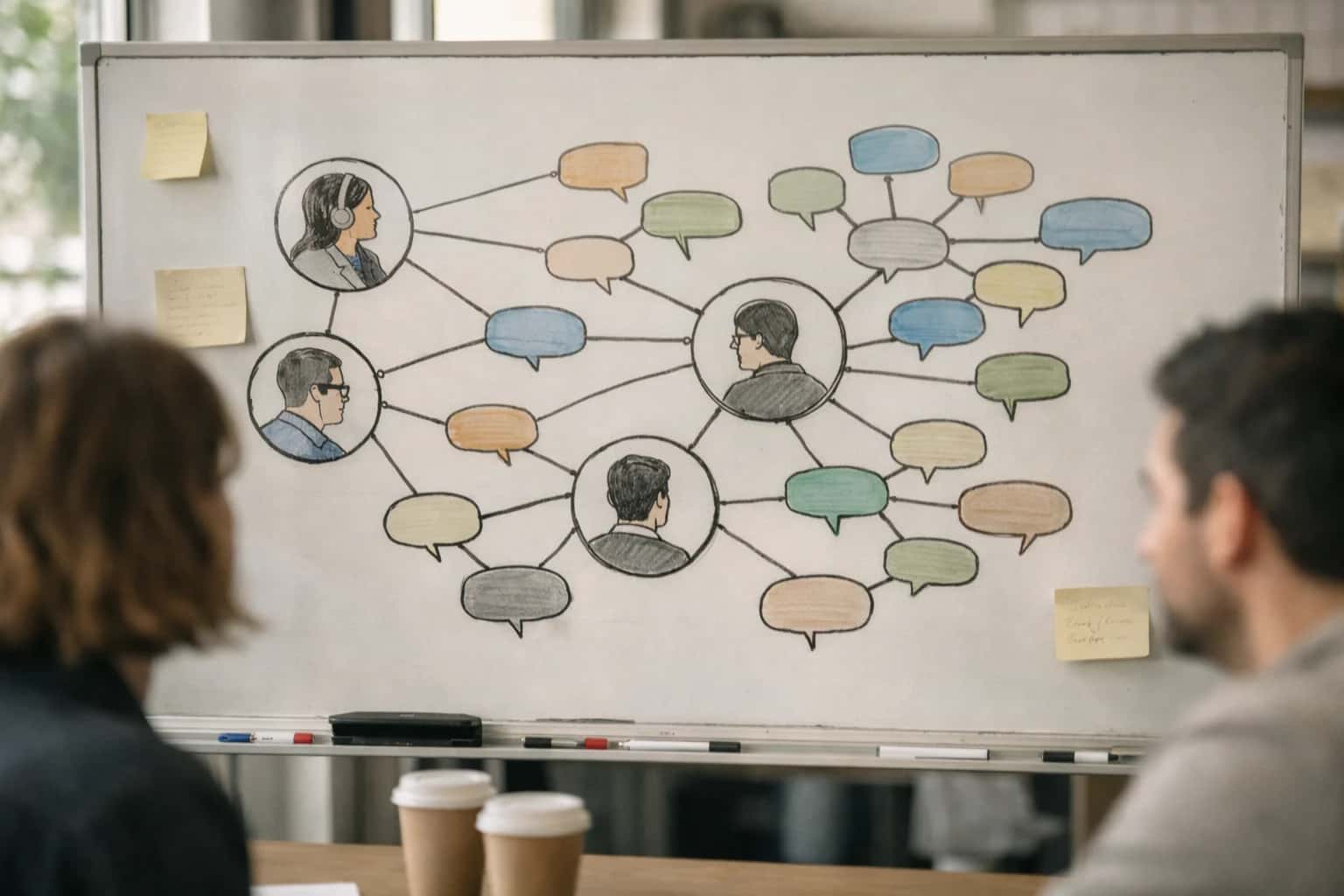
Stigmergy is a coordination mechanism where autonomous agents communicate indirectly by modifying a shared environment, with the trace of a prior action stimulating the execution of a subsequent action. Unlike direct message passing, agents do not negotiate synchronously; instead, they read and write signals to a common medium, such as a digital production schedule or a manufacturing knowledge graph, to achieve emergent, scalable collaboration.

Glossary
Stigmergy
A coordination mechanism where agents communicate indirectly by modifying a shared environment, such as a digital production schedule, to influence the behavior of subsequent agents.
INDIRECT COORDINATION
What is Stigmergy?
A coordination mechanism where agents communicate indirectly by modifying a shared environment, such as a digital production schedule, to influence the behavior of subsequent agents.
In industrial agentic workflows, stigmergy enables robust, decoupled scheduling where a routing agent leaves a priority marker on a work order, triggering a downstream agent to allocate resources. This mechanism, inspired by biological colonies, eliminates tight coupling and single points of failure, allowing complex production sequences to self-organize around the current state of the shared environment.
MECHANISMS OF INDIRECT COLLABORATION
Key Characteristics of Stigmergic Coordination
Stigmergy enables autonomous agents to coordinate complex workflows without direct communication by modifying a shared environment. The following characteristics define how this mechanism drives efficiency in industrial agentic systems.
01
Indirect Communication
Agents do not send messages to specific recipients. Instead, they modify a shared digital environment—such as a production schedule, a Kanban board, or a digital twin—leaving signals that influence the behavior of subsequent agents. This decouples the sender from the receiver in time and space, eliminating the need for complex handshake protocols and enabling asynchronous, loosely coupled workflows that are highly resilient to individual agent failures.
02
Environmental State as Memory
The shared medium acts as an externalized, persistent memory for the entire multi-agent system. Unlike ephemeral messages, the modifications left in the environment—such as a locked resource token or an updated quality threshold—persist until explicitly changed. This provides a durable, auditable history of agent actions and system state, allowing new agents joining the workflow to immediately understand the current context without querying a central database.
03
Emergent Coordination
Complex, globally optimized behaviors emerge from simple, local rules executed by individual agents. No single agent possesses a master plan. For example, in a stigmergic scheduling system:
- An agent marks a machine as 'occupied' after claiming a job.
- Another agent sees the mark and routes work to the next available asset.
- The overall production flow optimizes itself without a central dispatcher. This bottom-up coordination is highly scalable and adapts dynamically to disruptions.
04
Sign-Based vs. Sematectonic Stigmergy
Stigmergic signals fall into two distinct categories:
- Sign-based stigmergy: A signal deposited specifically to influence behavior, such as a digital marker flagging a quality defect or a priority flag on a work order. It is an explicit communication mechanism.
- Sematectonic stigmergy: Coordination occurs through the current state of the work itself. An agent observes a partially assembled product and performs the next logical step without an explicit signal, driven purely by the physical or digital state of the artifact.
05
Decentralized Control Architecture
Stigmergic systems inherently lack a single point of control or failure. Decision-making authority is distributed among all agents interacting with the shared environment. This contrasts sharply with hierarchical orchestration models where a conductor agent assigns tasks. In a stigmergic factory, if one robot fails, others continue working on available tasks signaled in the environment, providing intrinsic fault tolerance and eliminating the bottleneck of a central scheduler.
06
Threshold-Driven Activation
Agents are configured with quantitative thresholds that trigger action based on accumulated environmental signals. An agent does not react to a single mark but to a critical mass of evidence. Examples include:
- A maintenance agent is dispatched only when vibration anomaly markers exceed a defined frequency threshold.
- A replenishment order is triggered when a digital inventory signal drops below a minimum quantity. This prevents thrashing and ensures agents act on statistically significant trends, not noise.
STIGMERGY IN INDUSTRIAL AGENTIC WORKFLOWS
Frequently Asked Questions
Explore the core concepts of stigmergy, a powerful coordination mechanism that enables autonomous agents to self-organize and optimize complex manufacturing and supply chain operations by leaving digital traces in a shared environment.
Stigmergy is a coordination mechanism where autonomous agents communicate indirectly by modifying a shared environment, with the trace of their work influencing the subsequent actions of other agents. In a manufacturing context, the shared environment is typically a digital production schedule, a digital twin, or a manufacturing knowledge graph. An agent does not send a direct message to another agent. Instead, it executes a task—such as reserving a machine time slot or flagging a quality deviation—and writes this update to the shared data structure. A downstream agent perceives this environmental change and adapts its own behavior accordingly, for example, by routing a part to an alternative work cell. This decoupled communication enables highly scalable, flexible, and resilient industrial agentic workflows without the need for complex, point-to-point negotiation protocols.
Enabling Efficiency, Speed & Accuracy
Intelligent Analysis, Decision & Execution
We build AI systems for teams that need search across company data, workflow automation across tools, or AI features inside products and internal software.
Talk to Us
Search across company data
Give teams answers from docs, tickets, runbooks, and product data with sources and permissions.
Useful when people spend too long searching or get different answers from different systems.
Enterprise searchRAGPermissions
Read more
Automate internal workflows
Use AI to route work, draft outputs, trigger actions, and keep approvals and logs in place.
Useful when repetitive work moves across multiple tools and teams.
AI agentsWorkflow automationGovernance
Read more
Add AI to products and internal tools
Build assistants, guided actions, or decision support into the software your team or customers already use.
Useful when AI needs to be part of the product, not a separate tool.
AI integrationDecision supportModel routing
Read more
About the author
Prasad Kumkar
CEO & MD, Inference Systems
Prasad Kumkar is the CEO & MD of Inference Systems and writes about AI systems architecture, LLM infrastructure, model serving, evaluation, and production deployment. Over 5+ years, he has worked across computer vision models, L5 autonomous vehicle systems, and LLM research, with a focus on taking complex AI ideas into real-world engineering systems.
His work and writing cover AI systems, large language models, AI agents, multimodal systems, autonomous systems, inference optimization, RAG, evaluation, and production AI engineering.
LinkedIn
Limited slotsGet a Free AI Consultation
Partnered with leading AI, data, and software stack.





How We Work
Custom AI workflows for your Business
One-fit-all AI don't work for modern businesses. At Inferensys, we aim to understand your business & custom requirements; which we use to define most efficient agentic workflows, the data, and the tools for your business.
01
Review the use case
We understand the task, the users, and where AI can actually help.
Read more02
Pick the right approach
We define what needs search, automation, or product integration.
Read more03
Build the first useful version
We implement the part that proves the value first.
Read more04
Improve from there
We add the checks and visibility needed to keep it useful.
Read moreThe first call is a practical review of your use case and the right next step.
Talk to Us