Multi-Agent Orchestration is the supervisory coordination framework that governs how independent, heterogeneous AI agents collaborate to complete a complex, multi-step production objective. Unlike simple task delegation, orchestration actively manages the dependency graph between agents, ensuring that the output of a procurement agent correctly feeds into a scheduling agent without creating a deadlock or resource conflict. This layer enforces the sequence of operations, handles Contract Net Protocol negotiations, and maintains the global state of the workflow, transforming a collection of specialized agents into a coherent, deterministic manufacturing execution system.

Glossary
Multi-Agent Orchestration
The coordination framework that manages dependencies, communication, and resource allocation between heterogeneous autonomous agents to execute a shared manufacturing workflow.
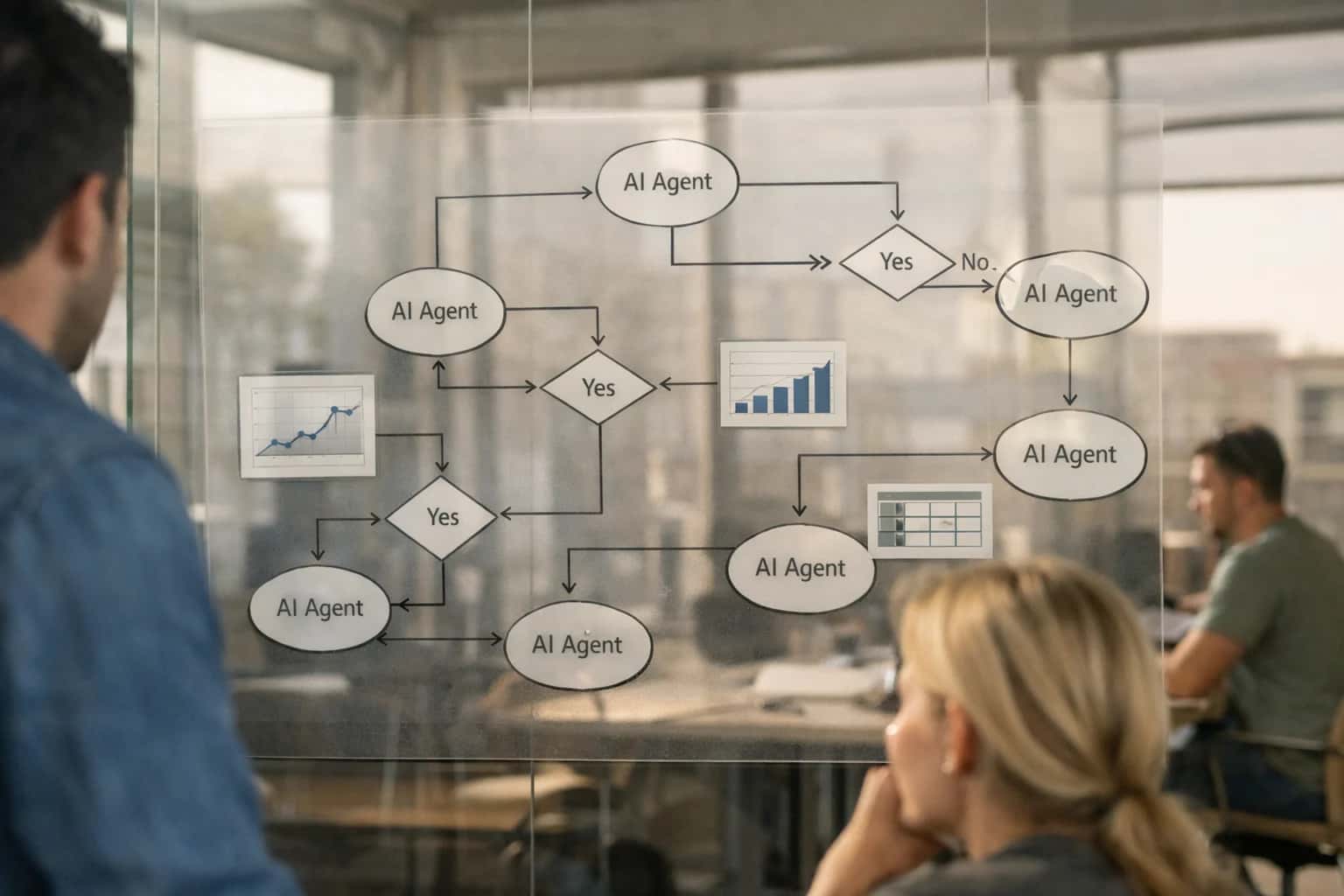
COORDINATION FRAMEWORK
What is Multi-Agent Orchestration?
Multi-agent orchestration is the coordination layer that manages dependencies, communication, and resource allocation between heterogeneous autonomous agents to execute a shared manufacturing workflow as a unified system.
The core technical challenge is resolving concurrency and partial failures in a distributed environment. The orchestrator must implement a Saga Pattern to manage long-running transactions, triggering compensating actions if a downstream agent fails. It allocates shared resources—such as robotic arms or testing stations—using mechanisms like Auction-Based Scheduling or Combinatorial Auctions to optimize for makespan. By abstracting inter-agent communication through standards like FIPA-ACL, the orchestration layer provides a single pane of glass for Human-in-the-Loop oversight, enabling operators to monitor a Digital Control Tower and intervene only when the system escalates a low-confidence exception.
COORDINATION ARCHITECTURE
Key Features of Multi-Agent Orchestration
The essential mechanisms that enable heterogeneous autonomous agents to negotiate, communicate, and execute interdependent manufacturing workflows without centralized control.
01
Agent Communication Protocols
Standardized languages and interaction patterns that allow agents to share intent, capability, and status. FIPA-ACL defines message semantics—such as inform, request, and propose—while the Contract Net Protocol enables task announcement and bidding. These protocols ensure agents from different vendors can interoperate within a shared production environment without custom integration code.
FIPA-ACL
IEEE Standard
22+
Communicative Acts
02
Dependency Graph Resolution
The algorithmic backbone that prevents production deadlocks. Before execution, the orchestrator builds a Directed Acyclic Graph (DAG) where nodes represent manufacturing operations and edges encode prerequisite constraints. The resolver topologically sorts tasks to guarantee that no agent begins work until all upstream dependencies are satisfied, eliminating work-in-process starvation.
03
Deadlock Detection and Recovery
Continuous monitoring that identifies circular wait states where Agent A holds Resource X and waits for Resource Y, while Agent B holds Y and waits for X. Detection algorithms construct a wait-for graph and periodically check for cycles. Upon detection, recovery strategies include preemption—forcibly revoking a resource—or rollback via the Saga Pattern, where compensating transactions undo partially completed work.
04
Auction-Based Resource Allocation
Dynamic market mechanisms where production slots, machine time, or AGV capacity are allocated to the highest-bidding agent. Combinatorial auctions allow agents to bid on bundles of resources, capturing synergistic value—for example, a furnace and a press scheduled together reduce setup time. VCG mechanisms incentivize truthful bidding by charging winners the marginal harm their win imposes on others.
05
Stigmergic Coordination
Indirect communication through environmental modification. Agents leave digital markers—such as updated inventory levels or reserved time slots—in a shared Blackboard Architecture. Subsequent agents read these traces and adapt their behavior without direct peer-to-peer messages. This decoupled pattern scales efficiently in large fleets and tolerates intermittent agent availability.
06
Human-in-the-Loop Escalation
A safety valve that prevents autonomous errors from cascading. When an agent encounters a low-confidence decision—such as an unrecognized defect pattern or a scheduling conflict exceeding defined thresholds—it pauses execution and escalates to a human operator via a structured prompt. The operator's resolution is logged as a training signal, progressively reducing future escalation frequency.
EXPERT INSIGHTS
Frequently Asked Questions
Clear, technically precise answers to the most common questions about coordinating autonomous agents in industrial production environments.
Multi-agent orchestration is a coordination framework that manages dependencies, communication, and resource allocation between heterogeneous autonomous agents to execute a shared manufacturing workflow. Unlike simple automation scripts, an orchestrator dynamically assigns tasks, resolves conflicts, and monitors execution state across a distributed system. The mechanism typically relies on a Directed Acyclic Graph (DAG) to define task dependencies, a message-passing protocol such as FIPA-ACL or MCP for inter-agent communication, and a scheduling algorithm—often auction-based or constraint-satisfaction—to allocate resources. For example, when a production order arrives, the orchestrator decomposes it into sub-tasks, broadcasts them to capable agents, collects bids, awards contracts, and monitors for exceptions like deadlocks or resource starvation, escalating to a human operator via a Human-in-the-Loop (HITL) pattern when confidence is low.
MULTI-AGENT ORCHESTRATION
Industrial Use Cases
Real-world deployments where coordinated autonomous agents optimize complex manufacturing and supply chain workflows, delivering measurable operational efficiency.
01
Dynamic Production Scheduling
Orchestrating heterogeneous agents to continuously re-optimize factory schedules in response to real-time disruptions.
- Auction-Based Allocation: Agents bid for machine time slots using Contract Net Protocol, prioritizing orders by due date and margin
- Constraint Resolution: A Dependency Graph solver ensures no operation starts before its prerequisite sub-assembly is complete
- Deadlock Prevention: Continuous monitoring detects circular waits between a milling agent and a painting agent competing for shared resources
Example: A semiconductor fab reduces cycle time by 18% by allowing lithography and etching agents to negotiate batch sequences autonomously.
18%
Cycle Time Reduction
< 2 sec
Re-schedule Latency
02
Supply Chain Exception Management
Deploying a swarm of logistics agents to detect and resolve disruptions before they cascade into stockouts.
- Bullwhip Dampening: Agents share real-time POS data upstream, preventing demand signal amplification
- Combinatorial Bidding: A VCG Auction allows carriers to bid on bundled delivery lanes, capturing synergistic route value
- Saga Pattern Rollback: If a shipment fails customs, compensating transactions automatically re-route inventory from an alternate distribution center
Example: A global retailer uses autonomous agents to re-route 40% of disrupted shipments without human intervention, preserving 99.5% on-time delivery.
40%
Autonomous Re-routing
99.5%
On-Time Delivery
03
Heterogeneous Fleet Coordination
Orchestrating a mixed fleet of autonomous mobile robots (AMRs) and manual forklifts in a shared warehouse space.
- Stigmergic Signaling: Agents deposit digital pheromones on a shared grid map to indicate congested aisles, influencing path planning for all subsequent vehicles
- Blackboard Architecture: A central workspace aggregates task requests; specialized agents for charging, picking, and replenishment claim tasks based on proximity and battery state
- MCTS Path Planning: Each agent runs Monte Carlo Tree Search simulations to select trajectories that minimize collision probability and travel distance
Example: A 3PL provider coordinates 200+ AMRs alongside 50 human-operated vehicles, achieving a 25% throughput increase.
200+
Coordinated Robots
25%
Throughput Gain
04
Just-in-Time Material Replenishment
Synchronizing procurement agents with production agents to deliver raw materials precisely when a workstation becomes available.
- BDI Architecture: A procurement agent maintains beliefs about inventory levels, desires to prevent stockouts, and intentions to issue purchase orders
- POMDP Decision-Making: Agents operate under partial observability, maintaining a probabilistic belief about supplier lead times and updating replenishment decisions as new tracking data arrives
- Mechanism Design: Incentive structures ensure suppliers truthfully report their capacity constraints, enabling the orchestrator to select the globally optimal allocation
Example: An automotive assembly plant reduces line-side inventory by 30% while eliminating production stoppages caused by parts shortages.
30%
Inventory Reduction
0
Line Stoppages
05
Digital Control Tower Operations
A centralized AI-driven visibility platform aggregating real-time telemetry from agents across global supply chain tiers.
- Causal Inference: When a yield drop is detected, the engine determines whether a specific raw material batch or machine parameter caused the deviation, not just correlates with it
- HITL Escalation: Low-confidence exceptions, such as a supplier bankruptcy risk, are surfaced to human operators with prescriptive response options
- FIPA-ACL Messaging: Standardized agent communication ensures semantic interoperability between legacy ERP systems and modern AI agents
Example: A CPG company achieves end-to-end visibility across 15 contract manufacturers and 200+ suppliers, reducing exception resolution time from days to minutes.
15
Manufacturing Sites
Minutes
Resolution Time
06
Genetic Algorithm Schedule Optimization
Applying evolutionary computation to evolve near-optimal production schedules that minimize makespan and energy cost.
- Population Initialization: A population of 10,000 candidate schedules is generated, each representing a unique assignment of jobs to machines
- Fitness Evaluation: Each schedule is scored on total completion time, electricity cost given time-of-use rates, and penalty for late orders
- Crossover & Mutation: High-fitness schedules are combined and randomly perturbed over 500 generations, converging on a Pareto-optimal frontier
Example: A steel mill reduces energy costs by 12% by shifting energy-intensive arc furnace operations to off-peak hours while maintaining throughput targets.
12%
Energy Cost Reduction
500
Evolutionary Generations
Enabling Efficiency, Speed & Accuracy
Intelligent Analysis, Decision & Execution
We build AI systems for teams that need search across company data, workflow automation across tools, or AI features inside products and internal software.
Talk to Us
Search across company data
Give teams answers from docs, tickets, runbooks, and product data with sources and permissions.
Useful when people spend too long searching or get different answers from different systems.
Enterprise searchRAGPermissions
Read more
Automate internal workflows
Use AI to route work, draft outputs, trigger actions, and keep approvals and logs in place.
Useful when repetitive work moves across multiple tools and teams.
AI agentsWorkflow automationGovernance
Read more
Add AI to products and internal tools
Build assistants, guided actions, or decision support into the software your team or customers already use.
Useful when AI needs to be part of the product, not a separate tool.
AI integrationDecision supportModel routing
Read moreCOORDINATION PARADIGMS
Orchestration vs. Choreography vs. Centralized Control
A structural comparison of the three primary patterns for coordinating autonomous agents in industrial manufacturing workflows.
| Feature | Orchestration | Choreography | Centralized Control |
|---|---|---|---|
Control Topology | Hub-and-spoke with a conductor agent | Peer-to-peer mesh with no single coordinator | Hierarchical star with a monolithic controller |
Decision Authority | Delegated to orchestrator agent | Distributed across all agents | Concentrated in a single control node |
Coupling Level | Loose coupling via defined interfaces | Very loose coupling via events | Tight coupling to central logic |
Fault Tolerance | Single point of failure at orchestrator | Graceful degradation on node failure | Catastrophic failure on controller loss |
Scalability Ceiling | Limited by orchestrator throughput | Horizontally scalable with agent count | Limited by controller compute capacity |
Inter-Agent Communication | Directed commands and status callbacks | Publish-subscribe event broadcasting | Polling and command-response cycles |
Workflow Visibility | End-to-end trace in orchestrator | Emergent from event logs | Full visibility in central monitor |
Reconfiguration Latency | Moderate, requires orchestrator update | Low, agents adapt to new events | High, requires controller reprogramming |

About the author
Prasad Kumkar
CEO & MD, Inference Systems
Prasad Kumkar is the CEO & MD of Inference Systems and writes about AI systems architecture, LLM infrastructure, model serving, evaluation, and production deployment. Over 5+ years, he has worked across computer vision models, L5 autonomous vehicle systems, and LLM research, with a focus on taking complex AI ideas into real-world engineering systems.
His work and writing cover AI systems, large language models, AI agents, multimodal systems, autonomous systems, inference optimization, RAG, evaluation, and production AI engineering.
LinkedIn
Limited slotsGet a Free AI Consultation
Partnered with leading AI, data, and software stack.





How We Work
Custom AI workflows for your Business
One-fit-all AI don't work for modern businesses. At Inferensys, we aim to understand your business & custom requirements; which we use to define most efficient agentic workflows, the data, and the tools for your business.
01
Review the use case
We understand the task, the users, and where AI can actually help.
Read more02
Pick the right approach
We define what needs search, automation, or product integration.
Read more03
Build the first useful version
We implement the part that proves the value first.
Read more04
Improve from there
We add the checks and visibility needed to keep it useful.
Read moreThe first call is a practical review of your use case and the right next step.
Talk to Us