Blackboard Architecture is a collaborative problem-solving model where specialized, independent agents communicate exclusively through a shared data repository—the blackboard—to incrementally construct a solution. Each agent is an expert in a specific sub-problem, opportunistically contributing its partial result when the blackboard's evolving state matches its expertise, without direct inter-agent communication or centralized control flow.

Glossary
Blackboard Architecture
A collaborative problem-solving model where specialized knowledge sources (agents) read and write partial solutions to a shared data structure, incrementally solving complex scheduling problems that lack a predetermined solution path.
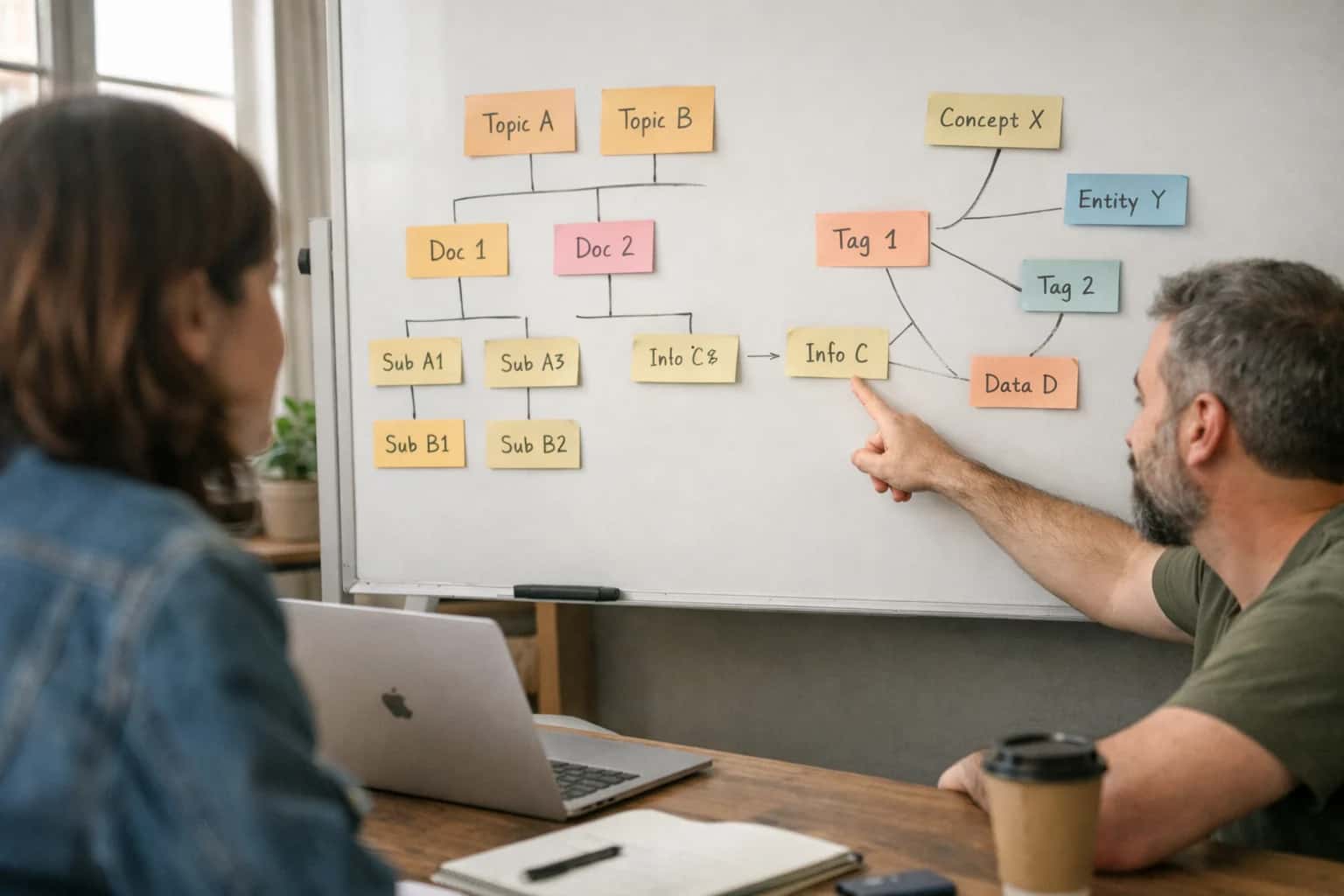
COLLABORATIVE PROBLEM-SOLVING MODEL
What is Blackboard Architecture?
A specialized knowledge-based architecture where independent, heterogeneous software agents collaboratively solve a complex problem by reading and writing partial solutions to a shared, globally accessible data structure called the blackboard.
The architecture is defined by three core components: the blackboard, a structured global database holding the problem state and partial solutions; knowledge sources, the domain-specific agents that read and write to the blackboard; and a control shell or scheduler that monitors the blackboard and decides which agent to activate next based on the current solution context. This model excels at solving complex, non-deterministic scheduling and planning problems where no single algorithm suffices.
ARCHITECTURAL FOUNDATIONS
Key Characteristics of Blackboard Systems
The blackboard architecture is a collaborative problem-solving model where specialized knowledge sources converge on a shared data structure. Unlike rigid, sequential pipelines, it enables opportunistic reasoning to solve complex, non-deterministic scheduling problems.
01
The Shared Data Structure
The blackboard is a globally accessible repository that holds the current state of the problem, including partial solutions and intermediate hypotheses. All agents read from and write to this common workspace.
- Common Vocabulary: All data is represented in a unified, agreed-upon format.
- State Visibility: Any agent can inspect the current solution state at any time.
- Incremental Construction: Solutions are built step-by-step, with each contribution refining the output.
02
Independent Knowledge Sources
Specialized agents, or knowledge sources, operate as independent modules that contain expertise for a specific sub-problem. They do not communicate directly with each other.
- Domain Specialization: One agent handles machine scheduling, another manages material constraints.
- Loose Coupling: Agents are unaware of each other's internal logic, enabling modular system design.
- Parallel Development: Teams can build and test agents in isolation before integration.
03
Opportunistic Control Loop
A control component monitors the blackboard and decides which knowledge source to activate next based on the current state, rather than following a hard-coded script.
- Dynamic Prioritization: The system can pivot to a high-priority constraint violation immediately.
- Event-Driven Activation: Agents trigger when their specific expertise becomes relevant.
- Goal-Directed Reasoning: The control loop works backward from the final goal to determine the next best step.
04
Incremental Solution Building
The system does not require a complete plan upfront. It progresses by posting partial solutions and hypotheses, allowing the final schedule to emerge from the accumulation of expert contributions.
- Hypothesis Testing: An agent can post a tentative schedule, which another agent validates against constraints.
- Non-Monotonic Reasoning: The system can retract and revise earlier assumptions as new data arrives.
- Emergent Optimization: The final solution is often more robust than any single agent could produce alone.
05
Uncertainty Management
Blackboard systems excel in environments with incomplete or noisy data. Agents can annotate contributions with certainty factors or confidence scores.
- Probabilistic Reasoning: Agents weigh competing hypotheses based on evidence strength.
- Conflict Resolution: When two agents propose conflicting schedules, the control component arbitrates based on defined metrics.
- Graceful Degradation: The system produces the best possible solution with available data rather than failing completely.
06
Separation of Data from Logic
A strict architectural boundary exists between the problem state (the blackboard) and the problem-solving logic (the agents). This separation is the key to extensibility.
- Technology Agnosticism: Agents can be written in different programming languages or run on separate hardware.
- Hot-Swappable Logic: A new scheduling algorithm can be added without modifying the core data structure.
- Persistent Memory: The blackboard serves as a durable log of the entire reasoning process for audit and debugging.
BLACKBOARD ARCHITECTURE
Frequently Asked Questions
Explore the foundational concepts of blackboard systems, a collaborative problem-solving model where specialized knowledge sources incrementally build solutions on a shared data structure to tackle complex, non-deterministic scheduling and planning challenges.
A blackboard architecture is a collaborative problem-solving model where multiple specialized software modules, known as knowledge sources, asynchronously read from and write to a shared, structured data repository called the blackboard. The system operates through an opportunistic control loop: a scheduler or control shell monitors the state of the blackboard and activates the most relevant knowledge source based on the current partial solution. Each knowledge source contributes its specific expertise—such as a scheduling heuristic, a constraint validator, or a material availability checker—by posting incremental modifications or hypotheses. This process continues iteratively until a complete solution, such as a fully resolved production schedule, is assembled. Unlike rigid, top-down algorithms, the blackboard pattern excels in domains with no predetermined solution path, allowing diverse, independent agents to converge on an optimal outcome organically.
Enabling Efficiency, Speed & Accuracy
Intelligent Analysis, Decision & Execution
We build AI systems for teams that need search across company data, workflow automation across tools, or AI features inside products and internal software.
Talk to Us
Search across company data
Give teams answers from docs, tickets, runbooks, and product data with sources and permissions.
Useful when people spend too long searching or get different answers from different systems.
Enterprise searchRAGPermissions
Read more
Automate internal workflows
Use AI to route work, draft outputs, trigger actions, and keep approvals and logs in place.
Useful when repetitive work moves across multiple tools and teams.
AI agentsWorkflow automationGovernance
Read more
Add AI to products and internal tools
Build assistants, guided actions, or decision support into the software your team or customers already use.
Useful when AI needs to be part of the product, not a separate tool.
AI integrationDecision supportModel routing
Read more
About the author
Prasad Kumkar
CEO & MD, Inference Systems
Prasad Kumkar is the CEO & MD of Inference Systems and writes about AI systems architecture, LLM infrastructure, model serving, evaluation, and production deployment. Over 5+ years, he has worked across computer vision models, L5 autonomous vehicle systems, and LLM research, with a focus on taking complex AI ideas into real-world engineering systems.
His work and writing cover AI systems, large language models, AI agents, multimodal systems, autonomous systems, inference optimization, RAG, evaluation, and production AI engineering.
LinkedIn
Limited slotsGet a Free AI Consultation
Partnered with leading AI, data, and software stack.





How We Work
Custom AI workflows for your Business
One-fit-all AI don't work for modern businesses. At Inferensys, we aim to understand your business & custom requirements; which we use to define most efficient agentic workflows, the data, and the tools for your business.
01
Review the use case
We understand the task, the users, and where AI can actually help.
Read more02
Pick the right approach
We define what needs search, automation, or product integration.
Read more03
Build the first useful version
We implement the part that proves the value first.
Read more04
Improve from there
We add the checks and visibility needed to keep it useful.
Read moreThe first call is a practical review of your use case and the right next step.
Talk to Us