Edge inference is the process of running a pre-trained machine learning model locally on a device—such as a smart camera, industrial PC, or Neural Processing Unit (NPU)—rather than sending raw data to a remote server. This architecture minimizes inference latency to single-digit milliseconds, which is critical for real-time defect detection on high-speed production lines. By processing data at the source, edge inference also preserves bandwidth and ensures operational continuity during network outages.

Glossary
Edge Inference
Edge inference is the execution of a trained neural network model directly on a local embedded device or gateway on the factory floor, minimizing inference latency and eliminating the need for continuous cloud connectivity.
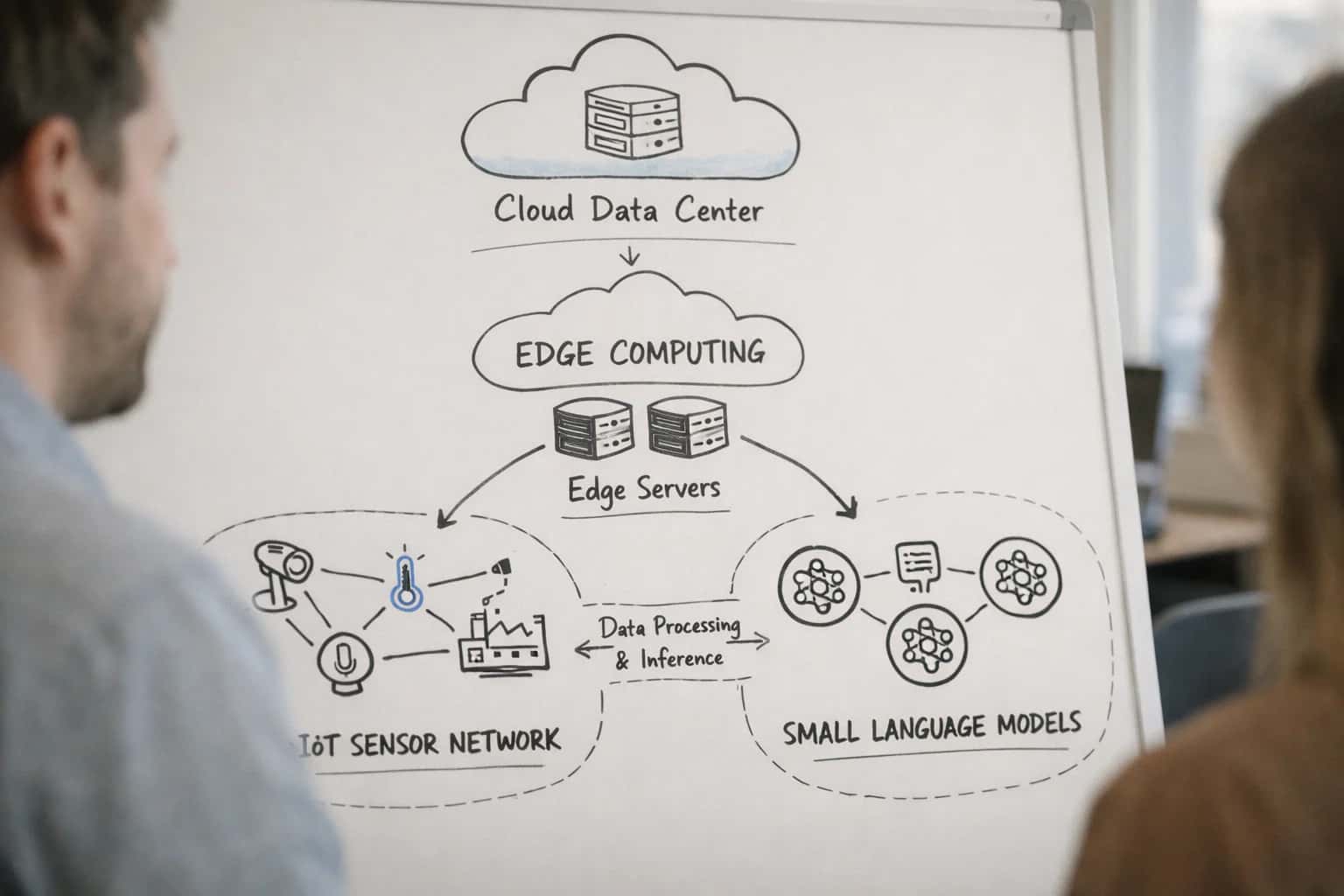
DEFINITION
What is Edge Inference?
Edge inference is the execution of a trained neural network model directly on a local embedded device or gateway, eliminating the need for continuous cloud connectivity.
Deploying inference at the edge requires model optimization techniques like FP16 quantization and weight pruning to fit within the constrained memory and power budgets of embedded hardware. Unlike cloud-dependent architectures, edge inference keeps sensitive proprietary production data within the factory perimeter, addressing critical security and data sovereignty requirements. This local execution model is the foundational enabler for closed-loop adaptive process control where inspection results must trigger immediate corrective actions.
LOW-LATENCY AI AT THE SOURCE
Key Characteristics of Edge Inference
Edge inference defines the operational profile of a trained neural network executing directly on localized hardware. These characteristics distinguish it from cloud-dependent architectures, prioritizing speed, resilience, and data sovereignty on the factory floor.
01
Sub-Millisecond Deterministic Latency
Edge inference eliminates the variable network round-trip time (RTT) to a cloud data center. By executing the model on a local Neural Processing Unit (NPU) or GPU, inference latency becomes a fixed, deterministic computational cost—often under 1 millisecond for optimized models. This is non-negotiable for real-time control loops, such as triggering a reject actuator upon defect detection or halting a robotic arm to prevent a collision. The jitter introduced by WAN connectivity is completely removed from the critical path.
< 1 ms
Typical Inference Latency
02
Air-Gapped Operational Resilience
A defining characteristic is the ability to function with zero cloud dependency. The inference pipeline operates on a completely air-gapped or locally networked device, ensuring that a production line continues to run at full capacity even during an internet outage or a cloud service disruption. This architecture is critical for high-cost manufacturing environments where unplanned downtime can exceed $100,000 per hour. The model, application logic, and data persist entirely on the edge node.
100%
Uptime During WAN Failure
03
Bandwidth-Agnostic Data Filtration
Edge inference acts as an intelligent filter, processing high-bandwidth sensor streams locally and transmitting only metadata or exception events to upstream systems. Instead of streaming a raw 4K video feed at gigabits per second, the edge device transmits a structured JSON payload containing the defect type, bounding box coordinates, and confidence score. This reduces backhaul network load by over 99%, making the architecture scalable across thousands of sensor points without requiring costly network infrastructure upgrades.
99%+
Bandwidth Reduction
04
Hardware-Aware Model Compilation
Edge inference mandates that models are not just trained but compiled for a specific silicon target. This process involves graph optimizations such as operator fusion, where multiple neural network layers are merged into a single compute kernel to reduce memory I/O. Techniques like INT8 post-training quantization convert 32-bit floating-point weights to 8-bit integers, dramatically reducing model size and enabling execution on resource-constrained MCUs or FPGAs without significant accuracy loss.
4x
Typical Throughput Gain via Quantization
05
Physical Data Sovereignty
By processing raw imagery and telemetry directly on the device, edge inference guarantees that sensitive intellectual property and proprietary process data never leave the factory premises. This is a critical characteristic for defense contractors, pharmaceutical manufacturers, and any organization subject to strict ITAR or GDPR compliance regimes. The raw pixel data is ephemeral, used for inference and immediately discarded, while only anonymized, structured results are persisted or forwarded.
06
Heterogeneous Sensor Fusion
An edge inference node often ingests and fuses multiple sensor modalities simultaneously before making a decision. A single device might correlate a thermal camera feed detecting a hotspot with a vibration sensor detecting a bearing anomaly and a microphone capturing an ultrasonic signature. This multi-modal sensor fusion happens locally, creating a unified, high-confidence inference context that would be impossible to synchronize with the latency of separate cloud pipelines.
EDGE INFERENCE FAQ
Frequently Asked Questions
Clear, technically precise answers to the most common questions about executing neural network models directly on factory-floor hardware for low-latency, autonomous quality inspection.
Edge inference is the execution of a pre-trained neural network model directly on a local embedded device or industrial gateway, rather than sending data to a remote cloud server for processing. The model, which has already been trained on a powerful GPU cluster, is optimized and deployed to a device on the factory floor. When a line scan camera captures an image of a component, the raw pixel data is fed directly into the local model. The model performs a forward pass—executing matrix multiplications through its layers—to produce a prediction, such as a defect classification or a bounding box, in milliseconds. This eliminates the latency and bandwidth variability introduced by network round-trips, enabling real-time decision-making for high-speed production lines.
Enabling Efficiency, Speed & Accuracy
Intelligent Analysis, Decision & Execution
We build AI systems for teams that need search across company data, workflow automation across tools, or AI features inside products and internal software.
Talk to Us
Search across company data
Give teams answers from docs, tickets, runbooks, and product data with sources and permissions.
Useful when people spend too long searching or get different answers from different systems.
Enterprise searchRAGPermissions
Read more
Automate internal workflows
Use AI to route work, draft outputs, trigger actions, and keep approvals and logs in place.
Useful when repetitive work moves across multiple tools and teams.
AI agentsWorkflow automationGovernance
Read more
Add AI to products and internal tools
Build assistants, guided actions, or decision support into the software your team or customers already use.
Useful when AI needs to be part of the product, not a separate tool.
AI integrationDecision supportModel routing
Read more
About the author
Prasad Kumkar
CEO & MD, Inference Systems
Prasad Kumkar is the CEO & MD of Inference Systems and writes about AI systems architecture, LLM infrastructure, model serving, evaluation, and production deployment. Over 5+ years, he has worked across computer vision models, L5 autonomous vehicle systems, and LLM research, with a focus on taking complex AI ideas into real-world engineering systems.
His work and writing cover AI systems, large language models, AI agents, multimodal systems, autonomous systems, inference optimization, RAG, evaluation, and production AI engineering.
LinkedIn
Limited slotsGet a Free AI Consultation
Partnered with leading AI, data, and software stack.





How We Work
Custom AI workflows for your Business
One-fit-all AI don't work for modern businesses. At Inferensys, we aim to understand your business & custom requirements; which we use to define most efficient agentic workflows, the data, and the tools for your business.
01
Review the use case
We understand the task, the users, and where AI can actually help.
Read more02
Pick the right approach
We define what needs search, automation, or product integration.
Read more03
Build the first useful version
We implement the part that proves the value first.
Read more04
Improve from there
We add the checks and visibility needed to keep it useful.
Read moreThe first call is a practical review of your use case and the right next step.
Talk to Us