Run-to-Run Control (R2R) is a discrete-part manufacturing control methodology that adjusts process recipe parameters on a lot-to-lot or wafer-to-wafer basis using feedback from post-process measurements. Unlike real-time feedback control, R2R operates between processing cycles, using metrology data to update the recipe for the next run via an observer or model-based algorithm such as an Exponentially Weighted Moving Average (EWMA) controller.

Glossary
Run-to-Run Control (R2R)
Run-to-Run Control (R2R) is a form of adaptive process control where recipe parameters are modified between processing runs based on post-process metrology to compensate for drift and maintain target quality.
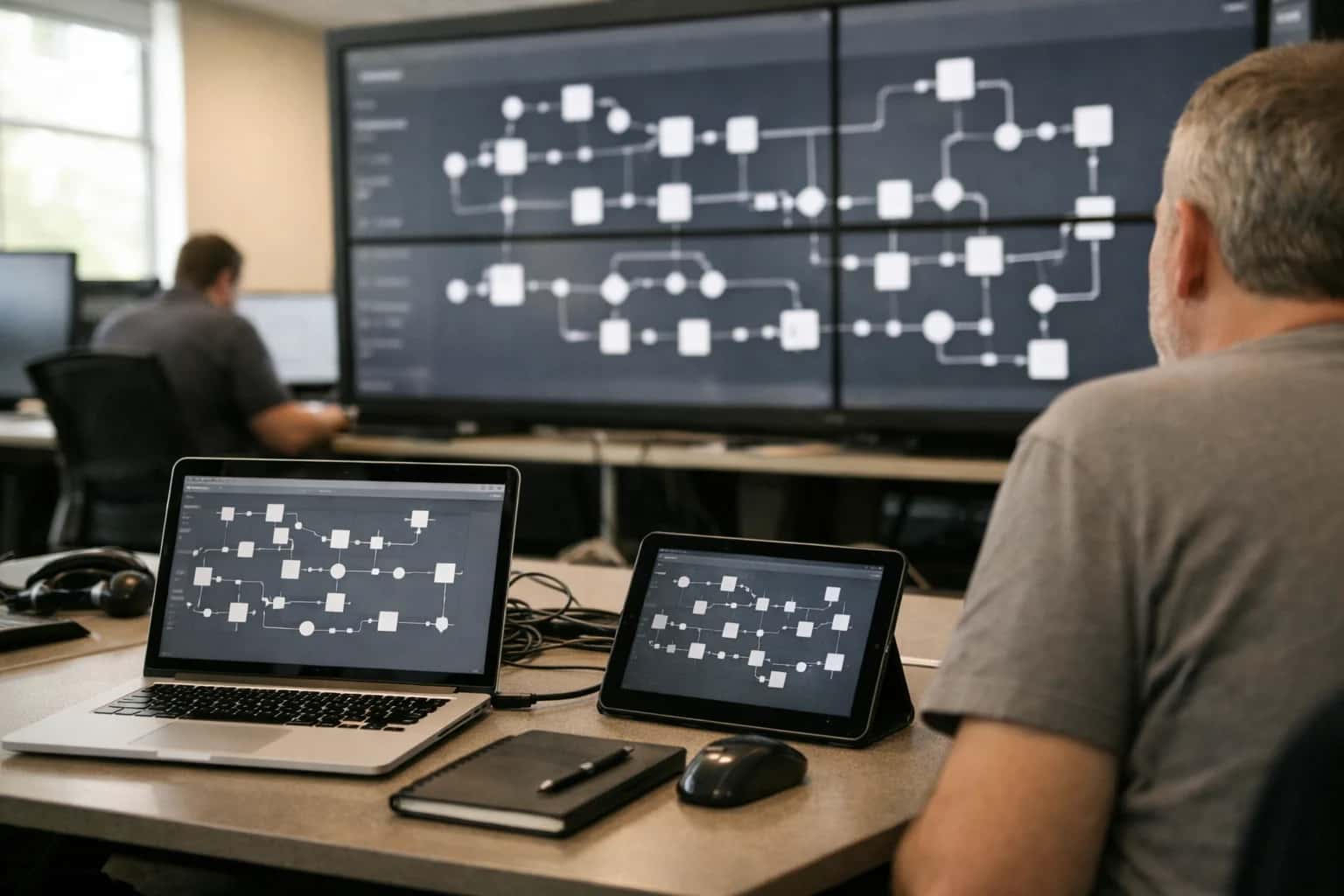
ADAPTIVE PROCESS CONTROL
What is Run-to-Run Control (R2R)?
Run-to-Run (R2R) control is a form of adaptive process control where recipe parameters are modified between discrete processing runs based on post-process metrology to compensate for process drift and maintain target quality.
The core mechanism involves comparing post-process metrology against a target, feeding the error into a process model, and computing an updated recipe to nullify the predicted deviation. This compensates for gradual disturbances like tool aging, chamber seasoning, or incoming material variation. R2R is foundational in semiconductor manufacturing for processes like chemical-mechanical planarization and etch, where it tightly controls critical dimensions without invasive real-time sensors.
RUN-TO-RUN CONTROL
Key Characteristics of R2R Control
Run-to-Run (R2R) control is a discrete adaptive process control methodology that modifies recipe parameters between processing runs based on post-process metrology to compensate for drift and maintain target quality. The following characteristics define its core operational principles.
01
Lot-to-Lot Discrete Correction
R2R operates on a wafer-to-wafer or lot-to-lot basis, not in real-time. After a batch completes processing, post-process metrology data is fed into a control algorithm that calculates updated recipe parameters for the next run. This contrasts with real-time feedback control, which adjusts actuators mid-process. The discrete nature makes R2R ideal for processes where in-situ measurement is impossible or too slow, such as Chemical Mechanical Planarization (CMP) or plasma etching in semiconductor fabrication.
60-80%
Reduction in Process Variance
02
Exponentially Weighted Moving Average (EWMA)
The EWMA filter is the foundational statistical engine for most R2R controllers. It smooths noisy metrology data and provides a stable estimate of process drift. The controller updates the model intercept for the next run using:
a_{t+1} = w * (y_t - b*u_t) + (1 - w) * a_t
w(lambda): The EWMA weight (0 < w ≤ 1). A high weight responds quickly to shifts but amplifies noise. A low weight filters noise but responds slowly to real drift.a_t: The estimated process offset at run t.y_t: The measured output.b: The process gain (sensitivity of output to input).
This simple yet robust method handles the non-stationary drift common in manufacturing tools like deposition chambers and etch reactors.
0.2-0.4
Typical Optimal EWMA Weight
03
Process Model Granularity
R2R controllers rely on a linear or non-linear process model that maps recipe parameters to quality outputs. The granularity of this model defines controller capability:
- Single-Input Single-Output (SISO): Controls one quality metric with one recipe parameter. Simple but ignores cross-variable interactions.
- Multi-Input Multi-Output (MIMO): Controls multiple correlated quality metrics simultaneously using multiple recipe parameters. Requires a gain matrix to model interactions.
- Non-Linear Models: Employs Gaussian Process Regression or neural networks when the process response is highly non-linear, such as in advanced etch depth control.
Model fidelity directly determines how accurately the controller can predict the required recipe adjustment to hit the target.
MIMO
Dominant Architecture in Advanced Nodes
04
Threaded Control for High-Mix Manufacturing
In high-mix, low-volume fabs, a single tool processes many different products with distinct process requirements. Threaded R2R control maintains separate EWMA state estimates for each unique context thread—a combination of product, technology, and tool chamber. When a context switches, the controller retrieves the correct thread's state, applies the appropriate recipe, and updates only that thread's model after metrology. This prevents cross-contamination of drift estimates between dissimilar products and enables precise control in flexible manufacturing environments.
1000+
Active Threads in a Typical Fab
05
Metrology Delay Compensation
A critical challenge in R2R is the measurement lag—the delay between processing a lot and receiving its metrology results. Several lots may be processed before the first lot's quality data arrives. The controller must handle this by:
- Predicting the current process state using the EWMA model and all available pre-metrology data.
- Retroactively updating the state estimate when delayed measurements finally arrive.
- Using virtual metrology to provide immediate, albeit less accurate, quality predictions based on equipment sensor traces, bridging the gap until physical measurements are available.
This ensures the controller can continue making informed adjustments even when physical metrology is hours or days behind.
4-24 hrs
Typical Metrology Delay in CMP
06
Safeguarding with I-MR Charts
R2R controllers are not autonomous black boxes; they operate within a supervisory control framework. Individuals and Moving Range (I-MR) charts monitor the controller's performance and the process stability. Key safeguards include:
- Deadband: A threshold around the target. If the predicted deviation is within the deadband, no recipe change is made, preventing unnecessary adjustments due to measurement noise.
- Rate Limits: Maximum allowed recipe change per run to prevent aggressive corrections that could overshoot or destabilize the process.
- Out-of-Control Action Plans (OCAPs): If the I-MR chart detects a violation (e.g., a point outside control limits), the controller is suspended, and an alarm triggers human intervention for root cause analysis.
This layered approach ensures the controller optimizes the process safely without masking catastrophic tool failures.
±3σ
Standard Control Limit Threshold
RUN-TO-RUN CONTROL
Frequently Asked Questions
Answers to the most common questions about how run-to-run control algorithms automatically adjust recipe parameters between processing runs to compensate for drift and maintain target quality in semiconductor and advanced manufacturing.
Run-to-run control (R2R) is a form of adaptive process control where recipe parameters are modified between discrete processing runs based on post-process metrology data, rather than making adjustments in real-time during a run. The core mechanism follows a three-step cycle: a wafer or batch is processed using a baseline recipe, critical quality characteristics are measured offline using metrology tools, and a control algorithm calculates updated recipe parameters for the next run to compensate for any observed deviation from the target. This approach is distinct from real-time feedback control because it operates on a lot-to-lot or wafer-to-wafer basis, making it ideal for processes like chemical-mechanical planarization (CMP), plasma etching, and lithography where in-situ measurement is impractical. The most common algorithm is the Exponentially Weighted Moving Average (EWMA) controller, which applies a smoothing factor to filter out high-frequency noise while tracking slower process drift.
Enabling Efficiency, Speed & Accuracy
Intelligent Analysis, Decision & Execution
We build AI systems for teams that need search across company data, workflow automation across tools, or AI features inside products and internal software.
Talk to Us
Search across company data
Give teams answers from docs, tickets, runbooks, and product data with sources and permissions.
Useful when people spend too long searching or get different answers from different systems.
Enterprise searchRAGPermissions
Read more
Automate internal workflows
Use AI to route work, draft outputs, trigger actions, and keep approvals and logs in place.
Useful when repetitive work moves across multiple tools and teams.
AI agentsWorkflow automationGovernance
Read more
Add AI to products and internal tools
Build assistants, guided actions, or decision support into the software your team or customers already use.
Useful when AI needs to be part of the product, not a separate tool.
AI integrationDecision supportModel routing
Read more
About the author
Prasad Kumkar
CEO & MD, Inference Systems
Prasad Kumkar is the CEO & MD of Inference Systems and writes about AI systems architecture, LLM infrastructure, model serving, evaluation, and production deployment. Over 5+ years, he has worked across computer vision models, L5 autonomous vehicle systems, and LLM research, with a focus on taking complex AI ideas into real-world engineering systems.
His work and writing cover AI systems, large language models, AI agents, multimodal systems, autonomous systems, inference optimization, RAG, evaluation, and production AI engineering.
LinkedIn
Limited slotsGet a Free AI Consultation
Partnered with leading AI, data, and software stack.





How We Work
Custom AI workflows for your Business
One-fit-all AI don't work for modern businesses. At Inferensys, we aim to understand your business & custom requirements; which we use to define most efficient agentic workflows, the data, and the tools for your business.
01
Review the use case
We understand the task, the users, and where AI can actually help.
Read more02
Pick the right approach
We define what needs search, automation, or product integration.
Read more03
Build the first useful version
We implement the part that proves the value first.
Read more04
Improve from there
We add the checks and visibility needed to keep it useful.
Read moreThe first call is a practical review of your use case and the right next step.
Talk to Us