Edge inference is the process of running a fully trained machine learning model on a localized compute device—such as an industrial PC, embedded system, or smart sensor—rather than transmitting raw data to a centralized cloud server for processing. This architecture minimizes latency to single-digit milliseconds by eliminating network round-trips, making it indispensable for closed-loop manufacturing systems where a robotic actuator or process controller must react to sensor feedback within a deterministic time window.

Glossary
Edge Inference
Edge inference is the execution of a trained machine learning model directly on a local device or gateway near the data source, eliminating round-trip cloud latency for real-time closed-loop decisions.
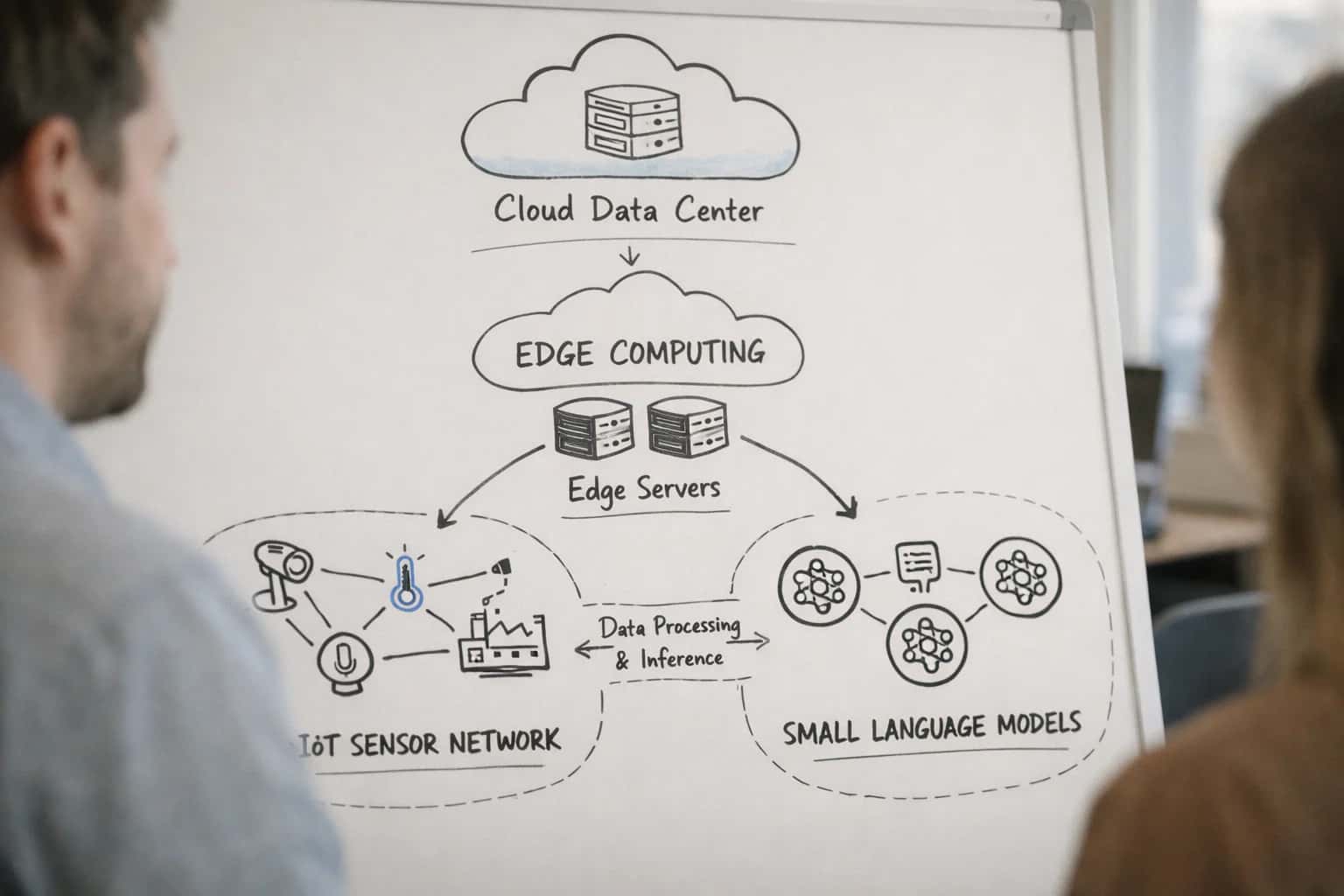
LOCALIZED MODEL EXECUTION
What is Edge Inference?
Edge inference is the execution of a trained machine learning model directly on a local device or gateway, processing data near its source to eliminate cloud latency and enable real-time decisions.
In a software-defined manufacturing context, edge inference gateways execute optimized models for tasks like vibration anomaly detection or visual defect classification directly adjacent to the production line. This local execution preserves bandwidth by transmitting only high-value inferences or exceptions upstream, ensures operational continuity during network interruptions, and strengthens data security by keeping proprietary process telemetry within the factory perimeter.
DEFINING ATTRIBUTES
Key Characteristics of Edge Inference
Edge inference is defined by a set of core technical attributes that distinguish it from cloud-based model serving. These characteristics directly enable the low-latency, high-reliability, and data-private closed-loop control required for modern manufacturing automation.
01
Ultra-Low Latency Execution
The defining characteristic of edge inference is the elimination of network round-trip time. By executing the model directly on a local gateway or embedded device, inference latency is reduced to single-digit milliseconds. This is critical for closed-loop control systems where a delayed decision on a high-speed production line can result in defective products or equipment damage. Unlike cloud inference, which is subject to WAN variability, edge inference provides deterministic response times suitable for real-time industrial control loops such as motion control and high-frequency defect detection.
< 10 ms
Typical Inference Latency
99.99%
Deterministic Uptime Target
02
Bandwidth Independence and Data Reduction
Edge inference processes raw sensor data locally, transmitting only abstracted results or exceptions to upstream systems. A machine vision camera performing inference at the edge can stream a simple pass/fail signal rather than a raw multi-gigabit video feed. This architecture drastically reduces bandwidth costs and decouples critical operations from WAN availability. In a closed-loop manufacturing context, this allows for continuous operation even during network interruptions, with the edge node buffering or aggregating telemetry for later synchronization with the Manufacturing Execution System (MES).
1000x
Potential Data Reduction Factor
03
Data Privacy and Sovereignty
By keeping raw data on-premise, edge inference provides a robust technical safeguard for intellectual property and proprietary process data. Sensitive information, such as proprietary golden batch profiles or in-situ metrology readings, never leaves the factory floor. This architecture is essential for defense contractors and highly regulated industries that require air-gapped operations or must comply with strict data sovereignty regulations. The model processes the data, extracts the insight, and only the non-sensitive metadata or control signal is ever transmitted externally.
04
Hardware-Optimized Model Footprints
Deploying inference at the edge requires models to be optimized for resource-constrained hardware. This involves techniques such as:
- Post-Training Quantization (PTQ): Reducing numerical precision (e.g., FP32 to INT8) to accelerate computation and reduce memory usage with minimal accuracy loss.
- Weight Pruning: Removing near-zero weights from a neural network to create a sparse, more efficient model.
- Hardware-Aware Neural Architecture Search (NAS): Designing model architectures specifically tailored to the target Neural Processing Unit (NPU) or microcontroller's instruction set. These optimizations enable complex computer vision and signal processing models to run on low-power embedded systems directly on a robotic arm or PLC.
05
Resilience and Offline Operation
A core requirement for industrial automation is resilience against infrastructure failure. Edge inference nodes are designed to operate autonomously without a persistent connection to a central server or cloud. This offline-first architecture ensures that critical safety interlocks, quality inspections, and process control loops continue to function during network outages. The system maintains a local model and rule set, guaranteeing uninterrupted production. This contrasts sharply with cloud-dependent systems, where a WAN failure directly halts the manufacturing process, creating a single point of failure.
06
Sensor-Proximate Processing
Edge inference physically co-locates computation with the data source, whether it's a vibration sensor, thermal camera, or microphone array. This proximity enables sensor fusion at the edge, where raw signals from multiple disparate sensors are combined and processed by a single inference model to create a holistic, real-time understanding of the machine state. For example, fusing acoustic emissions with vibration data on an edge gateway allows for the immediate detection of a bearing fault signature that neither sensor could classify alone, triggering an instant predictive maintenance alert.
EDGE INFERENCE EXPLAINED
Frequently Asked Questions
Clear, technically precise answers to the most common questions about executing machine learning models directly on factory-floor hardware for real-time closed-loop decisions.
Edge inference is the execution of a pre-trained machine learning model directly on a local computing device—such as an industrial PC, gateway, or smart camera—situated physically near the data source, rather than transmitting raw data to a centralized cloud server for processing. The workflow begins when a model is trained in a high-compute environment, then optimized and compressed using techniques like post-training quantization or weight pruning to fit within the memory and power constraints of the edge hardware. Once deployed, the model ingests real-time sensor streams—vibration data, thermal images, or acoustic signals—and generates predictions with single-digit millisecond latency. This architecture eliminates the round-trip delay to the cloud, enabling closed-loop control systems to react to anomalies before a defect is produced. The inference engine typically runs on a neural processing unit (NPU) or GPU embedded in the edge node, executing a forward pass through the neural network to output a classification, regression value, or anomaly score that directly triggers a programmable logic controller (PLC) action.
REAL-TIME FACTORY INTELLIGENCE
Edge Inference Use Cases in Manufacturing
Edge inference eliminates the latency, bandwidth, and connectivity dependencies of cloud-based AI by executing trained models directly on factory-floor hardware. This enables millisecond-level closed-loop decisions for mission-critical manufacturing processes.
01
Real-Time Visual Defect Detection
Deploying convolutional neural networks (CNNs) directly on smart cameras and vision sensors to inspect parts at line speed without streaming high-resolution images to the cloud.
- Latency: < 10 ms inference per frame
- Bandwidth savings: Eliminates gigabytes of video upload per shift
- Use case: A semiconductor fab detects sub-micron die cracks at 200 wafers per hour using on-camera inference
- Key enabler: Post-training INT8 quantization reduces model size by 4x while preserving 99.2% accuracy
< 10 ms
Inference Latency
99.2%
Accuracy Preserved
02
Predictive Maintenance at the Machine
Running vibration analysis models and thermal anomaly detectors on industrial gateways to forecast bearing failures hours before they occur, independent of cloud connectivity.
- Model types: 1D-CNNs for vibration spectrograms, autoencoders for anomaly scoring
- Hardware: Industrial PCs with Neural Processing Units (NPUs) or GPU-accelerated edge servers
- Example: A steel mill detects early-stage roller bearing spalling using on-premise inference, avoiding 72 hours of unplanned downtime
- Benefit: Alerts fire in < 50 ms, enabling automatic feed-rate reduction before catastrophic failure
< 50 ms
Alert Latency
72 hrs
Downtime Avoided
03
Closed-Loop Adaptive Welding
Executing reinforcement learning policies on edge controllers to dynamically adjust welding current, voltage, and travel speed based on real-time seam tracking and thermal camera feedback.
- Control loop: Sensor fusion → edge inference → PLC command in < 20 ms
- Inputs: Laser profilometry, infrared thermography, arc sound
- Outcome: Compensates for part fit-up variation and thermal distortion without pausing the line
- Architecture: Model Predictive Control (MPC) augmented with a neural network policy running on a soft PLC or industrial edge gateway
< 20 ms
Control Loop
40%
Defect Reduction
04
Acoustic Anomaly Detection for CNC Machining
Processing raw audio waveforms through spectrogram-based classifiers on edge microphones to detect tool chatter, insert wear, and coolant flow anomalies in real time.
- Model architecture: MobileNetV3 or EfficientNet backbones fine-tuned on factory audio
- Deployment: On-device inference on a Raspberry Pi 5 or industrial edge node with a USB microphone array
- Trigger: Detection of chatter frequencies (2-8 kHz band) automatically reduces spindle speed override via OPC UA
- Advantage: Operates in high-noise environments without requiring cloud audio streaming, preserving data sovereignty
2-8 kHz
Chatter Band
100%
On-Premise Data
05
Safety Zone Violation Detection
Running object detection models (YOLOv8, EfficientDet) on edge AI cameras to enforce dynamic safety zones around robotic workcells and autonomous mobile robots (AMRs).
- Inference hardware: Smart cameras with integrated Hailo-8 or Intel Movidius NPUs
- Response: If a human enters a restricted zone, the edge system triggers an emergency stop in < 100 ms without waiting for cloud round-trip
- Privacy: All video is processed locally; only anonymized event metadata is logged to the MES
- Compliance: Meets ISO 13849 PLd safety requirements when paired with certified safety relays
< 100 ms
E-Stop Trigger
0
Cloud Dependencies
06
Federated Model Updates Across Factory Fleets
Training a shared defect classification model across 15 global factories without centralizing proprietary production images. Each site trains locally on edge hardware and only shares encrypted gradient updates to a central aggregation server.
- Framework: TensorFlow Federated or PyTorch with Flower
- Privacy guarantee: Raw images never leave the factory floor; only mathematical weight deltas are transmitted
- Benefit: A rare defect type discovered in Factory A improves detection accuracy in Factories B through O within 24 hours
- Edge role: Local training runs on GPU-enabled edge servers during non-production hours, leveraging idle compute
15
Connected Factories
24 hrs
Global Model Sync
Enabling Efficiency, Speed & Accuracy
Intelligent Analysis, Decision & Execution
We build AI systems for teams that need search across company data, workflow automation across tools, or AI features inside products and internal software.
Talk to Us
Search across company data
Give teams answers from docs, tickets, runbooks, and product data with sources and permissions.
Useful when people spend too long searching or get different answers from different systems.
Enterprise searchRAGPermissions
Read more
Automate internal workflows
Use AI to route work, draft outputs, trigger actions, and keep approvals and logs in place.
Useful when repetitive work moves across multiple tools and teams.
AI agentsWorkflow automationGovernance
Read more
Add AI to products and internal tools
Build assistants, guided actions, or decision support into the software your team or customers already use.
Useful when AI needs to be part of the product, not a separate tool.
AI integrationDecision supportModel routing
Read moreDEPLOYMENT ARCHITECTURE COMPARISON
Edge Inference vs. Cloud Inference vs. Fog Computing
A technical comparison of three computational paradigms for executing machine learning models in industrial closed-loop manufacturing environments, evaluated across latency, bandwidth, autonomy, and data governance dimensions.
| Feature | Edge Inference | Cloud Inference | Fog Computing |
|---|---|---|---|
Data Processing Location | On-device or local gateway at the sensor/data source | Centralized remote data center | Intermediate nodes between edge and cloud (routers, local servers) |
Round-Trip Latency | < 5 ms | 50-500 ms | 10-50 ms |
Offline Operation Capability | |||
Bandwidth Dependency | None after model deployment | High; continuous data streaming required | Low; only aggregated or exception data forwarded |
Computational Capacity | Constrained by embedded hardware (MCU, NPU, GPU) | Virtually unlimited; elastic scaling | Moderate; more than edge, less than cloud |
Data Privacy Posture | Maximum; raw data never leaves the device | Lowest; raw data transmitted and stored externally | High; sensitive data filtered or anonymized locally |
Model Update Mechanism | Over-the-air updates; federated weight aggregation | Direct server-side redeployment | Staged rollout from cloud to intermediate nodes |
Typical Industrial Use Case | Real-time defect detection on a vision inspection camera | Batch analytics and long-horizon predictive maintenance | Factory-wide process optimization across multiple PLCs |

About the author
Prasad Kumkar
CEO & MD, Inference Systems
Prasad Kumkar is the CEO & MD of Inference Systems and writes about AI systems architecture, LLM infrastructure, model serving, evaluation, and production deployment. Over 5+ years, he has worked across computer vision models, L5 autonomous vehicle systems, and LLM research, with a focus on taking complex AI ideas into real-world engineering systems.
His work and writing cover AI systems, large language models, AI agents, multimodal systems, autonomous systems, inference optimization, RAG, evaluation, and production AI engineering.
LinkedIn
Limited slotsGet a Free AI Consultation
Partnered with leading AI, data, and software stack.





How We Work
Custom AI workflows for your Business
One-fit-all AI don't work for modern businesses. At Inferensys, we aim to understand your business & custom requirements; which we use to define most efficient agentic workflows, the data, and the tools for your business.
01
Review the use case
We understand the task, the users, and where AI can actually help.
Read more02
Pick the right approach
We define what needs search, automation, or product integration.
Read more03
Build the first useful version
We implement the part that proves the value first.
Read more04
Improve from there
We add the checks and visibility needed to keep it useful.
Read moreThe first call is a practical review of your use case and the right next step.
Talk to Us