A reinforcement learning agent is the decision-making core of a reinforcement learning system. It observes the current state of its environment, selects an action according to its policy, and receives a scalar reward signal indicating the desirability of the resulting state transition. The agent's objective is not to maximize immediate reward but to discover a policy that maximizes the expected cumulative discounted reward over a long time horizon, balancing exploration of unknown state-action pairs against exploitation of known high-reward behaviors.

Glossary
Reinforcement Learning Agent
An autonomous software entity that learns an optimal control policy through trial-and-error interaction with a dynamic environment to maximize a cumulative reward signal.
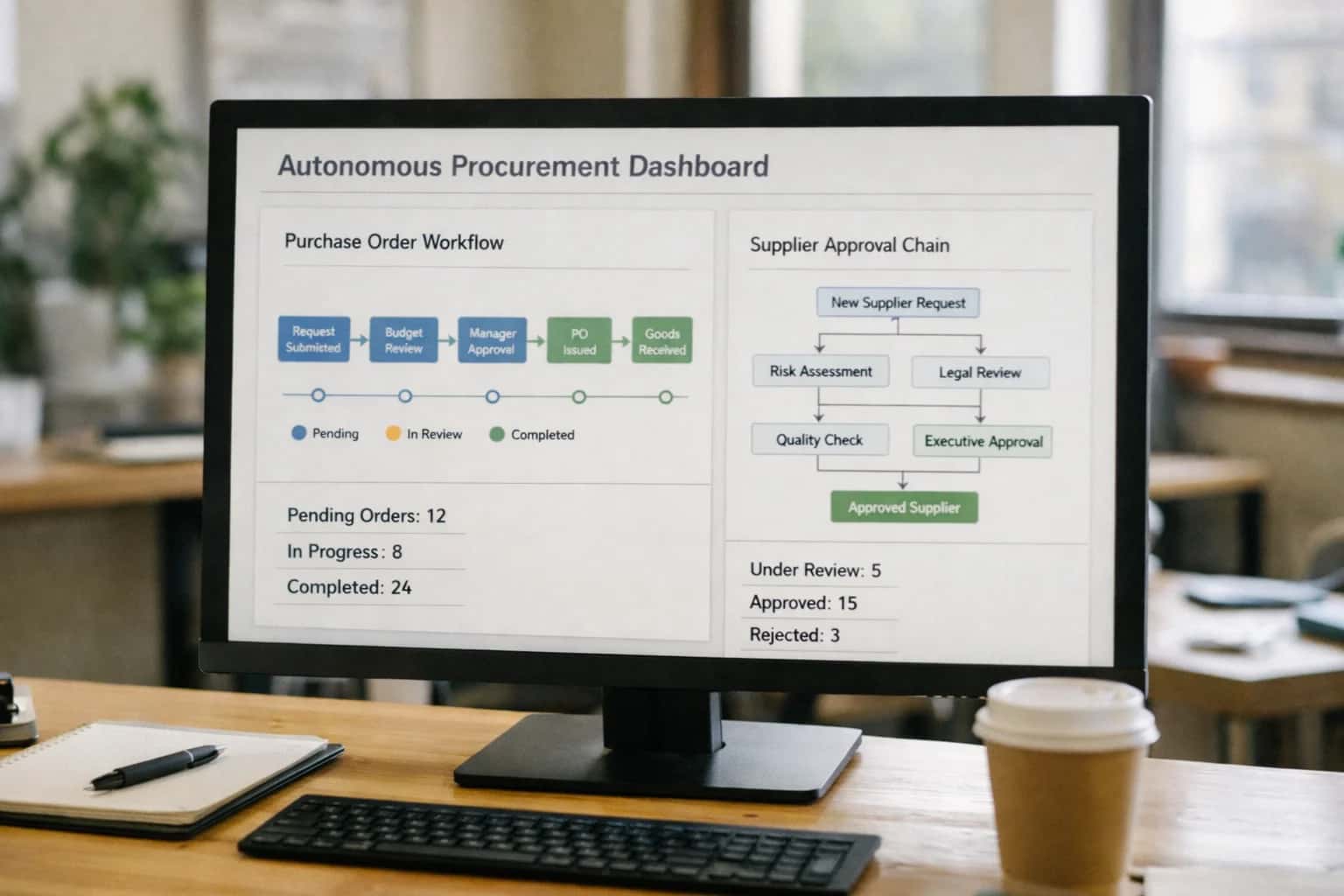
ADAPTIVE PROCESS CONTROL
What is a Reinforcement Learning Agent?
A reinforcement learning agent is an autonomous software entity that learns an optimal control policy through trial-and-error interaction with a dynamic environment to maximize a cumulative reward signal.
In manufacturing, the agent's environment is the digital twin or live process, its state is sensor telemetry, and its actions are control setpoints. Unlike a fixed PID controller, the agent continuously refines its policy using algorithms like Deep Deterministic Policy Gradient (DDPG) to handle continuous action spaces. This enables autonomous adaptation to non-linear dynamics, tool wear, and raw material variability without requiring an explicit first-principles model of the process.
ANATOMY OF AN INTELLIGENT CONTROLLER
Core Characteristics of RL Agents
A Reinforcement Learning agent is defined by its core components and behavioral properties. The following cards dissect the fundamental mechanisms that allow an agent to learn optimal control policies through autonomous interaction.
01
The Policy (π)
The policy is the agent's brain—a mapping from perceived environmental states to actions. It defines the agent's behavior at a given time.
- Deterministic Policy: Maps a state directly to a specific action
a = μ(s). Common in Deep Deterministic Policy Gradient (DDPG) algorithms for continuous control. - Stochastic Policy: Outputs a probability distribution over actions
π(a|s). Essential for exploration in Proximal Policy Optimization (PPO) and Soft Actor-Critic (SAC). - Parameterization: In deep RL, the policy is a neural network with weights θ, denoted as
π_θ. The goal of learning is to find the optimal weights θ* that maximize expected cumulative reward.
02
The Value Function
The value function predicts the expected long-term return, acting as a critic that evaluates how good a state or action is.
- State-Value Function V(s): The expected cumulative reward starting from state s and following policy π thereafter. Answers: "How good is it to be in this state?"
- Action-Value Function Q(s,a): The expected return starting from state s, taking action a, and then following policy π. Answers: "How good is it to take this action from this state?"
- Bellman Equation: The recursive mathematical backbone that expresses the relationship between the value of a current state and the values of successor states, enabling iterative learning via temporal-difference updates.
03
The Reward Hypothesis
All goals can be framed as the maximization of the expected value of the cumulative reward signal. The reward R_t is a scalar feedback signal sent by the environment at each time step.
- Dense vs. Sparse Rewards: Dense rewards provide frequent feedback (e.g., distance to target), while sparse rewards only signal task completion. Sparse rewards are often more natural but significantly harder to learn from.
- Reward Shaping: The engineering practice of designing intermediate reward functions to guide the agent toward desired behavior without introducing unintended loopholes or reward hacking.
- Discounted Return: Future rewards are geometrically decayed by a discount factor γ ∈ [0,1]. A γ close to 0 makes the agent myopic; a γ close to 1 makes it farsighted, valuing long-term outcomes.
04
Exploration vs. Exploitation
The fundamental dilemma of decision-making under uncertainty. The agent must exploit known high-reward actions while exploring unknown actions that might yield even higher returns.
- ε-Greedy: A simple strategy where the agent picks a random action with probability ε, and the greedy action otherwise. ε typically decays over time.
- Upper Confidence Bound (UCB): Selects actions based on their potential upside, balancing the estimated Q-value with an exploration bonus proportional to the uncertainty of that estimate.
- Entropy Regularization: Used in modern algorithms like SAC, this adds a bonus reward proportional to the entropy of the policy, explicitly encouraging the agent to maintain stochasticity and explore diverse strategies.
05
The Markov Decision Process (MDP)
The formal mathematical framework that defines the agent-environment interface. An MDP is a tuple (S, A, P, R, γ).
- Markov Property: The future is conditionally independent of the past given the present. A state
S_tis Markov if it captures all relevant information from history. - Transition Dynamics P(s'|s,a): The probability of transitioning to state s' after taking action a in state s. In model-free RL, the agent does not have access to this function.
- Partially Observable MDP (POMDP): An extension where the agent receives an observation
O_tthat is a noisy or incomplete proxy for the true underlying state, requiring memory mechanisms like LSTMs or transformers.
06
Model-Free vs. Model-Based
A critical architectural distinction based on whether the agent learns or uses a model of the environment's dynamics.
- Model-Free: Learns a policy or value function directly from raw experience tuples (s, a, r, s') without predicting future states. Examples: Q-Learning, DDPG. High asymptotic performance but often sample-inefficient.
- Model-Based: Learns an explicit transition model
P(s'|s,a)and reward functionR(s,a). The agent can then "imagine" future trajectories via planning or model-predictive control (MPC). Dramatically improves sample efficiency but suffers from model bias. - Dyna Architecture: A hybrid approach that uses real experience to learn a model and then generates simulated experience from that model to accelerate model-free policy learning.
REINFORCEMENT LEARNING AGENT FAQ
Frequently Asked Questions
Clear, technically precise answers to the most common questions about reinforcement learning agents in adaptive process control, designed for engineers and technical decision-makers evaluating autonomous manufacturing optimization.
A reinforcement learning agent is an autonomous software entity that learns an optimal control policy through trial-and-error interaction with a dynamic environment to maximize a cumulative reward signal. In manufacturing, the agent observes process variables—such as temperature, pressure, and vibration—as its state, selects control actions like adjusting valve positions or spindle speeds, and receives a reward based on outcomes like throughput, quality yield, or energy consumption. Unlike Model Predictive Control (MPC) which requires an explicit mathematical model, the agent learns directly from experience by balancing exploration of new control strategies against exploitation of known successful ones. Over thousands of episodes, the agent converges on a policy that maps sensor readings to actuator commands, often discovering non-intuitive operating regimes that outperform manually tuned PID controllers. This approach is particularly valuable for processes with non-linear dynamics, high-dimensional state spaces, or stochastic disturbances where first-principles modeling is impractical.
Enabling Efficiency, Speed & Accuracy
Intelligent Analysis, Decision & Execution
We build AI systems for teams that need search across company data, workflow automation across tools, or AI features inside products and internal software.
Talk to Us
Search across company data
Give teams answers from docs, tickets, runbooks, and product data with sources and permissions.
Useful when people spend too long searching or get different answers from different systems.
Enterprise searchRAGPermissions
Read more
Automate internal workflows
Use AI to route work, draft outputs, trigger actions, and keep approvals and logs in place.
Useful when repetitive work moves across multiple tools and teams.
AI agentsWorkflow automationGovernance
Read more
Add AI to products and internal tools
Build assistants, guided actions, or decision support into the software your team or customers already use.
Useful when AI needs to be part of the product, not a separate tool.
AI integrationDecision supportModel routing
Read more
About the author
Prasad Kumkar
CEO & MD, Inference Systems
Prasad Kumkar is the CEO & MD of Inference Systems and writes about AI systems architecture, LLM infrastructure, model serving, evaluation, and production deployment. Over 5+ years, he has worked across computer vision models, L5 autonomous vehicle systems, and LLM research, with a focus on taking complex AI ideas into real-world engineering systems.
His work and writing cover AI systems, large language models, AI agents, multimodal systems, autonomous systems, inference optimization, RAG, evaluation, and production AI engineering.
LinkedIn
Limited slotsGet a Free AI Consultation
Partnered with leading AI, data, and software stack.





How We Work
Custom AI workflows for your Business
One-fit-all AI don't work for modern businesses. At Inferensys, we aim to understand your business & custom requirements; which we use to define most efficient agentic workflows, the data, and the tools for your business.
01
Review the use case
We understand the task, the users, and where AI can actually help.
Read more02
Pick the right approach
We define what needs search, automation, or product integration.
Read more03
Build the first useful version
We implement the part that proves the value first.
Read more04
Improve from there
We add the checks and visibility needed to keep it useful.
Read moreThe first call is a practical review of your use case and the right next step.
Talk to Us