Online stability monitoring is the continuous, real-time assessment of a power system's transient stability margin using streaming synchrophasor data from Phasor Measurement Units (PMUs). Unlike traditional offline simulation, which evaluates pre-defined contingency lists, online monitoring applies machine learning classifiers directly to high-resolution, time-synchronized measurements to instantly detect the onset of rotor angle instability following a disturbance.

Glossary
Online Stability Monitoring
The use of streaming synchrophasor data and machine learning classifiers to provide real-time situational awareness of proximity to transient instability without offline simulation.
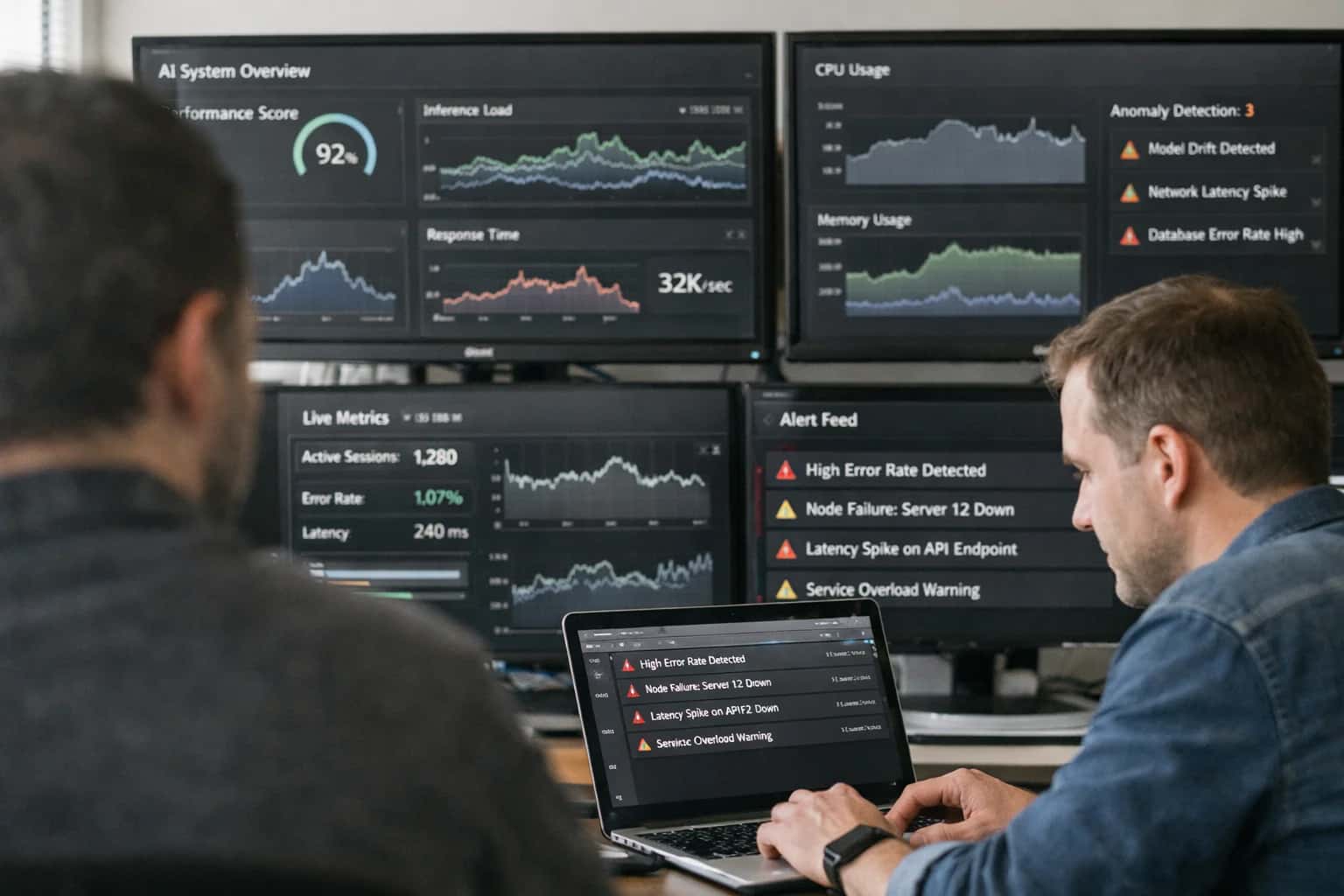
REAL-TIME TRANSIENT ASSESSMENT
What is Online Stability Monitoring?
Online stability monitoring provides real-time situational awareness of a power grid's proximity to transient instability using streaming sensor data and machine learning classifiers, eliminating the need for offline simulation.
These systems ingest dynamic state estimation outputs and frequency metrics like Rate of Change of Frequency (RoCoF) to compute a real-time Transient Energy Margin or stability index. By leveraging architectures such as Graph Neural Networks (GNNs) and Temporal Fusion Transformers, online stability monitoring provides operators with actionable, sub-second alerts on proximity to the Region of Attraction boundary, enabling preemptive Remedial Action Schemes (RAS) activation.
REAL-TIME STABILITY INTELLIGENCE
Key Characteristics
Online stability monitoring shifts grid operations from reactive protection to proactive situational awareness, using streaming synchrophasor data to continuously assess proximity to transient instability.
01
Streaming Synchrophasor Ingestion
The system ingests Phasor Measurement Unit (PMU) data streams at rates of 30-60 samples per second, providing sub-cycle visibility into voltage and current phasors across wide-area networks. This high-resolution time-synchronized data, timestamped via GPS clocks, replaces traditional SCADA polling (every 2-4 seconds) with continuous observability of electromechanical dynamics.
02
ML-Based Instability Classification
Trained supervised classifiers—including decision trees, support vector machines, and deep neural networks—map real-time PMU feature vectors onto discrete stability categories. These models are trained offline on massive libraries of simulated N-1 and N-k contingencies, then deployed to infer proximity to transient instability from live measurements without solving differential-algebraic equations online.
03
Post-Fault Trajectory Prediction
Advanced architectures like Temporal Fusion Transformers and Physics-Informed Neural Networks (PINNs) forecast rotor angle trajectories milliseconds to seconds ahead. By predicting whether post-fault swings will damp or diverge, operators gain critical seconds to arm Remedial Action Schemes (RAS) before the Critical Clearing Time expires.
04
Voltage and Frequency Stability Indicators
Beyond rotor angle stability, online monitors compute real-time indices for voltage collapse proximity and Rate of Change of Frequency (RoCoF). These composite metrics fuse bus voltage magnitudes, reactive power margins, and frequency derivatives into intuitive dashboards that flag emerging instability across multiple physical domains simultaneously.
05
Uncertainty-Aware Decision Support
Modern online monitors incorporate uncertainty quantification layers that distinguish between aleatoric noise (sensor jitter) and epistemic uncertainty (novel operating conditions outside training distribution). Confidence intervals on stability predictions enable risk-informed operator decisions rather than binary alarm thresholds.
06
Wide-Area Situational Awareness
By correlating PMU streams across multiple substations, online monitoring systems detect inter-area oscillation modes and generator coherency patterns in real time. This wide-area perspective reveals instability propagation paths that local relays cannot observe, enabling coordinated wide-area damping control and controlled islanding strategies.
Enabling Efficiency, Speed & Accuracy
Intelligent Analysis, Decision & Execution
We build AI systems for teams that need search across company data, workflow automation across tools, or AI features inside products and internal software.
Talk to Us
Search across company data
Give teams answers from docs, tickets, runbooks, and product data with sources and permissions.
Useful when people spend too long searching or get different answers from different systems.
Enterprise searchRAGPermissions
Read more
Automate internal workflows
Use AI to route work, draft outputs, trigger actions, and keep approvals and logs in place.
Useful when repetitive work moves across multiple tools and teams.
AI agentsWorkflow automationGovernance
Read more
Add AI to products and internal tools
Build assistants, guided actions, or decision support into the software your team or customers already use.
Useful when AI needs to be part of the product, not a separate tool.
AI integrationDecision supportModel routing
Read moreREAL-TIME GRID STABILITY
Frequently Asked Questions
Essential questions about how streaming synchrophasor data and machine learning classifiers provide instantaneous situational awareness of power system stability without relying on offline simulation.
Online stability monitoring is a real-time situational awareness framework that continuously ingests streaming synchrophasor data from Phasor Measurement Units (PMUs) and applies machine learning classifiers to assess the power system's proximity to transient instability. Unlike traditional offline simulation that analyzes pre-defined contingency lists hours or days in advance, online monitoring operates on a sub-second refresh cycle. The system extracts features from voltage and current phasors—such as Rate of Change of Frequency (RoCoF), voltage dip duration, and inter-area oscillation mode damping ratios—and feeds them into pre-trained classifiers like Random Forests, Gradient Boosted Trees, or Graph Neural Networks (GNNs). These models output a stability index or binary classification (stable/unstable) for the current operating state, enabling operators to take preventive action before a cascading blackout develops. The architecture typically includes a Phasor Data Concentrator (PDC) for time-alignment, a feature extraction engine, and a model inference layer that publishes results to the control room HMI or directly to Remedial Action Schemes (RAS).

About the author
Prasad Kumkar
CEO & MD, Inference Systems
Prasad Kumkar is the CEO & MD of Inference Systems and writes about AI systems architecture, LLM infrastructure, model serving, evaluation, and production deployment. Over 5+ years, he has worked across computer vision models, L5 autonomous vehicle systems, and LLM research, with a focus on taking complex AI ideas into real-world engineering systems.
His work and writing cover AI systems, large language models, AI agents, multimodal systems, autonomous systems, inference optimization, RAG, evaluation, and production AI engineering.
LinkedIn
Limited slotsGet a Free AI Consultation
Partnered with leading AI, data, and software stack.





How We Work
Custom AI workflows for your Business
One-fit-all AI don't work for modern businesses. At Inferensys, we aim to understand your business & custom requirements; which we use to define most efficient agentic workflows, the data, and the tools for your business.
01
Review the use case
We understand the task, the users, and where AI can actually help.
Read more02
Pick the right approach
We define what needs search, automation, or product integration.
Read more03
Build the first useful version
We implement the part that proves the value first.
Read more04
Improve from there
We add the checks and visibility needed to keep it useful.
Read moreThe first call is a practical review of your use case and the right next step.
Talk to Us