A unidirectional gateway, also known as a data diode, is a hardware-enforced security device that physically permits data to travel only in one direction. Unlike software firewalls that can be misconfigured or bypassed, this device uses an optical fiber link with a severed return path—typically a laser transmitter on the sending side and a photodiode receiver on the receiving side—to create an absolute physical air gap. This architecture ensures that no malicious traffic, command, or acknowledgment packet can ever travel back into the protected Operational Technology (OT) network.

Glossary
Unidirectional Gateway
A unidirectional gateway, or data diode, is a hardware-enforced security device that physically permits data to travel only in one direction, typically from a secure OT network to an external system, making remote command injection impossible.
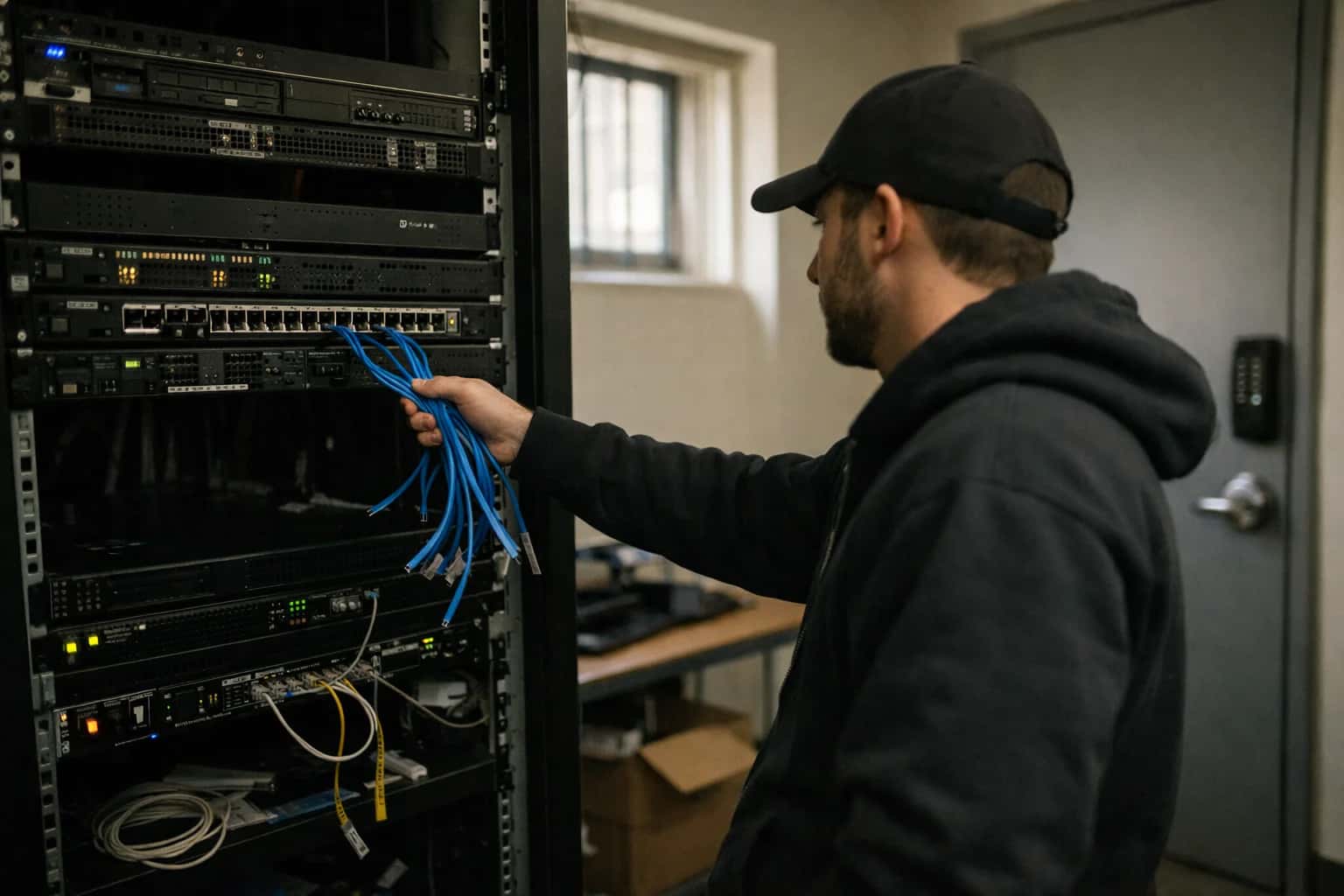
HARDWARE-ENFORCED DATA DIODE
What is a Unidirectional Gateway?
A unidirectional gateway is a physical network security appliance that enforces a one-way-only flow of data, typically from a secure OT network to an external system, making remote command injection mathematically impossible.
In SCADA anomaly detection architectures, the unidirectional gateway is the definitive boundary between the protected Industrial Control System (ICS) and the external corporate IT or cloud-based monitoring system. Security teams deploy a proxy server on the OT side to replicate real-time DNP3 or Modbus TCP data streams across the diode, allowing external behavioral baseline analysis and passive monitoring without introducing any attack surface. This guarantees that even if the external network is fully compromised, an adversary cannot inject a malicious function code or alter a zero-day threat payload into the critical control loop.
HARDWARE-ENFORCED SECURITY
Key Features of Unidirectional Gateways
Unidirectional gateways, or data diodes, provide absolute network segmentation through physical hardware constraints. Unlike software firewalls that can be misconfigured or bypassed, these devices enforce a one-way data flow that makes remote command injection and data exfiltration physically impossible.
01
Physical Layer Enforcement
A unidirectional gateway enforces security at the physical layer by using an optical fiber link with the transmit laser on one side and the receive photodiode on the other. There is no return path for light, making it physically impossible for data to travel back. This is fundamentally different from software firewalls, which rely on configurable rules that can be misconfigured, disabled, or bypassed through vulnerabilities.
- Uses separate transmit and receive optical components
- No shared electronics between the sending and receiving sides
- Eliminates entire classes of remote attacks at the hardware level
Physical
Enforcement Layer
02
OT-to-IT Data Replication
The primary use case is securely replicating real-time operational data from a protected OT network to an external IT or business network. The gateway acts as a proxy server on the OT side, collecting data from industrial devices via protocols like OPC UA, Modbus, or DNP3, then forwarding it unidirectionally. On the IT side, a receiving server reconstructs the data stream for historians, dashboards, and analytics platforms.
- Breaks the direct network connection between OT and IT
- Supports common industrial protocols for data collection
- Enables cloud analytics without exposing control systems
03
Remote Command Immunity
Because there is no physical return path, an attacker who compromises the external IT network cannot send any command back to the OT network through the gateway. This renders remote manipulation of Programmable Logic Controllers (PLCs) and other field devices impossible via this path. Even if the receiving server is fully compromised, the attacker cannot inject malicious Modbus writes or DNP3 control commands.
- Prevents remote manipulation of physical processes
- Neutralizes pivoting from IT to OT environments
- Eliminates the attack vector exploited in TRITON and INDUSTROYER campaigns
04
Data Diode Architecture
The core hardware component is often referred to as a data diode—an electronic analog to a check valve in fluid systems. The simplest implementation uses a fiber optic cable with the transmit (TX) pin connected on the source side and the receive (RX) pin connected on the destination side, with no reciprocal connection. More sophisticated implementations use dedicated hardware boards with separate unidirectional data paths.
- Based on the principle of an electronic check valve
- Can be implemented with standard fiber optic components
- Validated under Common Criteria EAL levels for high-assurance environments
05
Protocol Break and Proxy
A unidirectional gateway does not simply forward packets; it terminates the bidirectional protocol on the OT side and rebuilds a new unidirectional stream. For example, a TCP three-way handshake requires bidirectional communication, so the gateway acts as a TCP proxy on the OT side, extracts the payload, and sends only the data. The IT-side server then republishes this data using a fresh bidirectional session.
- Terminates TCP sessions to enforce unidirectionality
- Strips protocol overhead before forwarding payload
- Prevents protocol-level attacks from traversing the boundary
06
Regulatory Compliance Alignment
Unidirectional gateways directly satisfy the network segmentation requirements mandated by multiple industrial cybersecurity standards. They provide a defensible, auditable boundary that simplifies compliance with frameworks requiring strict separation between safety-critical and administrative networks.
- IEC 62443: Satisfies zone and conduit segmentation requirements
- NERC CIP: Meets Critical Infrastructure Protection standards for electronic security perimeters
- NIST SP 800-82: Aligns with guidance for ICS network segmentation
- Simplifies audit evidence by providing a physically verifiable boundary
UNIDIRECTIONAL GATEWAY ESSENTIALS
Frequently Asked Questions
Clear, technically precise answers to the most common questions about hardware-enforced data diodes and their role in OT network segmentation.
A unidirectional gateway, commonly called a data diode, is a hardware-enforced network security device that physically permits data to travel exclusively in one direction—typically from a secure OT network to an external business system. Unlike software firewalls that can be misconfigured or bypassed, the gateway achieves this through a fundamental physical layer break: a transmit-only fiber optic cable on the sending side connected to a receive-only optical receiver on the receiving side, with no return path for light. Internally, the device often uses a field-programmable gate array (FPGA) or dedicated ASIC to strip away any protocol handshakes, acknowledgments, or bidirectional transport mechanisms (such as TCP's SYN-ACK) before forwarding payload data. The sending proxy terminates the OT protocol, extracts the raw data, and passes it across the optical gap, while a receiving proxy on the other side repackages the data into the destination protocol. This physical air-gap enforcement makes remote command injection, data exfiltration via reverse channels, and lateral movement from the business network into the control system mathematically impossible, as there is no physical medium for a return signal to traverse.
HARDWARE-ENFORCED VS. SOFTWARE-DEFINED SEGMENTATION
Unidirectional Gateway vs. Other Security Controls
A comparison of the unidirectional gateway (data diode) against firewalls, industrial demilitarized zones (IDMZ), and protocol whitelisting across critical OT security dimensions.
| Feature | Unidirectional Gateway | Next-Gen Firewall | Protocol Whitelisting |
|---|---|---|---|
Physical enforcement mechanism | Hardware (optical/TX-only) | ||
Prevents remote command injection | |||
Permits bidirectional handshakes | |||
Latency introduced | < 1 µs | 50-500 µs | 100-1000 µs |
Susceptible to zero-day exploits | |||
Requires proxy server for data egress | |||
Typical deployment layer | OT/IT boundary | IT perimeter | ICS protocol layer |
Validates process state |
Enabling Efficiency, Speed & Accuracy
Intelligent Analysis, Decision & Execution
We build AI systems for teams that need search across company data, workflow automation across tools, or AI features inside products and internal software.
Talk to Us
Search across company data
Give teams answers from docs, tickets, runbooks, and product data with sources and permissions.
Useful when people spend too long searching or get different answers from different systems.
Enterprise searchRAGPermissions
Read more
Automate internal workflows
Use AI to route work, draft outputs, trigger actions, and keep approvals and logs in place.
Useful when repetitive work moves across multiple tools and teams.
AI agentsWorkflow automationGovernance
Read more
Add AI to products and internal tools
Build assistants, guided actions, or decision support into the software your team or customers already use.
Useful when AI needs to be part of the product, not a separate tool.
AI integrationDecision supportModel routing
Read more
About the author
Prasad Kumkar
CEO & MD, Inference Systems
Prasad Kumkar is the CEO & MD of Inference Systems and writes about AI systems architecture, LLM infrastructure, model serving, evaluation, and production deployment. Over 5+ years, he has worked across computer vision models, L5 autonomous vehicle systems, and LLM research, with a focus on taking complex AI ideas into real-world engineering systems.
His work and writing cover AI systems, large language models, AI agents, multimodal systems, autonomous systems, inference optimization, RAG, evaluation, and production AI engineering.
LinkedIn
Limited slotsGet a Free AI Consultation
Partnered with leading AI, data, and software stack.





How We Work
Custom AI workflows for your Business
One-fit-all AI don't work for modern businesses. At Inferensys, we aim to understand your business & custom requirements; which we use to define most efficient agentic workflows, the data, and the tools for your business.
01
Review the use case
We understand the task, the users, and where AI can actually help.
Read more02
Pick the right approach
We define what needs search, automation, or product integration.
Read more03
Build the first useful version
We implement the part that proves the value first.
Read more04
Improve from there
We add the checks and visibility needed to keep it useful.
Read moreThe first call is a practical review of your use case and the right next step.
Talk to Us