Supervisory Control and Data Acquisition (SCADA) is a centralized control system architecture that provides high-level supervisory management by collecting real-time telemetry data from remote field devices, processing it, and issuing automated or operator-driven control commands. It forms the core nervous system for geographically dispersed industrial processes in utilities, pipelines, and transportation networks.

Glossary
SCADA
Supervisory Control and Data Acquisition (SCADA) is a centralized system architecture that monitors, gathers, and processes real-time data to control industrial equipment and processes across geographically distributed assets.
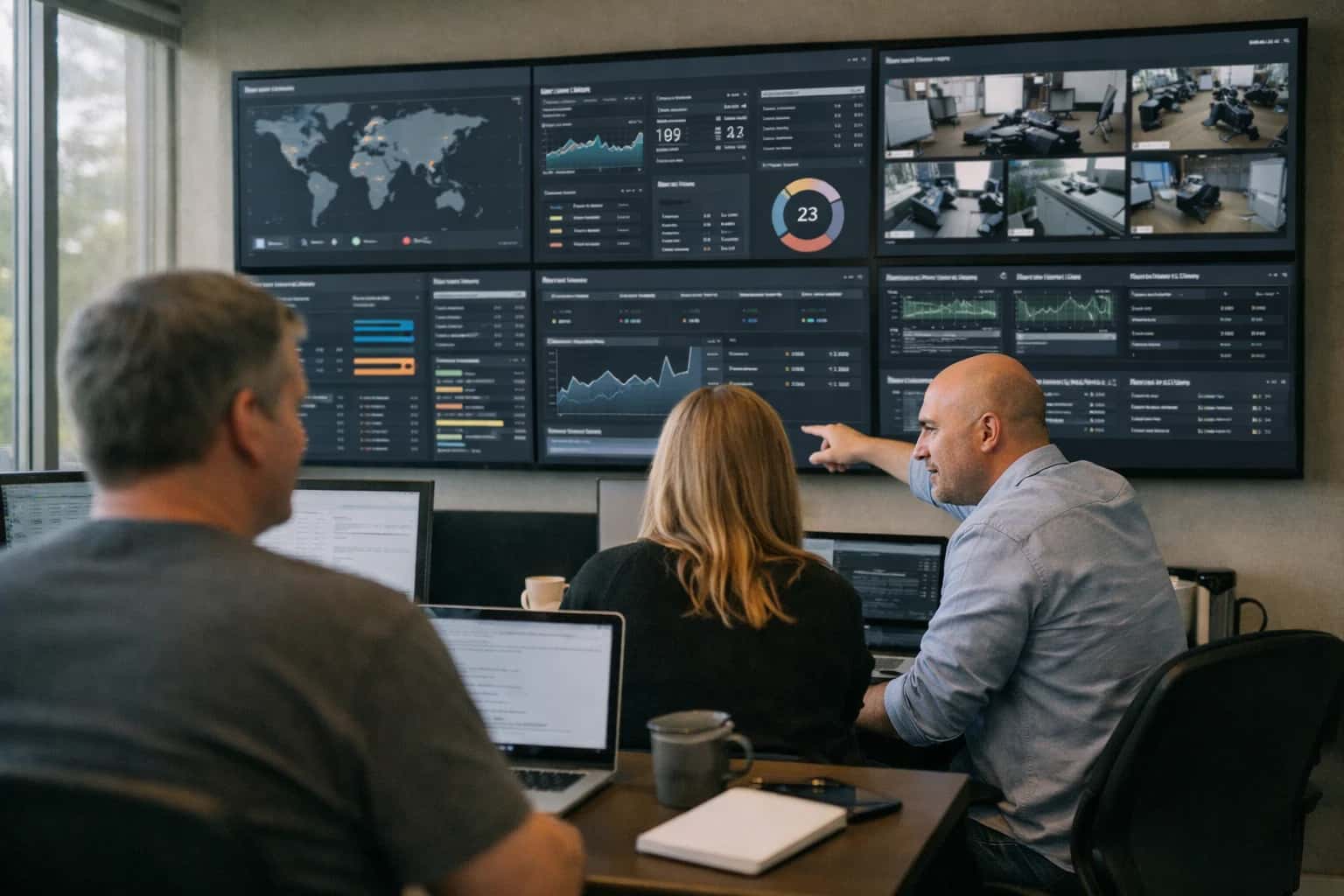
INDUSTRIAL CONTROL ARCHITECTURE
What is SCADA?
Supervisory Control and Data Acquisition (SCADA) is a centralized system architecture that monitors, gathers, and processes real-time data to control industrial equipment and processes across geographically distributed assets.
A SCADA system integrates Remote Terminal Units (RTUs) and Programmable Logic Controllers (PLCs) with a central Human-Machine Interface (HMI) to enable operators to visualize process status, acknowledge alarms, and adjust setpoints. Unlike localized Distributed Control Systems (DCS) that prioritize closed-loop process regulation, SCADA emphasizes wide-area data acquisition and supervisory command dispatch over long-distance communication links.
ARCHITECTURE
Core Characteristics of SCADA Systems
Supervisory Control and Data Acquisition (SCADA) is defined by a distinct set of architectural attributes that differentiate it from standard IT networks. These characteristics prioritize deterministic control, extreme reliability, and geographic distribution over raw data throughput.
01
Centralized Master Station
The Master Terminal Unit (MTU) or SCADA server acts as the centralized brain, polling remote devices and presenting a unified Human-Machine Interface (HMI) to operators. Unlike peer-to-peer networks, all supervisory commands and data aggregation logically flow through this central hub, creating a strict hierarchical topology that simplifies auditing and access control.
02
Remote Terminal Units (RTUs)
Remote Terminal Units are ruggedized field computers deployed at substations, wellheads, or pipeline valve stations. They interface directly with physical sensors and actuators, converting analog signals (4-20mA current loops) to digital protocol objects. RTUs are designed for extreme temperature ranges and often include battery backup and store-and-forward capabilities to survive communication outages.
03
Programmable Logic Controllers (PLCs)
Programmable Logic Controllers execute high-speed, localized control loops using ladder logic or structured text. While an RTU focuses on telemetry, a PLC handles deterministic, sub-millisecond decisions like emergency shutdowns or valve sequencing. In modern architectures, PLCs often connect directly to the SCADA master via Modbus TCP or EtherNet/IP.
04
Poll-Response Communication
SCADA systems traditionally rely on a master-slave polling mechanism rather than report-by-exception. The MTU sequentially interrogates each RTU for updated values. This deterministic polling guarantees predictable bandwidth utilization and ensures that a communication failure is detected immediately when a slave fails to respond within the configured timeout window.
05
Real-Time Historian Database
A time-series historian is a specialized database optimized for high-speed insertion and retrieval of timestamped process data. Unlike relational databases, historians compress millions of data points per second using swinging-door compression algorithms, allowing operators to trend years of operational data for forensic analysis and regulatory compliance reporting.
06
Geographic Redundancy & Failover
Mission-critical SCADA architectures employ hot-standby redundancy with geographically separated servers. A heartbeat signal between the primary and secondary MTU ensures a bumpless transfer of control within seconds of a primary failure. This redundancy extends to communication paths, often using dual-ring fiber topologies or satellite backup links.
Enabling Efficiency, Speed & Accuracy
Intelligent Analysis, Decision & Execution
We build AI systems for teams that need search across company data, workflow automation across tools, or AI features inside products and internal software.
Talk to Us
Search across company data
Give teams answers from docs, tickets, runbooks, and product data with sources and permissions.
Useful when people spend too long searching or get different answers from different systems.
Enterprise searchRAGPermissions
Read more
Automate internal workflows
Use AI to route work, draft outputs, trigger actions, and keep approvals and logs in place.
Useful when repetitive work moves across multiple tools and teams.
AI agentsWorkflow automationGovernance
Read more
Add AI to products and internal tools
Build assistants, guided actions, or decision support into the software your team or customers already use.
Useful when AI needs to be part of the product, not a separate tool.
AI integrationDecision supportModel routing
Read moreSCADA FUNDAMENTALS
Frequently Asked Questions
Clear, technically precise answers to the most common questions about Supervisory Control and Data Acquisition systems, their architecture, and their role in modern industrial operations.
Supervisory Control and Data Acquisition (SCADA) is a centralized system architecture that monitors, gathers, and processes real-time data to control industrial equipment and processes across geographically distributed assets. A SCADA system works through a continuous control loop: Remote Terminal Units (RTUs) and Programmable Logic Controllers (PLCs) at field sites interface directly with sensors and actuators, converting analog physical measurements into digital data. This data is transmitted via communication protocols such as DNP3, Modbus TCP, or IEC 61850 to a central Master Terminal Unit (MTU) or control server. The MTU processes the incoming telemetry, presents it to human operators through a Human-Machine Interface (HMI), and sends supervisory commands back to the field devices to adjust setpoints, open valves, or trip breakers. The entire loop operates with deterministic timing requirements, often demanding scan rates measured in milliseconds for critical substation automation tasks.

About the author
Prasad Kumkar
CEO & MD, Inference Systems
Prasad Kumkar is the CEO & MD of Inference Systems and writes about AI systems architecture, LLM infrastructure, model serving, evaluation, and production deployment. Over 5+ years, he has worked across computer vision models, L5 autonomous vehicle systems, and LLM research, with a focus on taking complex AI ideas into real-world engineering systems.
His work and writing cover AI systems, large language models, AI agents, multimodal systems, autonomous systems, inference optimization, RAG, evaluation, and production AI engineering.
LinkedIn
Limited slotsGet a Free AI Consultation
Partnered with leading AI, data, and software stack.





How We Work
Custom AI workflows for your Business
One-fit-all AI don't work for modern businesses. At Inferensys, we aim to understand your business & custom requirements; which we use to define most efficient agentic workflows, the data, and the tools for your business.
01
Review the use case
We understand the task, the users, and where AI can actually help.
Read more02
Pick the right approach
We define what needs search, automation, or product integration.
Read more03
Build the first useful version
We implement the part that proves the value first.
Read more04
Improve from there
We add the checks and visibility needed to keep it useful.
Read moreThe first call is a practical review of your use case and the right next step.
Talk to Us